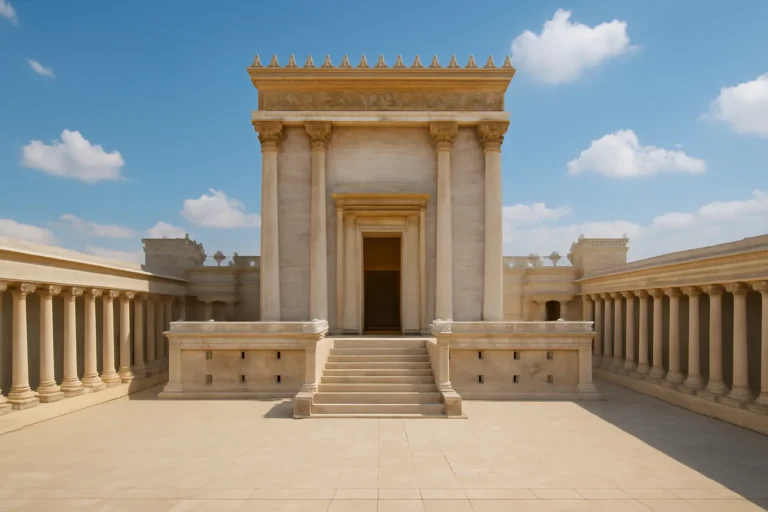
Understanding the Third Temple in Jerusalem: History, Belief, and Modern Relevance
The phrase Third Temple refers to a future sanctuary in Jerusalem that is envisioned by various Jewish traditions as a fulfillment of biblical prophecy and a central hub for religious life. This idea sits at the intersection of ancient history, theology, and contemporary politics, and it continues to shape discussions among scholars, religious communities, and policymakers. In this article, we explore the historical layers that give rise to the concept, the religious significance attributed to this temple in different streams of Judaism, and how the notion resonates—or creates tension—in today’s world. We will also examine how the idea has inspired modern organizations, rituals, and debates about sovereignty, space, and peace in the region.
Terminology, scope, and variations of the concept
The term Third Temple is a shorthand used in Jewish thought for a future sanctified structure that would replace or supersede the two ancient temples once standing on the Temple Mount. However, there are several ways people discuss this idea:
Beit HaMikdash HaShlishi (the “Third Beit HaMikdash”): a direct liturgical reference to a future sanctuary described in Jewish sources.
Temple in Jerusalem after the exile: a broad category that includes the idea of rebuilding or restoring temple service in the city that holds sacred significance for Judaism.
Temple movement or Temple restoration movement: modern groups that advocate, symbolically or physically, for a future Temple or for restoring certain priestly rites.
Across these variations, the common thread is a longing for a centralized center of worship, where pilgrimages, sacrifices (in historical contexts), and liturgy would be conducted according to biblical and rabbinic outlines. At the same time, the practical implications are deeply entangled with the political and religious realities of Jerusalem, the Temple Mount, and the broader Israeli–Palestinian conflict.
A concise historical background: from ancient sanctuaries to present memory
The First Temple period and the exile
The story begins in the biblical era with the tradition that Solomon’s Temple—the First Temple—stood as the primary house of worship for the people of ancient Israel. Constructed in the 10th century BCE, this temple served as the focal point for religious life, sacrificial offerings, and national rituals. In 586 BCE, following a confrontation with the Babylonian empire, the First Temple was destroyed and much of Judah’s population was exiled. This catastrophe did not erase the memory of a singular sanctuary; rather, it seeded a powerful longing for a future dwelling place where heaven and earth would meet through ritual service.
The Second Temple era and Herodian expansion
After the return from exile, a new sanctuary was built—the Second Temple, completed around 516 BCE. The structure underwent a dramatic expansion and refurbishment under King Herod around the turn of the common era. The Second Temple stood for several centuries as a center of religious leadership, teaching, and pilgrimages, culminating in its destruction by the Romans in 70 CE during the First Jewish–Roman War. The absence of a standing temple since that date has left a persistent expectation among many Jews that a future sanctuary will be established in the same holy space.
The devastation of the Second Temple era marked the beginning of a long diaspora, but it did not erase the longing for a sacred center. Throughout centuries of exile, liturgical prayers, messianic hopes, and rabbinic writings kept alive the vision of a time when a renewed Beit HaMikdash—often described in terms of greater spiritual light or universal peace—would once again serve as the heart of Jewish worship.
Religious and theological dimensions of the Third Temple concept
Judaism: eschatology, liturgy, and priestly service
For many in Judaism, the Third Temple is not merely a rebuilding project; it is tied to eschatological expectations about the messianic era, national renewal, and a restored priesthood. In rabbinic literature and later medieval to modern Jewish thought, the idea is often linked to:
The restoration of sacrificial rites led by the descendants of Aaron, the Kohanim.
Purification rituals, purity laws, and ceremonial practices that once operated within a central sanctuary.
The prophetic hope of universal recognition of God and a time of peace among peoples, sometimes phrased as a vision where sacrifices and holy days become a shared spiritual experience.
It is important to note that Jewish thinkers hold a spectrum of views about the timing, feasibility, and nature of a prospective Temple. Some emphasize the ethical and spiritual dimensions of worship over ritual specifics, while others discuss the temple structure and instruments in more concrete terms. Across traditions, however, the concept remains a potent symbol of national identity, continuity, and spiritual longing.
Islamic, Christian, and interfaith perspectives
The site traditionally associated with the Third Temple is also the location of the Dome of the Rock and Al-Aqsa Mosque, sacred to Muslims as well as to Jews and Christians with deep historical ties. The competing sacred claims around the Temple Mount add a complex layer to discussions about a hypothetical future sanctuary in Jerusalem. In Christian thought, the temple’s symbolism often intersects with eschatological narratives and the study of biblical prophecies, while in Islamic tradition the sanctity of the site is anchored in long-standing religious and historical reverence. These overlapping reverences shape how communities approach the topic of a possible temple’s rebuilding, and they influence public discourse, policy, and diplomacy in the region.
Modern rediscovery and the emergence of organized temple ideas
The Zionist era and shifting conversations
In the late 19th and early 20th centuries, Jewish thinkers and leaders began re-engaging with ancient temple imagery within a modern national project. As Zionism developed, the idea of a rebuilt sanctuary—whether understood as a spiritual aspiration or a future political-religious project—reentered public and scholarly discussions. The conversation intensified after the 1948 creation of the State of Israel and especially after the 1967 Six-Day War, when Israeli control of the Old City and Jerusalem’s religious sites reshaped possibilities, anxieties, and debates about sovereignty, worship, and access.
Contemporary organizations and people advancing the idea
In recent decades, several groups have kept the dream of the Third Temple in active discussion through education, ritual, and advocacy. Among them are:
Temple Institute (Jerusalem): a scholarly-religious organization dedicated to educating people about ancient temple service and fabricating ritual vessels, priestly garments, and other implements for a future temple.
Temple Mount Faithful or other advocacy bodies: groups focused on the sanctity of the Temple Mount and ongoing discussions about its sacred role, sometimes calling for changes in access or worship arrangements.
Academic researchers in Jewish studies, theology, and archaeology who examine temple-related texts, archaeology, and rituals to better understand how the temple shapes memory and identity.
These organizations typically emphasize education, prayer, and cultural memory rather than immediate political action. Yet their work intersects with public policy, religious freedom, and the delicate balance of worship rights on the Temple Mount complex.
The Temple Mount, sovereignty, and the politics of space
The site most closely associated with the dream of a future sanctuary is the Temple Mount, a spatial nexus charged with religious significance for Jews, Muslims, and Christians. The current regime under which the site operates is often described as a status quo arrangement, which generally restricts certain types of Jewish prayer while allowing Muslim worship to proceed. This arrangement reflects decades of conflict, negotiation, and international diplomacy.
Temple-related proposals inevitably collide with political and security considerations in a city with a highly charged history.
Any change in the status or use of the Temple Mount has the potential to affect regional stability, illuminate competing memories, and mobilize different constituencies.
Religious leaders, scholars, and policymakers frequently advocate for preserving access and safety while acknowledging the sensitivities surrounding sacred space.
Legal and diplomatic dimensions
The question of a possible restoration of temple-era worship raises questions about:
Religious liberty and minority rights in a multi-faith city
National sovereignty and the right to worship in a contested space
International diplomacy and the role of religious symbols in public life
In scholarly and policy circles, discussions about a potential temple must grapple with the risk of fueling conflict, while also considering the legitimate religious impulses that motivate many believers. This tension—between spiritual aspiration and pragmatic coexistence—defines much of the modern dialogue around the Third Temple idea.
Modern relevance: how the idea informs faith, culture, and public life
Ritual, memory, and identity
For many communities, the dream of a rebuilt Beit HaMikdash is a way of preserving a continuous thread of history, connecting present generations to their ancestors and to the geography of their faith. The idea can shape:
Ritual calendars, pilgrimages, and liturgical imagery that evoke the biblical Temple and its services
Educational programs that teach about priestly roles, sacred utensils, and ceremonial procedures
Public memory, museums, and cultural production that keep ancient narratives alive in the modern age
Technology, artifacts, and scholarly inquiry
The modern temple discourse blends devotion with material culture. The Temple Institute, among others, creates replicas and educational artifacts to illustrate what temple service might look like in a future era. These efforts include:
Replica priestly garments in accordance with traditional descriptions
Models of sacred vessels, altars, and ceremonial tools
Educational resources that explain temple rites, calendar events, and priestly duties
Critics, meanwhile, caution that replicas should be understood as symbolic and educational, not as an immediate blueprint for political action. The distinction between symbolic preparation and actual political implementation is central to contemporary debates about this topic.
Ethical and practical considerations for the future
Any discussion of a potential Third Temple must weigh ethical questions, including the impact on multi-faith coexistence, minority rights, and the potential for escalations in a volatile environment. Practical considerations include:
Whether space on the Temple Mount could accommodate a future sanctuary without infringing on existing sacred sites
How to maintain peaceful access for diverse religious communities
How to reconcile ancient ritual practices with modern legal and civic frameworks
In many analyses, the strong emphasis is placed on keeping the peace, protecting lives, and honoring sacred spaces for all. Some scholars argue that spiritual significance can be expressed through study, prayer, and charitable acts without another physical sanctuary, while others maintain that a future sanctuary could be a unifying symbol if approached with broad, inclusive dialogue.
The contemporary conversation about the Third Temple features a mix of religious scholars, educators, and civic voices. Notable players include:
Temple Institute and affiliated scholars who study temple ritual and create educational materials
Various advocacy groups focused on the sanctity of the Temple Mount, the protection of religious freedom, and constructive interfaith dialogue
Academic researchers in Jewish studies, rabbinic literature, archaeology, and religious history who contextualize temple discourse within long-term memory and ritual revival
Beyond religious communities, the symbol of a potential Third Temple informs literature, public discourse, and media representations. It often appears in:
Historical and theological essays explaining temple architecture, ritual practice, and priestly lineage
Documentaries and museum exhibits that explore the two ancient temples and the cultural memory surrounding them
Literary works and cinematic narratives that imagine a rebuilt sanctuary and its consequences for world affairs
This broad cultural footprint demonstrates how sacred history persists in the present, shaping how people understand sacred space, national memory, and religious identity.
Variations of the theme: how different communities engage with the idea
Religious Zionist perspectives
Some adherents of Religious Zionism view the return to the land of Israel, the restoration of Jewish sovereignty, and the eventual temple as interconnected milestones in a divinely guided process. For them, political sovereignty and religious aspiration are not separate paths but intertwined realities that may converge in a future temple if and when conditions permit.
Non-religious or secular historical interpretations
Others approach the temple narrative as a powerful symbol within Jewish history and memory, analyzed through the lenses of archaeology, politics, and cultural studies. They emphasize the temple’s role in shaping Jewish identity, while also examining how memory and imagination influence contemporary political and social life.
A number of interfaith voices argue that sacred space should be a site of shared memory and mutual respect. They propose dialogues that honor the sanctity of the location for Muslims, Jews, and Christians alike and emphasize safeguarding human lives and holy places over any single group achieving exclusive control.
Possible futures and ongoing debates
Looking ahead, a spectrum of possibilities exists, ranging from symbolic and educational commemorations to hypothetical political scenarios. The central questions involve:
What does “rebuilding the Temple” mean in a pluralistic society?
How can religious leaders and governments collaboratively ensure safety and respect for all faith communities?
What role does memory play in guiding present-day ethics and diplomacy?
While some hold fast to the belief that a physical temple could someday be realized, others emphasize a broader interpretation of worship that centers on ethical conduct, Torah study, charity, and peacemaking as the primary forms of worship in the modern world.
Glossary of terms and quick references
The following terms frequently appear in discussions about the Third Temple and related topics:
Beit HaMikdash – the Hebrew term for the Temple in Jerusalem.
Beit HaMikdash HaShlishi – commonly translated as the “Third Temple.”
Temple Mount – the elevated site in Jerusalem that houses sacred structures, including the Dome of the Rock and Al-Aqsa Mosque.
Kohanim – descendants of Aaron who were historically priests in the Temple service.
Temple Institute – an organization in Jerusalem devoted to education about temple ritual and to creating ceremonial objects for a future temple.
Closing reflections: honoring memory while navigating reality
The idea of a Third Temple in Jerusalem remains one of the most enduring and debated motifs in religious history. It embodies deep yearnings for spiritual renewal, authentic ritual experience, and a unifying center of worship, while also posing challenges related to political complexity, religious pluralism, and the fragile peace that sustains daily life in a city sacred to many. Whether understood as a literal future rebuilding, a symbolic reclaiming of spiritual heritage, or a combination of both, the topic invites thoughtful dialogue, rigorous scholarship, and a commitment to protect sacred spaces and people alike. In the end, the conversations surrounding the Third Temple reveal as much about contemporary values as they do about ancient roots, reminding readers that history and hope often travel together in the shared geography of Jerusalem.