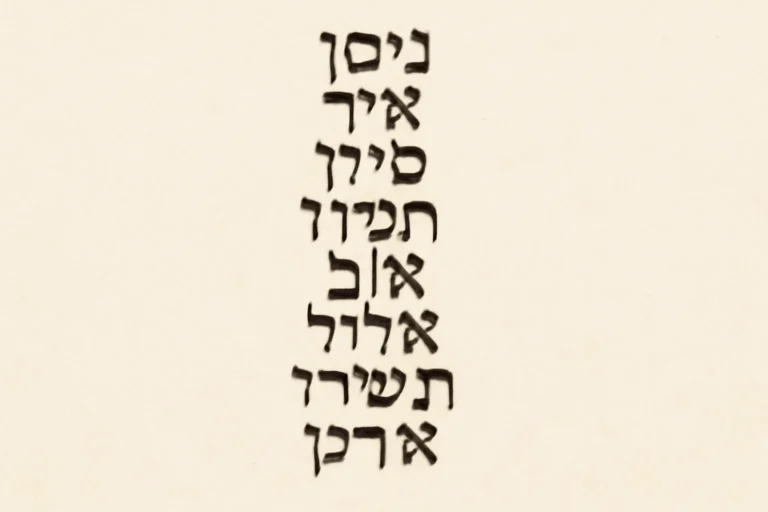
The Hebrew calendar is a luni-solar system that blends lunar months with a solar adjustment to keep the year aligned with the seasons. Each month in the tradition has a distinct name, often rooted in ancient Near Eastern calendars, agriculture, or the rhythm of Jewish life in the Land of Israel and in the diaspora. The sequence of twelve months in a common year, and thirteen months in a leap year, establishes a yearly cycle that underpins major holidays, agricultural festivals, and daily rhythms. In this article, you will find a comprehensive, structured guide to the names, order, and meanings of the Hebrew months, with emphasis on how each month contributes to the calendar narrative, the holidays associated with it, and the practical aspects like month length and leap year adjustments.
The months are named in a way that preserves continuity with historical month schemes while reflecting the Jewish religious and agricultural cycles. The year begins, for civil and religious purposes, in Tishrei, the autumn month that hosts Rosh Hashanah and Yom Kippur and signals a turn toward judgment and renewal. The months continue through the winter, spring, and summer, culminating in Elul, a month of preparation for the new year. In leap years, an extra month, Adar I, is inserted before Adar II, creating a 13-month year that keeps the lunar months in step with the solar year.
Month names carry meanings and associations that tie together time, ritual practice, and seasonal change. While the etymologies can be layered and sometimes debated, the practical takeaway is clear: each month marks a particular window in the cycle of the year—season, weather, agricultural cycles, and the cadence of holidays. The following sections present the month-by-month guide in a structured way, with emphasis on names, order, and meanings.
Month-by-Month Guide: Names, Order, and Meanings
Tishrei — the opening month of the civil year and a central spiritual pivot
Position in the calendar: first month of the civil year; seventh month of the religious year.
Season and weather: autumn in the northern hemisphere; typically cool, with harvest themes in some regions.
Length: 30 days in most years.
Major holidays and rites:Rosh Hashanah (the Jewish New Year), Yom Kippur (the Day of Atonement), Sukkot (the Feast of Tabernacles), and Simchat Torah (celebration of the Torah’s cycle). These days anchor the fall spiritual season and shape social and family life.
Meanings and associations: the name is traditionally connected to the notion of beginning or a turning point in the yearly cycle. It is the month that sets the tone for the year’s reckoning, reflection, and renewal.
Practical notes: because Tishrei begins the civil year, many Jews observe the start of the annual cycle with liturgical and familial gatherings, and the calendar remains in focus for the next weeks as holidays proceed in a rapid sequence.
Cheshvan (also called MarCheshvan) — a month characterized by variability
Position in the calendar: second month in the sequence, following Tishrei.
Length: 29 or 30 days, depending on whether the year is a common (non-leap) year or part of a leap cycle with adjusted days.
Season and weather: typically late autumn into early winter in the northern hemisphere; a quiet interval between the high-activity autumn holidays and the later winter observances.
Holidays and observances: there are no major holidays tied to this month in the standard calendar, which makes it notable as a time of relative quiet or reflection between the intense fall festival period and winter observances.
Meanings and associations: the traditional name MarCheshvan reflects historical naming patterns that emphasize the month’s position and the absence of major ritual events, highlighting a practical balance within the year.
Practical notes: in years when Kislev and Tevet carry more days, Cheshvan may be shorter, which demonstrates how the Hebrew calendar uses month lengths to keep the lunar cycle aligned with the solar year.
Kislev — the month of resilience and the dovetail with Hanukkah
Position in the calendar: third month in the sequence, follows Cheshvan.
Season and weather: late autumn to early winter; often associated with the beginning of longer nights in the northern hemisphere.
Length: 29 or 30 days depending on the year’s leap-balancing pattern.
Holidays and observances:Hanukkah commonly occurs in Kislev (sometimes stretching into Tevet). This holiday, centered on the rededication of the Temple and the miracle of oil, is closely linked with Kislev’s position in the calendar and its themes of light and endurance.
Meanings and associations: Kislev’s name and its rhythm reflect a cluster of late-fall/early-winter qualities, including endurance through longer nights and the sense of preparing for the winter festival season.
Practical notes: the presence of Hanukkah within Kislev makes this month a focal point for family celebrations, gift-giving, and lighting menorahs, adding a cultural layer to its place in the year.
Tevet — the quiet but important bridge to winter
Position in the calendar: fourth month; between Kislev and Shevat.
Season and weather: mid-winter in many places, often a period of cold weather and deepening night.
Length: 29 days typically, though the calendar’s balancing acts can affect adjacent months.
Holidays and observances: there are no major national holidays anchored to Tevet, but some communities observe fasts or commemorations in connection with historical events or tragedies connected to this time.
Meanings and associations: the name Tevet, like other month names, belongs to a tradition of Babylonian-era month naming that survived into Hebrew usage, marking a stable part of the annual cycle.
Practical notes: Tevet serves as a transition month, bridging the Hanukkah period with the next month, Shevat, which starts to bring a sense of renewal with trees and plant life.
Shevat — the tree month and the seedbed of renewal
Position in the calendar: fifth month in the sequence, preceding Adar in common years.
Season and weather: winter to early spring, especially in Israel where Tu BiShvat (the New Year for Trees) falls within this period.
Length: 30 days in most years.
Holidays and observances:Tu BiShvat (the New Year for Trees) occurs in Shevat, giving the month a natural agricultural theme and a focus on the renewal of vegetation and the land.
Meanings and associations: the name Shevat is often linked to the ancient naming patterns that reflect a position within the year; its association with trees and the environment endows the month with ecological and spiritual resonance.
Practical notes: in Israel and in Jewish communities abroad, Tu BiShvat emphasizes environmental and agricultural literacy, often celebrated with fruit-focused meals and nature-related learning.
Adar I (in leap years) — a precursor to Adar II
Position in the calendar: in leap years, Adar I appears after Shevat and before Adar II; in common years, this month is not present.
Length: 29 days typically, as with other bridge months that balance the cycle.
Season and weather: late winter to early spring in many places, depending on regional climate.
Holidays and observances: no major new holiday is tied specifically to Adar I; its role is primarily structural, keeping the calendar aligned with the lunar-solar system.
Meanings and associations: the designation Adar I reflects a historical need to insert an additional lunar month to maintain seasonal alignment in leap years, preserving the integrity of holidays later in the year.
Practical notes: because Adar I does not host the primary Adar II festivities, its presence is primarily technical but essential for the calendar’s arithmetic.
Adar II (in leap years) — the primary Adar month for Purim and related observances
Position in the calendar: follows Adar I in leap years; in common years, Adar is simply called Adar.
Season and weather: late winter to early spring, often a period of anticipation before Passover preparations.
Length: 29 days typically, mirroring other months that balance lunar cycles.
Holidays and observances:Purim is celebrated in Adar (Adar II in leap years), a festive commemoration with readings of the Megillah and charitable giving.
Meanings and associations: Adar II serves as the principal Adar in leap years, making it the month during which Purim and many associated customs take place, connecting joy and charity in the calendar’s reconciliation of lunar months with the solar year.
Practical notes: in leap years, the inclusion of Adar I and Adar II shifts the timing of holidays later in the year compared to common years, impacting how families plan celebrations and travel.
Nisan — the spring month of freedom and Passover
Position in the calendar: comes after Adar II (in leap years) or Adar in common years, marking the transition from late winter to early spring.
Season and weather: broadly associated with springtime and renewal in many regions, including the biblical narrative context.
Length: 30 days typically, continuing the alternating pattern of 29 and 30 days observed across the months.
Holidays and observances:Passover (Pesach) is the central event of Nisan, commemorating the Exodus from Egypt. The month also includes the counting of the Omer from the second night of Passover until Shavuot, linking Nisan with spiritual growth and liberation.
Meanings and associations: Nisan’s position signals new beginnings, liberation, and the harvest themes that echo across Jewish history and liturgy.
Practical notes: practical aspects of Nisan include extensive meal planning around Passover laws (especially in households observing Passover) and a shift in dietary and ritual routines that emphasize renewal.
Iyar — the counting and growth month
Position in the calendar: follows Nisan; in the spring sequence, it sits between Passover and the giving of laws at Sinai in the biblical frame.
Season and weather: springtime in many climates, with a sense of growth and preparation for the harvest.
Length: 29 days typically.
Holidays and observances: no major national Jewish holidays at the level of the monthly calendar, but it is a traditional period for counting the Omer, which connects the spring holidays with the bringing of offerings in ancient times and with spiritual preparation in contemporary practice.
Meanings and associations: Iyar’s rhythm is closely tied to counting and preparation, a month that emphasizes discipline, reflection, and anticipation of the climactic summer events in the calendar.
Practical notes: the Omer count is a daily educational and spiritual activity for many households and communities, linking the calendar to daily life, study, and personal growth.
Sivan — the festival month of revelation and Shavuot
Position in the calendar: comes after Iyar; part of the spring sequence.
Season and weather: late spring in the northern hemisphere, leading toward early summer.
Length: 30 days typically.
Holidays and observances:Shavuot (the Feast of Weeks) occurs in Sivan and is a central agricultural and historical festival, commemorating the giving of the Torah at Mount Sinai.
Meanings and associations: the name Sivan belongs to a family of month names rooted in ancient calendars; its meaning is less about a literal translation and more about its placement in the year around the time of the wheat harvest and the climactic festival of Shavuot.
Practical notes: Sivan’s position makes it a peak for Torah study, community gatherings, and the culmination of the Omer period with a focus on covenantal revelation.
Tammuz — a month linked with fasting and historical memory
Position in the calendar: follows Sivan; marks the transition from late spring toward summer.
Season and weather: early to mid-summer in many areas, with heat in the northern hemisphere in many years.
Length: 29 days typically.
Holidays and observances:the 17th of Tammuz is a fast day commemorating a number of historical events related to the destruction of Jerusalem and the Temple. The month’s rhythm is often described in terms of fasting and reflection, especially in historical memory contexts.
Meanings and associations: Tammuz’s name evokes Mesopotamian origins, reflecting historical cross-cultural impacts on the calendar. The month’s religious associations emphasize remembrance and penitence as the year moves toward the summer period.
Practical notes: people often note the days of Tammuz as markers for communal memories and fast observances that shape spiritual life in the months ahead.
Av — the month of sorrow and a turning point toward consolation
Position in the calendar: follows Tammuz; typically a time of heat and intensity in many regions, leading toward the major fasts in late summer.
Season and weather: summer heat dominates in many places in the northern hemisphere.
Length: 30 days.
Holidays and observances:Tisha B’Av (the Ninth of Av), a major fast that commemorates disasters in Jewish history, resides in Av and shapes communal mourning and reflection for many communities.
Meanings and associations: the name Av (אב) carries the sense of father or strength in Hebrew, but the month is widely remembered for its historical sorrows and the resilience that follows in later biblical narratives.
Practical notes: the intensity of Av in many years mirrors the emotional tempo of the year, and it is often a prelude to the hopeful or penitential moods that reappear as the year moves toward Elul and Rosh Hashanah.
Elul — the month of introspection and preparation for the new year
Position in the calendar: final month of the Hebrew year, just before the onset of Tishrei again.
Season and weather: late summer to early autumn, depending on climate in various regions.
Length: 29 days typically.
Holidays and observances: although Elul itself has no major public holiday, it is renowned as a period of repentance and preparation leading into Rosh Hashanah and Yom Kippur; many communities engage in extra prayers, self-examination, and the sounding of the shofar during certain days of Elul.
Meanings and associations: the name Elul is often discussed in the context of introspection, repair, and spiritual renewal that culminate with the Days of Awe in Tishrei.
Practical notes: Elul is widely observed as a month of spiritual work at the personal, family, and communal levels; it is a time to prepare the heart and home for the high holidays.
Leap Years, Adar, and Special Considerations
A distinctive feature of the Hebrew calendar is the intercalation of a leap month to sync the lunar rhythm with the solar year. This adjustment ensures the seder of holidays remains aligned with the seasons. In leap years, a second Adar (Adar II) is added after Adar I, increasing the total number of months to thirteen. The inclusion of Adar I and Adar II affects the order of months and the timing of Passover, Purim, and other observances.
In leap years: the sequence includes Adar I before Adar II, followed by Nisan. This structural change helps keep Passover in the spring against the lunar cycle.
In common years: the only Adar is simply Adar, and Nisan follows after Tevet, Kislev, and Cheshvan.
Why leap years exist: the Hebrew calendar uses a 19-year cycle (the Metonic cycle) with specific leap-year rules to correct for the fact that lunar months alone do not align with the solar year. The leap year helps ensure that the agricultural seasons and holidays stay in their intended seasonal windows.
Seasonal Themes and the Calendar’s Rhythm
Beyond the individual months, the Hebrew calendar articulates a larger seasonal rhythm that ties time to land, harvest, and communal memory. Each cluster of months carries particular themes:
Autumn harvest and judgment cycle: Tishrei anchors the year with Rosh Hashanah and Yom Kippur, setting a mood of reflection, renewal, and ethical accounting.
Winter quiet and learning: Kislev and Tevet move the calendar toward Hanukkah and the momentum of winter, with a focus on resilience and continuity of tradition.
Spring renewal and liberation: Nisan, Iyar, and Sivan are tightly linked to Passover, counting the Omer, and Shavuot—moments of liberation, instruction, and covenantal revelation.
Summer memory and penance: Tammuz, Av, and Elul carry forward the memory of upheavals and the call to repentance that precedes the new year cycle.
This cyclical design is a key reason why the month names and their placement matter for Jewish life: they situate holidays, liturgy, and communal practices in a predictable pattern, while also allowing communities to adapt to regional climates and cultural customs.
Common Variants and Transliterations
While the standard Hebrew month names are universally recognized in traditional and modern contexts, you may encounter variations in transliteration and occasional alternate spellings across communities and texts. The most common set includes:
Tishrei (sometimes rendered as Tishri in some sources)
Cheshvan (also called MarCheshvan in some traditions)
Kislev
Tevet
Shevat
Adar I (in leap years)
Adar II (in leap years)
Nisan
Iyar
Sivan
Tammuz
Av
Elul
In addition to transliteration nuances, you may also encounter Ashkenazi, Sefardi, or local naming conventions in educational materials, but the core order and meanings remain the same. The practical takeaway is that the names reflect historical layers and the calendar’s structure, not only linguistic tradition.
Practical Implications for Learners and Readers
Whether you are studying the Hebrew calendar for religious study, cultural literacy, or academic purposes, a few practical points help make sense of the long, richly layered year:
Holidays drive the rhythm: The months are not mere timekeepers; they host major holidays that shape family life, travel, liturgy, and dietary practices. Knowing which month hosts Passover, Shavuot, or Purim helps contextualize readings and observances.
Month lengths are variable: Most months alternate between 29 and 30 days in a given year, but the exact lengths can shift due to the leap-year intercalations, ensuring the calendar aligns with the solar year.
Adar I and Adar II: In leap years, the extra month Adar I is inserted before Adar II; Purim occurs in Adar II, which can affect the timing of Purim in that year compared to common years.
Seasonal alignment: In Israel and other regions with different climatic patterns, the months correlate with harvests, plant cycles, and seasonal life in ways that enrich observance and learning about agriculture and nature.
Lateral connections: Several months have strong associations with particular themes or symbols (for example, Tu BiShvat in Shevat, and Shavuot in Sivan), which helps in educational settings to associate time with ethics, study, and community acts like charity and hospitality.
Hebrew calendar — a luni-solar calendar used by the Jewish people to mark months, years, and holidays.
Metonic cycle — a 19-year cycle used to balance lunar months with the solar year, including leap years with Adar I and Adar II.
Rosh Hashanah — the Jewish New Year, observed in Tishrei with themes of judgment, renewal, and introspection.
Yom Kippur — the Day of Atonement, observed in Tishrei as a day of fasting and atonement.
Hanukkah — the Festival of Lights, commonly observed in Kislev (and sometimes Tevet).
Passover (Pesach) — a major spring festival in Nisan commemorating the Exodus.
Shavuot — the Festival of Weeks, celebrated in Sivan, marking the giving of the Torah.
Purim — a festive holiday in Adar (Adar II in leap years) that commemorates deliverance in the Book of Esther.
Tisha B’Av — a fast day in Av commemorating disasters in Jewish history.
In Summary: A Rich, Interlinked Calendar
The list of Hebrew months represents more than a sequence of dates; it is a living framework that structures ritual life, scholarly study, family gatherings, and communal memory. From the autumntide cycle of Tishrei through the spring harvests tied to Nisan and Shavuot, to the summer fasts of Tammuz and Av, and the preparatory contemplations of Elul, each month contributes to a larger spiritual and cultural narrative. The calendar’s leap-year mechanism ensures the months stay in harmony with the seasons, so the holidays continue to align with the appropriate times of year. For students, educators, and curious readers, understanding the names, order, and meanings of these months opens a window into Jewish liturgy, history, and daily life.
If you would like, I can tailor this guide to a particular audience — for example, a classroom-friendly version with activities for each month, a short reference card for travelers who want to hear about holidays during their visits, or a more in-depth scholarly overview that traces the etymology and historical evolution of each month’s name. The Hebrew calendar is a rich topic with many entry points, and the month-by-month map above serves as a solid foundation for further exploration.