What month is it on the Jewish calendar? A practical guide to the Hebrew calendar and how months are determined
In everyday life, people often ask what month is it on the Jewish calendar or which Hebrew month are we in. The answer is not a single word, because the Hebrew calendar is a complex, rule-driven system that blends lunar months with a solar-cycle correction to keep the festivals anchored to the agricultural and seasonal year. The question can be answered precisely for any given Gregorian date by converting that date to a Hebrew date, but there is also value in understanding the underlying structure: how months are named, how long they last, when a leap month is added, and how Rosh Chodesh marks the start of each new month. This article explores the question from several angles: the nature of the months, the order of the year, how to determine the current Hebrew month, and why the concept matters for daily life, holidays, and study.
The structure of the Hebrew calendar: lunar months with a solar adjustment
To understand which month the Hebrew calendar shows today, it helps to grasp two core ideas. First, each month is tied to a lunar cycle, roughly reflecting the moon’s orbit around the Earth. Second, to keep Jewish festivals aligned with the seasons, the calendar adds a solar correction by occasionally inserting a leap month. This means the calendar is not a simple lunar calendar that drifts through the seasons; it is a sophisticated lunisolar system designed to preserve seasonal consistency for agriculture, festivals, and ritual timing.
Months in their traditional order
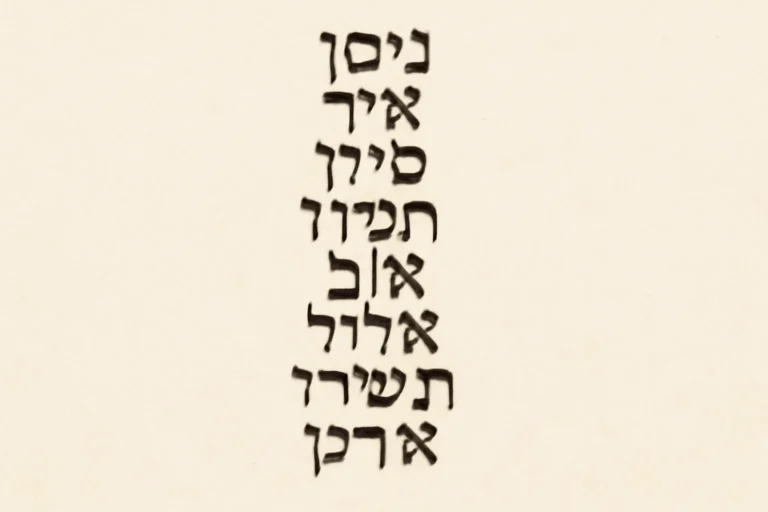
In the Hebrew calendar, there are two common ways to describe the order of the months, depending on whether you begin with the civil or religious year. The religious or Torah-centered order starts the year at Tishrei, the time of Rosh Hashanah, the Jewish New Year. The civil or agricultural order often places Nisan at the start of the year for counting months and for certain observances related to Passover. The standard order within a common (non-leap) year is:
Tishrei
Cheshvan (also called Marcheshvan in some traditions)
Kislev
Tevet
Shevat
Adar (the month of Adar; in leap years this is Adar I)
Nisan
Iyar
Sivan
Tammuz
Av
Elul
In a leap year, the calendar inserts a second month named Adar II between Shevat and Nisan, so the order becomes:
Tishrei, Cheshvan, Kislev, Tevet, Shevat, Adar I, Adar II, Nisan, Iyar, Sivan, Tammuz, Av, Elul
Each month alternates in length between 29 and 30 days in a roughly lunar pattern. This practice—29 or 30 days per month—helps keep lunar cycles roughly in alignment with the months while the leap months and year-length adjustments keep the holidays in their proper seasons.
Rosh Chodesh: the start of a new month
A key feature of the Hebrew calendar is Rosh Chodesh, the appearance of the new moon that marks the beginning of a new month. In Hebrew practice, Rosh Chodesh often coincides with a small special observance, and in many communities, the month is considered to begin on the day that the new month’s onset is observed in the Jerusalem tradition or calculated precisely by the fixed calendar the rabbis established. In modern times, most people rely on printed calendars or digital tools to know when Rosh Chodesh occurs for any given month. Because the start of a month is tied to the lunar cycle, you will typically hear the phrase Rosh Chodesh is coming when the calendar indicates the new month has begun.
How to determine the current Hebrew month: a practical workflow
If you ask someone today, what month is it on the Jewish calendar, they usually answer with the Hebrew month name, and sometimes the year in the Hebrew count. Here is a practical workflow you can follow to determine the current month on the Hebrew calendar:
Convert the date you have in the Gregorian calendar into a Hebrew (lunisolar) date. You can use online converters, calendar apps, or a traditional printed Hebrew calendar. The conversion will give you a Hebrew year, a month name, and a day-of-month in that month.
Identify leap year status: Hebrew leap years occur 7 times in a 19-year cycle. If you’re in a leap year, expect Adar I and Adar II to be present, which slightly changes the month order from one year to the next.
Note the month length: Because months alternate between 29 and 30 days, and because some months can be longer or shorter depending on the exact year type (deficient, regular, or complete years), the day number can help confirm the month. For example, if you know today is day 1 or day 30 of a month, you’re looking at a starting or ending day of that particular month.
Use a tool for cross-checking: If you want to verify quickly, consult a reputable Hebrew calendar tool, a Jewish educational site, or a calendar app that shows both Gregorian and Hebrew dates side by side. This helps avoid mistakes when crossing from one month to the next or when a leap month is involved.
Be mindful of regional practice: Some communities observe certain days as Rosh Chodesh based on the sighting of the new moon, while others rely on fixed calendar calculations. In general, for everyday use, the fixed calendar used by most synagogues and schools is accurate and consistent.
In practice, you can also learn to read a Hebrew calendar page. A typical page shows a grid where months are listed with corresponding dates in the Gregorian calendar for a given year. The month column will display the month name—Nisan, Iyar, Sivan, and so on—and the header often indicates whether the year is leap or common. If you’re new to this, start with a single year’s view and gradually explore how months shift across years, especially during leap years.
The Hebrew calendar is not just a list of months; it is the framework for a sequence of sacred time. Each month carries historical and religious associations, and most months host one or more significant observances. Here is a broad overview of how the months commonly align with major holidays and notable fasts or commemorations:
Autumn: Tishrei through Kislev
Tishrei — The head of the religious year, featuring Rosh Hashanah, Yom Kippur, Sukkot, and Shemini Atzeret/Simchat Torah.
Cheshvan and Kislev — The period following Sukkot, with Kislev bringing the first days of Hanukkah when it falls early enough in Kislev; otherwise, Hanukkah rolls into Kislev later. Kislev is also associated with the Festival of Lights in many communities.
Winter and early spring: Tevet through Sivan
Tevet — A minor fast day on 10 Tevet in many communities.
Shevat — Tu Bi’Shvat, the New Year for Trees, is celebrated in this month by planting and symbolic foods representing fruit trees in Israel and diaspora communities alike.
Adar (or Adar I in leap years) — In Adar, the joy of Purim is observed (in the entire Jewish world except where sun-oriented customs differ), with reading of the Megillah and celebratory meals. In leap years, Adar I precedes Adar II and purim is observed in Adar II to align with the festival’s seasonal timing.
Nisan — The month of Passover (Pesach), the central spring festival commemorating the Exodus, begins in Nisan and runs for seven or eight days depending on community practice. The Omer counting begins in Nisan after Passover.
Iyar and Sivan — Iyar includes minor fasts in some years; Sivan brings Shavuot, the Festival of Weeks, which occurs 50 days after Passover.
Summer: Tammuz through Elul
Tammuz — The period of the Three Weeks, a time of memorial observances leading to the 9th of Av in some traditions.
Av — The 9th of Av (Tisha B’Av) is a day of mourning for the destructions of the Temples and other calamities in Jewish history.
Elul — A period of spiritual preparation before the High Holy Days of Tishrei, typically marked by introspection, selichot (penitential prayers), and personal in-reach as the year closes.
These associations show which month is associated with which major observances and help communities plan for prayer services, Torah readings, and family customs. They also illustrate why the exact month matters beyond the calendar’s numbers: it signals the timing of liturgical cycles, agricultural rhythms, and communal rituals.
Variations in phrasing: how people ask about the current Hebrew month
People express the same question in different ways. Here are several common phrasings you might encounter, along with brief clarifications:
What Hebrew month are we in today? A straightforward inquiry for today’s month name and date in the Hebrew calendar.
Which month does the Jewish calendar indicate right now? Emphasizes that the calendar is a tool that maps to the present moment.
What month is it according to the Hebrew calendar today? Similar to the first, with emphasis on today’s date.
What month is it in the Hebrew year? Adds the sense of being within a yearly cycle and sometimes a specific Hebrew year (e.g., 5786).
Is this month Nisan, Iyar, or something else? A practical question during the transition between months.
How many days are in this Hebrew month? A related query that helps determine whether a month is ending or beginning.
All of these forms share a common goal: to locate the current month within the unique structure of the Hebrew calendar, and to understand how it interacts with holidays, fasts, and Torah readings. When you see a calendar or hear someone say “regarding the Jewish calendar, we are in …,” you can translate that to the Hebrew month name with confidence by using a converter or calendar tool if needed.
Why the month matters: practical implications for daily life, holidays, and study
The month you are in on the Jewish calendar has practical knock-on effects for prayer, study, and social life. Here are some key ways in which the month name matters in daily living:
Torah readings and haftorot: The annual cycle of Torah portions and haftarot is sectioned by month and week, so knowing the current month helps families and study groups anticipate what portion will be read in synagogue and in classrooms.
Special prayers and liturgy: Different months bring different prayers, piyutim, or selichot. For example, the Selichot prayers often begin in the weeks leading up to Rosh Hashanah, which is in Tishrei.
Fast days and commemorations: The month signals when certain fast days appear, such as 10 Tevet or 17 Tammuz, which guides personal fasting plans and community programming.
Festivals and family observances: The timing of Purim in Adar, Passover in Nisan, Shavuot in Sivan, and Hanukkah (Kislev) are critical for meal planning, travel, and religious education.
Agricultural and seasonal awareness: The calendar’s seasons influence agricultural traditions in Israel and the diaspora, impacting agricultural prayers and patterns of crops and harvest-related customs.
Leap years and Adar I / Adar II: how the calendar stays in sync
A distinctive feature of the Hebrew calendar is the intercalation of a leap month to keep lunar months aligned with the solar year. In leap years, an extra month—Adar II—is added after Adar I, preceding Nisan. This ensures that Passover remains in the spring, preserving the seasonal nature of the holidays. The leap year pattern follows a 19-year cycle, with leap years occurring in years 3, 6, 8, 11, 14, 17, and 19 of the cycle (but the exact year numbers depend on the current Hebrew year). Here’s what this means in practice:
In common years, you have Adar in its usual spot, followed by Nisan, Iyar, Sivan, Tammuz, Av, and Elul.
In leap years, the sequence becomes Adar I, Adar II, then Nisan and the rest, which shifts the months forward slightly compared with non-leap years.
Rosh Chodesh and month lengths adjust in leap years, so the start and the length of Adar I and Adar II influence when Rosh Chodesh falls for the following months.
For people planning travel, family events, or liturgical schedules around leap years, recognizing Adar II’s presence is essential. It is the month in which Purim is typically celebrated in most communities, while Purim in Adar I would still be observed in some tradition contexts depending on local custom. The leap year mechanism is a practical reminder that the Hebrew calendar is designed to align with both the lunar cycle and the solar year, creating a robust framework for religious life across centuries.
Common questions and practical examples about the current month
Here are some frequent questions people ask about the current Hebrew month, with concise explanations and scenarios that illustrate how the month is used in everyday life:
How do I know the Hebrew month if I only have a Gregorian date? Use a reliable calendar converter or an app that shows both dates. Many online resources provide a quick one-click conversion.
Can the Hebrew month be different from the Gregorian month? Absolutely. The Hebrew month can span portions of two Gregorian months, or sometimes a single Gregorian month contains two Hebrew months, depending on the year’s arrangement.
What happens if I miss Rosh Chodesh? Missing Rosh Chodesh does not invalidate observances; however, it may affect community prayers or specific customs tied to the new month. People may still add a Shacharit or special prayers when they realize Rosh Chodesh has begun.
Why does Passover happen in Nisan? Nisan is the month in which the biblical Exodus is said to have occurred, so Passover’s timing is anchored in that month to reflect that historical and religious memory.
What is the best approach to learning the month for a beginner? Start with a single year’s calendar, learn the month names and order, and note key holidays. Gradually incorporate leap year patterns and the concept of Rosh Chodesh to build familiarity.
Practical tools and resources for tracking the month
In the digital age, there are many accessible resources to help you keep track of the current Hebrew month. Here are some reliable options and tips for staying informed:
Hebrew calendar apps on smartphones often show dual dates and include reminders for holidays, fasts, and Shabbat times. Look for apps that offer offline access and the ability to switch between Hebrew and Gregorian formats.
Web-based converters that let you input a date in the Gregorian calendar and receive the corresponding Hebrew date, month name, and year.
Synagogue calendars and community bulletins typically list both calendars side by side for the current month and the next, making it easy to plan events and services.
Educational websites like reputable Jewish learning platforms offer explanations of the months, holidays, and the leap year system, which helps families and students learn over time.
Printed Hebrew calendars—these traditional tools provide a quick reference for the year, including Rosh Chodesh markings and major holidays, and can be used as a family study aid.
Thoughtful considerations: cultural and liturgical significance of month and season
The notion of “what month is it” in the Jewish calendar encompasses more than a date. It signals a layered set of cultural, liturgical, and personal rhythms. For families, the month guides when to prepare for holiday meals, order special foods, or adjust school schedules. For synagogues and study circles, it directs Torah portions, sermon themes, and study cycles. For individuals, it can shape prayer routines, daily aspirations, and personal reflection during periods such as Elul. The calendar thus functions as a community calendar and a personal calendar—a tool for memory, spiritual growth, and shared tradition.
Common misconceptions about the Hebrew calendar and the month
There are a few misconceptions worth addressing so that the question what month is it on the Jewish calendar yields an accurate answer rather than an assumption:
That the Hebrew calendar is purely lunar. It is not a pure lunar calendar; it is a lunisolar system with a leap month to align with the solar year.
That months always have the same length. While many months are 29 or 30 days, the exact distribution depends on the year type, and leap years introduce Adar I and Adar II which affects month lengths and ordering.
That Rosh Chodesh is fixed to a specific Gregorian date. Rosh Chodesh is tied to lunar timing, not fixed Gregorian dates; the fixed calendar used today provides precise dates, but historically some communities observed it differently.
That the month names change from year to year. The names stay the same; what changes is the presence of Adar II in leap years and the year type (deficient, regular, complete), which can affect how long a month is or when it begins.
That the Hebrew year number alone determines the month. The year number is useful, but you still need the month-name and day to describe the current moment accurately.
Putting it all together: an example walkthrough
Let’s consider a hypothetical date to illustrate how you would determine the current Hebrew month. Suppose you are looking at a Gregorian date, say, March 15, 2026. You would:
Use a reliable converter to translate March 15, 2026 into its Hebrew date: for example, it might fall in the month of Nisan or Iyar depending on the year’s alignment and whether Passover has begun yet in that year.
Check whether 2026 is a leap year in the Hebrew calendar. If it is a leap year, Adar II exists and affects the month order around this date.
Look at the day number within the month to see if you’re at the start, middle, or end of the month and whether Rosh Chodesh is approaching or has just begun.
Cross-check with a current Hebrew calendar or online tool to confirm the name of the month and any special observances near that date, such as Purim, Passover, or Shavuot coming up.
By following these steps, you turn a general question into a precise answer: the current Hebrew month is …, and you can attach the day and the year to get a complete Hebrew date. This process is exactly what you would do if someone asked you what month is it on the Jewish calendar today during your study or planning session.
Conclusion by way of a practical takeaway
While the phrase what month is it on the Jewish calendar might seem straightforward, it opens a doorway into a calendar system that balances lunar observance with seasonal regularity. The months form a repeating cycle, though the cycle includes a leap month in certain years to keep holidays aligned with the agricultural year in Israel and the ceremonial year around the world. Understanding the order of the months, the meaning of Rosh Chodesh, and the interplay between Adar I and Adar II can transform a simple date lookup into a fuller appreciation of Jewish timekeeping. Whether you are planning family life, preparing for a festival, or simply learning about a tradition that integrates lunar sighting, holidays, and study, knowing which month the calendar shows is a practical skill with cultural resonance. By using reliable converters, consulting printed calendars, and familiarizing yourself with the month names, you gain the ability to answer the recurring question with clarity and confidence: you can name the current Hebrew month, identify its place in the year, and anticipate the upcoming observances that shape community life and personal devotion.
Key terms to remember:
– Hebrew calendar, Bible months, Rosh Chodesh, Adar I, Adar II, Nisan, Iyar, Sivan, Tammuz, Av, Elul, Cheshvan, Kislev, Tevet, Shevat, Tishrei, Passover, Hanukkah, Tu Bi’Shvat, Purim, Shavuot, Tisha B’Av, and the concept of a lunar-solar calendar.