How Many Days in the Hebrew Calendar? A Comprehensive Guide to Year Lengths and Leap Years
The question of how many days are in the Hebrew calendar touches on a rich mix of lunar cycles, annual adjustments, and historical conventions. This calendar is not a simple year-by-year count of 365 days; instead, it is a carefully engineered lunisolar system that interlocks lunar months with solar seasons. In practice, the number of days in a single year can vary, and the variation is deliberate. In this article, we explore the full spectrum of year lengths and leap years, explain how the months are structured, and illuminate why the average length of a Hebrew year is not a fixed number but a carefully balanced rhythm over the 19-year cycle.
The Hebrew calendar combines a lunar month of about 29.53 days with a solar-year alignment system. Each lunar month is either 29 or 30 days, producing a month-long cycle that, if left unchecked, would drift relative to the seasons. To prevent drift and to ensure that major holidays fall in their intended seasons, the calendar uses a set of rules and adjustments known as metonic cycles and postponement rules (known in Hebrew as dehiyot). The result is a calendar that:
Defines months with fixed patterns in common years and a 13-month structure in leap years.
Maintains control over the total number of days in a year, so that the average year length aligns with the solar cycle enough to preserve seasonal integrity.
Guides the distribution of longer and shorter years to keep holidays in their appropriate seasons.
How many days in a common year?
In a common year (a year without a leap month), the total number of days can be one of three values. These are often described as:
353 days — the deficient year
354 days — the regular year
355 days — the complete year
The variability arises from the lengths of two particular months, Cheshvan (Heshvan) and Kislev (Kislev). These months can be shorter or longer depending on the year’s type. In the Hebrew calendar, most other months have fixed lengths:
Tishrei 30 days
Tevet 29 days
Shevat 30 days
Adar (in non-leap years) 29 days
Nisan 30 days
Iyar 29 days
Sivan 30 days
Tammuz 29 days
Av 30 days
Elul 29 days
The Cheshvan and Kislev months determine whether the year is deficient, regular, or complete:
Cheshvan 29 or 30 days
Kislev 29 or 30 days
When Cheshvan and Kislev are both short (29 and 29), the year is 353 days. When one is extended (for example, 29 and 30, or 30 and 29), the year can be 354 days. When both are extended (30 and 30), the year becomes 355 days.
How many days in a leap year?
A leap year in the Hebrew calendar adds a 13th.month, giving the year 383, 384, or 385 days, depending on the same adjustments to Cheshvan and Kislev. The presence of Adar I and Adar II in leap years creates the extra month. The lengths of the months in a leap year are generally the same pattern as in a common year, with the addition of Adar I (30 days) and Adar II (29 days) replacing the single Adar in common years.
383 days — the deficient leap year (Cheshvan 29, Kislev 29)
384 days — the regular leap year (Cheshvan 29, Kislev 30)
385 days — the complete leap year (Cheshvan 30, Kislev 30)
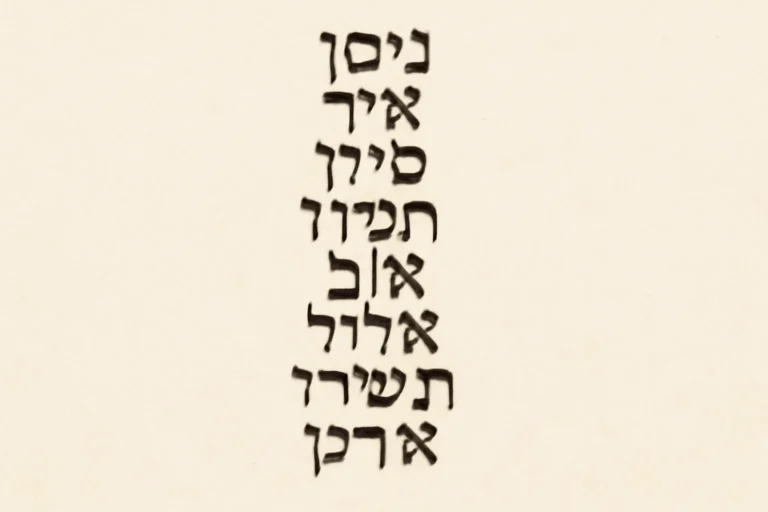
In leap years, the months go in this general order, with Adar I and Adar II taking the place of the single Adar:
Tishrei
Cheshvan
Kislev
Tevet
Shevat
Adar I
Adar II
Nisan
Iyar
Sivan
Tammuz
Av
Elul
The presence of Adar I and Adar II in leap years is the practical mechanism by which the calendar preserves alignment with the seasons while maintaining month lengths that mirror the lunar cycle. The leap-year-length variations are what allow the cycle to stay in step with astronomical reality over the long run.
The 19-year cycle and the average year length
The Hebrew calendar uses a Metonic-like 19-year cycle to reconcile lunar months with solar years. In this cycle, there are seven leap years and twelve common years, for a total of 235 lunar months over 19 years. This structure is the backbone that yields a stable average year length and keeps the holidays roughly in the same seasons across centuries.
The 19-year cycle contains 7 leap years and 12 common years.
The leap years typically occur in years 3, 6, 8, 11, 14, 17, and 19 of the cycle, though the exact labeling can vary slightly by tradition.
Over the full 19-year cycle, the total number of days approximates 6939.7 days, which translates to an average year length of about 365.2468 days.
To put this in context, the average year length in the Hebrew calendar differs from a simple 365-day year by roughly 6 hours and a small fraction. Those extra hours accumulate across years, which is why the leap-year rule and the 19-year cycle are essential for synchronizing the calendar with both the lunar months and the solar year.
How the cycle affects year lengths in practice
Because the 19-year cycle balances leap and common years, the calendar avoids drifting far from the solar year. This means that:
Most dates of the Gregorian calendar correspond to similar dates in years across the Hebrew cycle, preserving the timing of holidays relative to the seasons.
Some years will have an extra day or two compared to nearby years, but the pattern repeats every 19 years.
The cycle is not a perfect match to solar time, but it is sufficiently accurate for religious observances and agricultural references tied to the solar year.
Month lengths and how they contribute to total days
In addition to the overall year length, the day counts of individual months contribute to a year’s total. The basic month lengths (in days) are largely fixed, with the two exceptions being Cheshvan and Kislev, which determine the year type. The typical non-leap year offers a baseline set of month lengths, while leap years add Adar I and Adar II, which increases the total by 30 days when Adar I is present.
In leap years, Adar I and Adar II replace the single Adar:
Tishrei — 30
Cheshvan — 29 or 30
Kislev — 29 or 30
Tevet — 29
Shevat — 30
Adar I — 30
Adar II — 29
Nisan — 30
Iyar — 29
Sivan — 30
Tammuz — 29
Av — 30
Elul — 29
The month lengths are essential for Muslims to understand the longevity of the lunar cycle in the Hebrew calendar, the rhythm of religious observances, and the way that holidays are anchored to both lunar phases and solar seasons.
Why the calendar has postponement rules and how they influence day totals
The Hebrew calendar employs postponement rules to ensure that certain holidays do not begin on unsuitable days of the week, which would otherwise alter observances and community practices. These rules affect when Rosh Hashanah can begin and can in turn influence the perceived length of a year. The practical effect is that:
Rosh Hashanah cannot fall on Sunday, Wednesday, or Friday in most traditional calculations, which imposes constraints on the first day of the year.
The postponements help maintain consistency with agricultural and ceremonial cycles, which historically depended on seasonal cues and lunar visibility.
These rules, combined with the 19-year cycle, contribute to the non-uniformity of year lengths while preserving long-term accuracy.
Practical implications for holidays and daily life
The variability in year length has real-world implications for Jewish life and study. Some of the practical consequences include:
Shabbat and festival dates shift from year to year, because the calendar anchors holidays to specific lunar dates within the year.
The length of a season can feel longer or shorter in different years, especially when Cheshvan and Kislev are extended or shortened.
Planning for holidays, school calendars, and kosher slaughter schedules can require awareness of whether the coming year is common or leap, and whether it is deficient, regular, or complete.
Common questions about the length of the Hebrew year
How many days does a typical year have in the Hebrew calendar?
A “typical” Hebrew year is not a single fixed number. Depending on whether the year is common or leap, and on the lengths of Cheshvan and Kislev, a typical year can be 353–355 days (common year) or 383–385 days (leap year). The average over the 19-year cycle is approximately 365.2468 days.
The average year length, calculated from the 235 lunar months in the 19-year cycle, is about 365 days, 5 hours, 55 minutes (roughly 365.2468 days). This approximation helps explain why the calendar uses leap years and month-length adjustments rather than remaining a constant 365 days.
Why does the calendar intentionally vary the number of days per year?
The variation serves two purposes: to keep the lunar cycle aligned with the solar year and to ensure that major holidays stay in the correct seasons and days of the week. Without these adjustments, lunar months would drift, causing Passover, Sukkot, and other holidays to occur in inconsistent seasons. The result is a tightly regulated system that uses a fixed 19-year cycle to maintain seasonal fidelity while preserving lunar regularity.
If you want to determine the length of a specific Hebrew year, you can refer to a Hebrew calendar table or an astronomical calculator that accounts for Cheshvan and Kislev elevations. Here are some practical steps:
Identify whether the year in question is a leap year or a common year.
Check the status of Cheshvan and Kislev to determine whether the year is deficient, regular, or complete (for common years) or deficient, regular, or complete (for leap years).
Sum the fixed month lengths and the variable lengths of Cheshvan and Kislev, adding the 30-day Adar I and 29-day Adar II if the year is a leap year.
For researchers and curious readers, it can be helpful to use a tabular summary that lists year type (deficient/regular/complete), the number of days, whether it is a leap year, and which years in the cycle share that pattern.
Summary: How many days in the Hebrew calendar overall?
In short, the answer to “how many days in the Hebrew calendar” depends on the year type:
Common year: 353, 354, or 355 days
Leap year: 383, 384, or 385 days
Across the full 19-year cycle, these lengths balance to an average year length of about 365.2468 days, which is close to the solar year while preserving the essential lunar structure. This balancing act is what makes the Hebrew calendar a remarkable example of a sophisticated, culturally anchored timekeeping system.
Additional notes on terminology and clarity
When discussing days in the Hebrew calendar, you may encounter terms like deficient year, regular year, and complete year, as well as deficient leap year, regular leap year, and complete leap year. These descriptors refer to whether Cheshvan and Kislev are shortened or lengthened, which in turn affects the total number of days in the year.
Scholars and calendar enthusiasts sometimes use the phrase Metonic cycle to describe the 19-year pattern, even though the Hebrew calendar’s cycle is a refined form of that ancient concept. The concept remains central to understanding why months, holidays, and seasons align over time.
Further reading and resources
Those who want to delve deeper may examine historical sources on the development of the Hebrew calendar, the mathematical rules known as dehiyot, and the way modern calendar computations implement the leap-year pattern. For practical purposes, many Jewish communities maintain local calendar references or digital calendars that automatically compute year length, month lengths, and holiday dates for any given year.
Summary takeaways
The Hebrew calendar is a lunisolar system designed to keep lunar months in sync with the solar year.
In a common year, the duration ranges from 353 to 355 days.
In a leap year, the duration ranges from 383 to 385 days due to the added month Adar I / Adar II.
The calendar follows a 19-year cycle with 7 leap years and 12 common years, yielding an average year length of about 365.2468 days.
Understanding year length helps explain how holidays shift within the seasons and why scheduling remains stable across centuries.
In exploring how many days in the Hebrew calendar, you are touching the heart of a calendar that is both numerically precise and culturally meaningful. Whether you describe a year as deficient, regular, or complete, or you note whether a year contains Adar II in a leap year, you are observing a timekeeping system that has guided Jewish life for millennia. The varied day counts across years are not randomness; they are deliberate choices designed to harmonize the lunar cycle with the solar year, and to keep the cycle in sync with the changing seasons.