Jewish Calendar: Holidays, Months, and Observances – A Comprehensive Guide
The Hebrew calendar is a remarkable system that blends lunar months with a solar year, creating a lunisolar calendar suited to both agricultural cycles and religious observances. It is used to determine the dates of festivals, fast days, birthdays of the Jewish people, and the weekly rhythm of Shabbat. In this comprehensive guide, we explore the Jewish calendar—often called the Hebrew calendar or the Jewish lunisolar calendar—and explain how its months, holidays, and observances interact to shape the Jewish year, both in Israel and in Jewish communities around the world.
The Hebrew calendar is built on a combination of lunar months and a paralleled correction to align with the solar year. Each month begins with the appearance of the new moon and alternates between 29 and 30 days, creating a cycle that approximates the lunar month of ~29.5 days. However, because agriculture and the agricultural year depend on the changing seasons, the calendar periodically adds a leap month to keep the months aligned with the seasons. This combination yields a lunar-solar system that ensures major holidays stay in their proper seasonal context.
Two key elements define the calendar’s structure: the Metonic cycle and the set of postponement rules that determine when Rosh Hashanah can occur. The Metonic cycle, a 19-year pattern, intercalates a leap month seven times within the cycle. In practice, this means a year can be common (13 months) or leap (14 months), with leap years inserted to keep the agricultural and seasonal timing in harmony with the lunar months. The result is a calendar that remains both fixed in form and flexible enough to accommodate real-world astronomical and seasonal constraints.
Core Concepts: Months, Year Length, and Intercalation
Months in the Hebrew Calendar
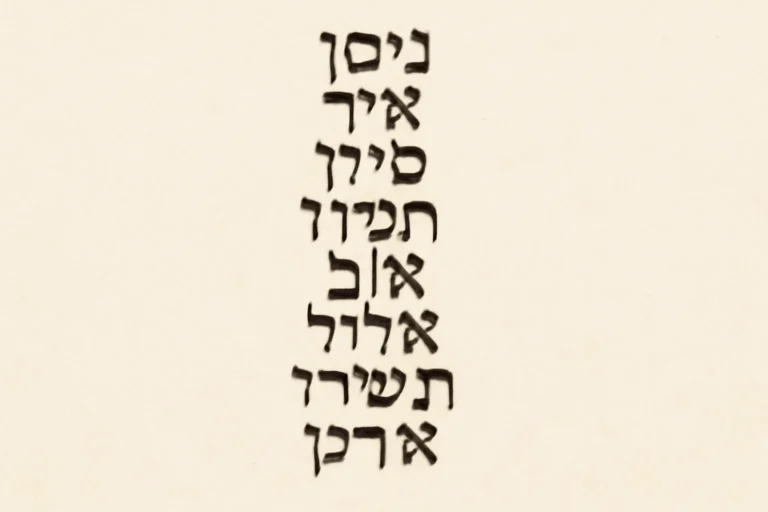
The months of the Hebrew calendar form a cycle that begins in the autumn with Tishrei, the opening month of the religious year. The order, counting forward, is approximately as follows: Tishrei, Cheshvan, Kislev, Tevet, Shevat, Adar (Adar I in leap years), Nisan, Iyar, Sivan, Tammuz, Av, Elul, and then back to Tishrei. In a leap year, the month Adar I is inserted before Adar II, so the sequence becomes Shevat, Adar I, Adar II, Nisan, Iyar, Sivan, Tammuz, Av, Elul, and then Tishrei again in the next cycle.
Each month has either 29 or 30 days in an alternating pattern, with occasional adjustments to ensure certain holidays land on appropriate days of the week. The fixed structure allows communities to plan annual and seasonal observances, while the lunar basis retains a connection to the natural moon cycle that has accompanied Jewish life for millennia.
For reference, a typical year in the Hebrew calendar features a sequence of months and days that can be summarized as follows: a year consists of 12 months in a common year or 13 months in a leap year, with total day lengths ranging roughly around 353–355 days in common years and 383–385 days in leap years. The distribution of days across months supports the rhythm of holidays that move through the year, creating an ever-shifting but familiar pattern that Jews have observed for centuries.
Leap Years and Adar I/Adar II
Leap years are essential to the luni-solar integrity of the calendar. In the 19-year Metonic cycle, there are seven leap years. During those leap years, the month Adar I is added after Shevat, and the month Adar II follows after Adar I. In a regular, non-leap year, there is only a single month of Adar. This intercalation prevents the Jewish holidays, which are set in lunar months, from drifting through the seasons and losing their seasonal significance, particularly for agricultural festivals tied to harvest times and seasonal weather patterns.
As a result, the timekeeping of holidays remains anchored to the year’s seasonal structure even as the lunar months advance. The presence or absence of Adar II changes the sequence of holidays and the way certain observances are celebrated in different years. This seasonal consistency is a hallmark of the calendar system.
Year Types and Their Implications
The Hebrew calendar distinguishes between different types of years based on the total number of days. A common year can be deficient (353 days), regular (354 days), or complete (355 days). In leap years, the year length can be deficient (383 days), regular (384 days), or complete (385 days). The exact length of the year influences when certain holidays fall on the weekly calendar, and it also determines the order of some observances within the year. This variability is one of the reasons the calendar uses the postponement rules to avoid certain days of the week for Rosh Hashanah and to ensure that long holidays don’t begin on problematic days for practical or liturgical reasons.
The religious year opens with Rosh Hashanah (the Jewish New Year), which is observed on the 1st and 2nd days of Tishrei. This is a solemn and sacred time marked by reflection, prayer, and the blowing of the shofar, a ram’s horn that calls for repentance and renewal. The days that follow culminate in Yom Kippur, the Day of Atonement, which is observed on the 10th day of Tishrei. Yom Kippur is the culmination of the High Holy Days and is dedicated to intensive fasting, prayer, and introspection. The period from Rosh Hashanah through Yom Kippur is often referred to as the Ten Days of Repentance, a time to examine one’s deeds, seek forgiveness, and resolve to make positive changes in the year ahead.
Festival Cycle: Sukkot, Shemini Atzeret, and Simchat Torah
Following Yom Kippur, the calendar continues with the autumn festival period of Sukkot, which begins on the 15th day of Tishrei. Sukkot is a week-long festival that emphasizes gratitude for harvest and the wilderness journey of the Exodus. It is followed by Shemini Atzeret and Simchat Torah on the 22nd and 23rd days of Tishrei, respectively. These observances mark the completion and restarting of the annual Torah reading cycle and serve as a joyful close to the festival season in the autumn calendar.
Winter Lights and Spring Festivals
In the late autumn and winter, two notable observances stand out for their historical, cultural, and religious resonance. Hanukkah (the Festival of Lights) spans eight days from 25 Kislev and carries both historical memory and religious celebration in communal life. Tu BiShvat, the Jewish New Year for the Trees, occurs on 15 Shevat and has taken on environmental and ecological significance in modern practice. While these two holidays have different origins—one has roots in the ancient resistance against cultural suppression and the other in the agricultural calendar—their observance reflects the calendar’s ability to carry memory through the months.
Spring Festivals: Pesach and Shavuot
One of the central religious obligations in the calendar is Passover (Pesach), which begins on 15 Nisan and lasts for seven days in the diaspora or eight days in the Land of Israel in many communities. Passover celebrates the Exodus from Egypt and includes family meals (seder) and the removal of chametz (leavened bread) from homes. A few weeks later, Shavuot arrives on 6–7 Sivan and commemorates the giving of the Torah at Sinai. Shavuot is traditionally marked by all-night study, festive meals, and the reading of the Book of Ruth in many communities. The two spring holidays together anchor the agricultural year and the spiritual narrative of Jewish identity in the Jewish calendar.
Purim and the Persians: A Purim Perspective
Purim occurs on 14 Adar (or 14 Adar II in a leap year) and celebrates the events described in the Book of Esther. It is known for its festive atmosphere, public readings of the Megillah (the Scroll of Esther), costume celebrations, and charitable giving. Purim is a reminder of courage, resilience, and communal solidarity in the face of adversity. In leap years, the shift of Adar II slightly repositions Purim within the calendar, illustrating how intercalation can influence the timing of joy within the annual cycle.
Fast Days and other Observances
Throughout the year, various fast days punctuate the calendar as occasions for fasting and reflection. The most well-known is Tisha B’Av, observed on the 9th day of Av, which commemorates the destruction of the First and Second Temples in Jerusalem, among other tragedies. There are additional fast days tied to historical events or prophetic readings, such as Ta’anit Esther (the fast of Esther) and Tzom Gedaliah, which commemorate specific moments in Jewish history.
National, Memorial, and Independence Days in the Jewish Calendar
In modern times, some days have taken on national or communal significance within the calendar of Israel and the broader Jewish world. Yom HaShoah (Holocaust Remembrance Day), Yom HaZikaron (Remembrance Day for fallen soldiers and victims of terror), and Yom HaAtzmaut (Independence Day) anchor the late spring portion of the calendar. While Yom HaShoah and Yom HaZikaron have the character of solemn remembrance, Yom HaAtzmaut is a public celebration of national renewal. In many diaspora communities, these days are observed in parallel with Israel’s schedule, reinforcing a shared sense of connection to the land and to Jewish history.
A distinctive feature of the Jewish calendar is how weekly Shabbat observance interacts with the annual cycle. Shabbat recurs every seventh day, providing a regular pause in ordinary activity and a focal point for rest, study, and community prayer. The calendar also marks Rosh Chodesh, the appearance of the new moon, as a special mini-holiday for women and for communities to recognize the start of a new month. This monthly observance has both liturgical and social dimensions, especially in communities that gather for special prayers or festive meals on Rosh Chodesh.
In addition to these, the religious calendar calls for certain liturgical practices tied to the months, days, and holidays. For example, the quarter-yearly reading schedule for the Torah and the special haftarah readings for each festival contribute to the sense that the calendar is a living guide for worship and study. The ritual calendars vary by tradition (Ashkenazi, Sephardi, Mizrahi, and others), but the underlying structure—months, holidays, and weekly rhythm—remains a shared framework across Jewish life.
Practical Implications for Communities and Families
Understanding the Hebrew calendar is essential for planning family events, synagogue programs, and school curriculums. Because the dates of holidays depend on lunar months and the solar year, the same holiday can fall on different days of the week from year to year. This shifting pattern requires flexibility in scheduling, especially for long holiday periods like Passover, which may begin on different weekdays in different years. Communities prepare in advance, creating calendars that accommodate travel, vacations, and work obligations while preserving the sanctity of the observances.
For families, the calendar serves as a guide for year-long planning: listening to the shofar during Rosh Hashanah, preparing for the fast of Yom Kippur, setting up the sukkah for Sukkot, and gathering with family for Passover seders. The intercalated leap year ensures that the spring and harvest festivals stay connected to their agricultural roots, while the autumn and winter festivals emphasize memory, gratitude, and renewal. The calendar’s design supports a rhythm of spiritual activities, family life, and communal responsibility that stretches across generations.
Calculating Dates: How the Hebrew Calendar Is Determined
The determination of dates in the Jewish calendar relies on a combination of astronomical observation, fixed rules, and historico-religious conventions. The calendar is primarily computed rather than purely observed, which means the fixed rules govern the calendar even as new calculations refine accuracy. Two core elements drive the calculation: the lunar months and the 12- or 13-month year structure, plus the postponement rules that ensure Rosh Hashanah avoids certain days of the week and that the year aligns with the agricultural and liturgical needs of the community.
The monthly cycle depends on the calculated or observed new moon, yet the day of Rosh Hashanah—the start of the religious year—must comply with weekly constraints. The classical rules, sometimes remembered by the mnemonic Lo Adu Rosh (Rosh Hashanah should not fall on Sunday, Wednesday, or Friday) and other dehiyyot (postponements), ensure that certain calendar years are preferred to others. This system prevents year-long drift and guarantees a predictable pattern that Jewish communities can rely on for planning, worship, and education.
In practice, determining a Hebrew year involves deciding whether the year is common or leap, applying detainment rules to the Molad Tishrei (the mean conjunction of the Moon with the Sun) to ensure Rosh Hashanah falls on an allowable day, and then mapping the months and holidays accordingly. The result is a robust calendrical framework that has endured for centuries and remains a living instrument for Jewish life in the modern era.
Variants and Interpretations Across Communities
Across Jewish communities worldwide, the calendar is used with slight liturgical and cultural variations. While the core structure—months, leap years, and holiday dates—remains shared, the way holidays are celebrated, the order of readings, and the synchronization with local custom can differ. Some communities observe additional customs on specific days, while others may emphasize different liturgical tunes or ritual practices on particular holidays. The calendar thus serves as a common framework that still allows for rich regional and denominational diversity, illustrating how a single system can support many forms of religious life.
When discussing the Jewish lunisolar calendar, it is common to refer to its modern and historical implementations. The modern civil use of the calendar in Israel and in many diaspora communities aligns with common religious practice but may reflect national and civic considerations as well. The resilient structure of the calendar—anchored by months, year lengths, and intercalation—provides continuity while enabling communities to adapt to contemporary life and global rhythms.
Common Terms and Quick References
Hebrew calendar — also called the Jewish calendar or Hebrew lunisolar calendar; the system used to schedule all religious and cultural observances.
Metonic cycle — a 19-year cycle that includes 7 leap years with an extra month, ensuring alignment with the solar year.
Rosh Hashanah — the Jewish New Year, a two-day holy day beginning on 1 Tishrei.
Lo Adu Rosh — a traditional mnemonic representing the rule that Rosh Hashanah should not fall on Sunday, Wednesday, or Friday.
Molad Tishrei — the mean conjunction of the moon and sun used in calculating the calendar.
Adar I / Adar II — the two Adars that appear in leap years; Adar II hosts Purim in leap years in many communities.
Leap year — a year with 13 months, including Adar I and Adar II, inserted to maintain seasonal alignment.
Common year — a year with 12 months, without Adar II; dates of holidays shift according to the year’s length.
Practical Guide for Learners and Readers
For readers seeking to understand the calendar system of Judaism in depth, this guide provides a framework to approach the topic. Start with the idea that the calendar is designed to align two powerful dimensions: the lunar cycle (months) and the solar cycle (seasons). Then recognize how intercalation (the leap month Adar II) preserves that alignment over many centuries. Finally, note the calendar’s rhythm: a sequence of holidays that moves through the year, a weekly Shabbat that provides a regular pause, and a set of fasts and commemorations that reflect historical experiences and theological motifs.
Whether you study the calendar for religious study, travel planning, or cultural education, you will gain appreciation for the calendar’s layered structure. It is a living artifact that records time through a fusion of astronomy, religious law, historical memory, and communal practice. As with any complex calendrical system, it helps to consult multiple resources, including synagogue calendars, educational materials, and primary texts, to understand how specific dates are calculated for a given year and how local customs might influence celebrations or observances.
Putting It All Together: A Snapshot of a Year
To illustrate how the pieces fit, imagine a typical year in the Jewish calendar cycle. The year begins in the autumn with Rosh Hashanah, followed by the introspective days of the Days of Awe and the solemn fast of Yom Kippur. The autumn festival season continues with Sukkot, and its concluding days with Shemini Atzeret and Simchat Torah. Moving into late autumn and winter, the calendar includes Hanukkah and Tu BiShvat, and then the spring festivals commence with Passover, culminating in Shavuot. If the year is a leap year, the presence of Adar I and Adar II affects the placement of Purim and other observances. The weekly cadence of Shabbat persists throughout, providing a steady beat within the yearly cycle. The calendar’s final arc returns to the next Rosh Hashanah, and the cycle repeats with a fresh set of readings, reflections, and communal gatherings.
In sum, the Jewish calendar—also termed the Hebrew lunisolar calendar—is a comprehensive framework that organizes time for a people whose religious practice, historical memory, and communal life span generations. Its attention to the cycles of the moon, the seasons, and the Sabathic rhythm creates a structure in which holidays, fasts, and commemorations are not isolated events but synchronized moments that guide study, worship, family life, and civic memory. By understanding the relationships among months, leap years, and festival dates, students and readers gain a clearer sense of why certain holidays fall when they do and how the calendar sustains Jewish identity across time and place.
For those who wish to explore further, consider consulting a Hebrew calendar (kevi’ot) and a desktop or paper calendar that marks the months, the holiday dates, and the Rosh Chodesh markers. Engaging with the calendar in a hands-on way—by tracking upcoming holidays, observing how Shabbat and Rosh Chodesh are celebrated, and comparing how different communities observe the same date—provides a practical path to appreciating both the precision and the depth of the Jewish calendar.