The Last Supper: History, Meaning, and Modern Interpretations
Across two millennia, the gathering known as the Last Supper has stood as a focal point for faith, art, and cultural reflection. This event, traditionally described as Christ’s final meal with his disciples before the crucifixion, is both a concrete historical claim and a symbol that has grown in significance beyond its original setting. In this article, we explore the history of the last supper narrative, examine its diverse meanings, and look at how contemporary readers, scholars, and communities interpret the farewell meal today. To capture the breadth of the topic, we move through historical sources, devotional meanings, artistic representations, and modern readings that keep the supper symbolic in many different lights.
To understand the supper before the crucifixion, it helps to situate it in its Jewish and early Christian milieu. The event is anchored in the Passover observance era of first-century Judea, a time of rich ritual memory about liberation from bondage. In the Gospels, the scene unfolds as Jesus shares bread and cup with his inner circle, redirects their expectations, and hints at a coming sacrifice. Yet the historiography of the supper is not a single, uniform record. It exists in several strands that theologians and historians analyze for meaning as well as for historical plausibility.
There are two broad families of accounts in the Christian scriptures often labeled Synoptic Gospels (Matthew, Mark, Luke) and the Gospel of John. In the Synoptics, the institution of the Eucharist—the blessing of bread and wine and the command to eat in remembrance of Jesus—is a central feature. In John, the narrative emphasizes a different theological arc: Jesus speaks about serving others, about love, and about a “new commandment” to love. This divergence is not a contradiction so much as a difference in emphasis, reflecting early Christian communities’ concerns and liturgical memories. The phrase “the Last Supper” is a later designation, a shorthand for this pivotal meal that became a turning point in the church’s identity and worship.
Historical dating and chronology remain topics of scholarly discussion. Some scholars emphasize a Passover framing, arguing that Jesus and his disciples were sharing a Passover meal that year. Others highlight John’s account suggesting a different sequence around the Passover festival. A key takeaway for readers is that the supper is a product of varied early Christian traditions, rather than a single, monolithic report. But across these traditions, a common thread persists: the supper is a moment when Jesus models a shared table rooted in hospitality, kinship, and a radical reorientation of power and ritual.
Beyond the Gospel texts, early Christian writers, patristic authors, and later church historians provide context. The very idea of a ritual meal centered on bread and wine emerges early in Christian practice, becoming a constitutive element of communal worship. Over time, this meal evolves into the central sacrament of many Christian communities, with variations that reflect local theology, liturgy, and culture. In education and scholarship, this is often described as the institution narrative of the Eucharist: a meal that becomes a sacrament, a sign that binds a community to the memory of Jesus’ life, death, and promised renewal.
Archaeological and artistic echoes
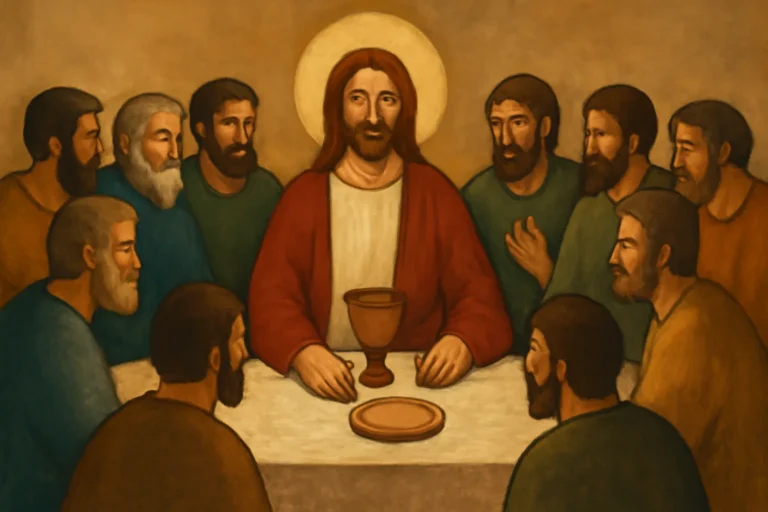
History also speaks through artistic representations and early Christian archaeology. The iconography of the Last Supper—Jesus at the center, the apostolic circle around a long table, sometimes with Judas depicted apart or separated—appears in a range of forms. The oldest surviving depictions are found in late antique and early medieval settings, including catacombs and architectural niches. A notable early example is a 3rd- to 4th-century scene from the Dura-Europos house church, which provides one of the earliest images of Jesus sharing a meal with his followers. Later centuries produced monumental works, most famously Leonardo da Vinci’s mural in Milan, a masterwork that reimagines balance, gesture, and perspective around the narrative of the supper. These images became touchstones for Christian imagination and have shaped how generations imagine the moment, the participants, and the implications of that evening.
In addition to Leonardo, painters, sculptors, and architects across Europe and the Mediterranean created a vast repertoire of Last Supper scenes. Each era interprets the event in light of its questions about authority, community, and divinity. In some depictions, Judas Iscariot is shown as a figure with a money bag, signaling betrayal and the economic dimensions of the betrayal narrative. In others, the emphasis falls on communal bond, on the sharing of bread as a sign of solidarity, and on the new commandment to love one another. The meal becomes a lens for reading power, mercy, and the moral demands of discipleship.
Meaning and the central themes of the supper
The meaning of the Last Supper has always rested on a few foundational ideas that recur across Christian denominations and across centuries of interpretation. Understanding these themes helps illuminate why the meal remains a living symbol in worship, ethics, and culture.
Communion and remembrance: The supper is often understood as a memorial meal that binds believers to the life, death, and ongoing significance of Jesus. The command to “do this in remembrance of me” anchors liturgical practice in memory and gratitude.
The bread and the cup as signs: Bread and wine serve as tangible signs of deeper realities—bread as the body and wine as the blood in many interpretive traditions. This symbolism is central to the way Christian communities conceive of Christ’s presence and sacrifice.
New Covenant and forgiveness: The supper is frequently described as inaugurating a New Covenant, a relational framework built on grace, reconciliation, and the breaking of old barriers between God and humanity, and among people themselves.
Ethics of hospitality and service: The meal foregrounds hospitality, mutual service, and the reversal of expectations—echoing Jesus’ teachings about humility and leadership.
Immediacy and eschatology: The supper looks forward—anticipating the kingdom, the full restoration of creation, and the próximo return of Christ in some traditions—while remaining acutely relevant to present-day communities who gather to eat, drink, and reflect on justice, mercy, and love.
Different theological traditions emphasize different facets of these core themes. In Catholic and Orthodox contexts, the Real Presence in the sacrament is a central claim, with the bread and wine understood, in various ways, to become or to signify the body and blood of Christ during the liturgical act. In many Protestant communities, the emphasis can lean toward remembrance and proclamation—the memorial dimension that invites believers to remember a salvific act and to live in light of it. Across these differences, the meal remains a rich ground for contemplating mystery, grace, and duty.
The last supper in theology, liturgy, and church practice
The institution of the Eucharist during the final meal has shaped centuries of Christian worship and ecclesiology. The meal is not only a story about what Jesus did once; it becomes a pattern that informs how Christian communities behave together, how they administer sacraments, and how they conceive the church’s mission in the world.
Within liturgy, you will find variations such as:
The Mass in Roman Catholic practice, with a long tradition of ritual, prayers, and the doctrinal concept of transubstantiation—the real, substantial change of the bread and wine into the body and blood of Christ, while the appearances remain the same.
Divine Liturgy in Eastern Orthodoxy, which likewise holds to real presence but expresses it through highly symbolic, liturgical language and a deep sense of mystery.
The Lord’s Supper or Communion in many Protestant churches, often framed as a memorial act, with variations that range from symbolic remembrance to a belief in spiritual presence and effect.
Alternative services in Anglican, Lutheran, and Reformed traditions that blend preached teaching, communal prayer, and the sharing of bread and wine in ways that reflect regional liturgical identities.
The practical life of the church—its missions, its social ethics, and its unity—has often revolved around how the Last Supper is understood and celebrated. In many communities, the meal is honored not only as a weekly rite but as a symbol of inclusive hospitality, a reminder of shared bread in an era of globalization, and a call to action for justice and mercy. These dimensions show how the supper continues to shape moral imagination: it invites adherents to examine how they feed the hungry, welcome the stranger, and forgive one another within a community of mutual accountability.
In modern ecumenical discussions, the Last Supper serves as a common ground where different traditions assess their shared roots and divergent expressions. Debates often revolve around the following questions:
What, exactly, is happening to the bread and wine during the service?
What is the role of faith in receiving the sacrament?
How should the church understand sacrifice, thanksgiving, and memory within this meal?
How can the church foster unity while honoring legitimate doctrinal differences?
These questions illustrate that the Last Supper remains a living conversation rather than a static doctrine. As communities reflect on the meal, they often address broader topics: how to welcome diverse people at the table, how to translate ancient rites into contemporary life, and how to interpret the symbol of the cup in a world of social and ethical complexity. The result is a dynamic tradition that preserves continuity with the past while engaging with present realities.
Modern interpretations and cultural impact
Today, the Last Supper extends far beyond church walls. It resonates in philosophy, literature, cinema, and social ethics, and it offers a rich field for contemporary readers to interrogate questions of power, vulnerability, and community. The following threads show how the supper continues to speak in the modern world:
Artistic reinterpretations: Reimaginings of the scene in painting, sculpture, and digital media challenge viewers to reconsider who sits at the table, who is included, and what the gesture of blessing means in different contexts. Modern artists may highlight power dynamics, the body language of betrayal, or the vulnerability of the host.
Literary and cinematic explorations: Novels and films use the aura of the Last Supper to probe questions about memory, identity, religious faith, and social justice. The moment is often used as a symbolic hinge around which characters confront moral choices and communal responsibility.
Ethical and social readings: Some interpreters draw ethical lessons from the supper—about hospitality, sharing resources, and resisting systems that oppress the vulnerable. The table becomes a moral pulpit for discussions about equality, care for the poor, and the dignity of every person at the table.
Interfaith and interdenominational dialogue: The Last Supper invites reflection on shared values across religious traditions, such as gratitude, sacrifice, the meaning of ritual meals, and the importance of communal identity grounded in memory and hope.
In the realm of religious pedagogy, the Last Supper serves as a powerful starting point for teaching about history, theology, and moral imagination. Educators use the supper to illustrate how religious meaning is produced through narrative, ritual, and communal practice. By examining how different communities interpret the same event, students learn to weigh textual evidence, historical context, and theological claims with critical thought and respectful discussion.
Contemporary reflections on inclusion and leadership at the table
Many modern readers approach the final meal as a lens to examine leadership, gender, and inclusion within faith communities. Questions commonly considered include:
How does a community handle leadership when power is contested or tested by betrayal?
What does it mean to share power at the table in a way that respects different gifts and vocations?
How can hospitality be extended to those on the margins without compromising core beliefs?
These reflections extend into practical life: how congregations design their worship to be welcoming to newcomers, how sermons and teaching address social justice, and how congregations plan outreach that mirrors the open table motif found in the supper narrative. The modern interpretation of the final meal is thus not just about theology; it is about living out the values that the meal envisions: hospitality, fidelity, mercy, and solidarity with the vulnerable in society.
Educational and historical resources for deeper study
For readers who want to explore the Last Supper more deeply, several avenues are particularly fruitful. Because the subject sits at the intersection of biblical studies, art history, and liturgical theology, a multi-disciplinary approach yields the richest understanding. Below are suggested paths for study, each with its own strengths:
Primary textual studies: Close reading of the Gospel narratives (Matthew, Mark, Luke, John) to compare wording, sequencing, and emphasis; cross-referencing with early Christian writings to understand how the memory of the supper evolved.
Historical-critical methods: Examining historical context, cultural practices of the era, and textual variants to gauge how the supper was perceived in ancient communities and how that perception evolved over time.
Art historical surveys: Tracing the evolution of Last Supper iconography—from early catacomb scenes to Renaissance masterpieces to modern reinterpretations—and analyzing how each era used the image to convey its own theological and social concerns.
Liturgy and worship studies: Studying how different Christian traditions shape the ritual act of sharing bread and cup, including language, sacramental theology, and the role of the assembly in shaping community life.
There is much to learn from cross-disciplinary study. By examining the supper through different lenses—historical, theological, cultural—readers gain a nuanced understanding of how a single meal can carry memories across centuries and continents, becoming a public symbol of faith, ethics, and hope.
Variations in terminology and semantic breadth
Throughout the centuries, translators and commentators have used a variety of terms to refer to this pivotal event. Some common synoyms and phrases include the Last Supper, the final meal, the farewell supper, the supper before the crucifixion, the institution of the Eucharist, and the Lord’s Supper. Each phrasing emphasizes a different dimension: the last meal in a chronological sense, the symbolism of farewell and closeness, or the consecration of a ritual that binds a community to its faith. Readers should recognize that these terms are not merely linguistic variations; they shape how people imagine the event and what it means for practice and belief.
To broaden semantic understanding, consider these key terms and their implications:
Eucharist: From the Greek word eucharistein, meaning “to give thanks,” this term foregrounds gratitude, blessing, and communal thanksgiving as the heart of the rite.
Communion: Emphasizes the sharing aspect—the bond among participants and their unity with Christ in a shared meal.
Mass or Divine Liturgy: Names the liturgical structure of the service in Catholic and Orthodox contexts, highlighting the worshipful and celebratory dimensions of the rite.
Lord’s Supper: A phrase that stresses discipleship and the framing of the meal as a deliberate act of imitation and devotion to the risen Lord.
These terms illuminate how communities orient themselves toward the meal. They remind readers that the legacy of the Last Supper depends not only on what happened historically but also on how people remember it, teach it, and apply its lessons to their own time and circumstances.
In summary, the Last Supper is a complex, multi-layered event whose significance transcends a single moment in a single Gospel. It embodies a historical memory rooted in a specific Jewish-feast setting, while at the same time serving as a living symbol for how communities understand communion, sacrifice, and justice at the table. The diverse interpretations—from sacramental theology to ethical social readings and artistic reinterpretations—demonstrate that the farewell meal continues to invite critical thought, spiritual nourishment, and communal action. Whether viewed as a sacred sacrament, a symbolic memorial, or a moral allegory about hospitality and leadership, the supper remains a potent reminder that food, faith, and fellowship are deeply entwined human experiences. As contemporary readers explore the meaning of the Last Supper, they join a long conversation that stretches back to the earliest Christian communities and forward into future generations, ensuring that the final meal remains a living conversation about who we are at the table together.