The Hebrew calendar, often called the Jewish calendar or the Hebrew lunisolar calendar, is the system by which the Jewish people determine dates for religious observance, public holidays, and daily life rhythms. It is a calendar that blends lunar months with solar adjustments so that important agricultural and ritual events stay aligned with the seasons. This means that months are based on lunar cycles, but the year is kept roughly in step with the solar year. In practice, this keeps holidays like Passover in spring, Rosh Hashanah in early autumn, and Hanukkah in winter, with occasional adjustments to prevent the calendar from drifting too far from the agricultural and seasonal cycle of the land of Israel and the wider world.
In discussing the calendar system of the Hebrew tradition, readers may hear terms such as the Jewish calendar, the Hebrew calendar, and the calendar of the Hebrew year used interchangeably. Regardless of the phrasing, the underlying principles are the same: a calculated, rule-driven framework designed to produce a predictable pattern of dates, while still accommodating the needs of sacred time.
Dates and timekeeping in the Jewish calendar
The dating system in the Hebrew calendar rests on three interlocking scales: days, months, and years. Each unit comes with its own rules, and together they form a complex but coherent whole.
Days are counted in the familiar 24-hour day. Each day begins at sunset in the traditional calendar, a convention that influences the timing of holidays and candle-lighting rituals.
Months are lunar or lunisolar in nature. A lunar month is roughly 29 days, 12 hours, and some minutes long; in practice, months alternate between 29 and 30 days to approximate a lunar cycle. The calendar’s designers sometimes adjust month lengths to keep the year in sync with the solar cycle.
Years are counted in a 19-year cycle that intercalates an extra month in leap years. The cadence of leap years ensures the holidays stay in their proper seasons across many centuries.
The result is a civil year count and a religious year count that tend to align closely but are used in slightly different contexts. The common frame of reference for most people is the year number such as 5784, 5785, and so on, which identifies the ongoing era of the Hebrew calendar. The way the dates advance through a year reflects both the lunar rhythm and the occasional solar correction.
Months of the year: structure, order, and how they vary
The year is divided into twelve months in a common year, with a thirteenth month inserted in leap years. The sequence of months is fixed, and most months have either 29 or 30 days. The variation between months is what creates the distinctive cadence of sacred time within the Jewish year.
Nisan (30 days) – the first month of the religious calendar in the spring, home to Passover’s observances.
Iyar (29 days)
Sivan (30 days)
Tammuz (29 days)
Av (30 days)
Elul (29 days)
Tishrei (30 days) – a central autumn period containing several major holidays.
Cheshvan (29 or 30 days) – length varies to help balance the year’s total days.
Kislev (29 or 30 days) – also varies in length depending on the year type.
Tevet (29 days)
Shevat (30 days)
Adar (29 days) in a common year; in a leap year it becomes two months: Adar I (30 days) and Adar II (29 days).
The months Cheshvan and Kislev are the ones that can stretch or shrink the year. This variation is what creates three possible common-year lengths: deficient (353 days), regular (354 days), and complete (355 days). In leap years, the total can be 383, 384, or 385 days, respectively, depending on how many days are allocated to Cheshvan and Kislev. The result is a calendar that looks the same from year to year in its structure, yet breathes differently in length from one year to the next.
The Hebrew calendar is fundamentally lunar yet kept in step with the solar year by adding an extra month in certain years. This synchronization is achieved through the Metonic cycle, a 19-year cycle in which seven years are leap years. In leap years, an extra month, Adar II, is inserted to ensure that Passover eventually occurs in spring and that winter holidays do not drift into the following year.
Leap years occur in years 3, 6, 8, 11, 14, 17, and 19 of the 19-year cycle.
In leap years, the calendar adds Adar I and Adar II, placing Adar II after Adar I and before Nisan. In common years, there is a single Adar month.
The extra month ensures that months and holidays keep their seasonal associations, so that spring festivals stay in spring and winter festivals stay in winter, in the broad sense of climate and agricultural cycles in the historical homeland and its diaspora.
This intercalation is a practical solution to the discrepancy between a purely lunar year (about 354 days) and the solar year (about 365.24 days). The leap-year mechanism is not arbitrary: it is designed to keep the cycle stable enough to predict dates far into the future, while accommodating the ritual timetable that the Jewish people have maintained for centuries.
The first day of the year in the religious calendar is Rosh Hashanah, which marks the beginning of the civil and religious year on 1 Tishrei. The way the year starts is not instantaneous; it is the result of a calculation that blends astronomical observations with a set of halachic (legal) rules known as Dehiyyot (postponements).
The basic rule Lo Adu Rosh forbids Rosh Hashanah from starting on Sunday, Wednesday, or Friday. This helps prevent certain fasts or celebrations from aligning awkwardly with the weekly cycle.
The Molad (the mean conjunction of the Moon and the lunar cycle) helps determine the GaT RaD rules, but the essential idea is that if the calculated molad would fall at or after noon, the start of the year is postponed by one day. This is known as Molad Zaken (the “molad of the hour” rule).
Additional postponements can occur to prevent the year from beginning on days restricted by other traditions, ensuring that Yom Kippur and other holidays don’t land in inauspicious configurations relative to the weekly cycle or to each other.
All told, the exact date of 1 Tishrei in a given year is the outcome of a precise calendar algorithm that has been refined over many centuries. Modern civil calendars, Jewish community calendars, and software implementations all rely on these rules to present a dependable schedule. The outcome is a year that is predictable yet flexible enough to accommodate the natural and religious needs of the community.
Year lengths, year types, and how it all feels on the ground
The Hebrew calendar’s year can be described in terms of its length and its typical distribution of days across months. The length often depends on whether the year is common or leap and on how Cheshvan and Kislev are set.
Common years come in three variants:
Deficient year: 353 days (Cheshvan and Kislev both contribute fewer days).
Regular year: 354 days (the standard pattern with one month of 29/30 balance).
Complete year: 355 days (one or both of Cheshvan and Kislev contribute an extra day).
Leap years come with lengths of 383, 384, or 385 days, reflecting the same minor adjustments but with the added month Adar I and Adar II.
In practical terms, this means that:
– The same Hebrew date can fall on different days of the week in different years, depending on how many days the year contains.
– The same Gregorian date can correspond to different Hebrew dates in different years, given the shifting length of the lunar cycle and the fixed rules around the start of the year.
– Communities in Israel and the Jewish diaspora may see shifts in how certain holidays are observed (for example, whether Shmini Atzeret and Simchat Torah are celebrated on one day or two in a given year) because of the calendar’s rules about holidays and weekdays.
A central feature of the Hebrew calendar is its package of holidays and sacred days. These days are anchored to specific months and days, and their observance is shaped by both ritual obligation and communal practice. The holidays are divided roughly into autumnal, winter, spring, and summer observances, and they include both biblical and rabbinic traditions.
Autumnal and early-winter holy days in Tishrei and Kislev
Rosh Hashanah (1–2 Tishrei) – the Jewish New Year, a time of reflection, sound-blowing, and charged symbolism about judgment and renewal.
Yom Kippur (10 Tishrei) – the Day of Atonement, the holiest day in the year, observed with fasting and intensive prayer.
Sukkot (15–21 Tishrei) – the Festival of Booths, celebrating gratitude and the harvest; in the diaspora, the holiday is followed by Shemini Atzeret (22 Tishrei) and in many communities Simchat Torah (23 Tishrei).
Simchat Torah (in diaspora typically 23 Tishrei) – a rejoicing over the Torah, completing and restarting the annual reading cycle.
Winter and spring holidays: Hanukkah, Purim, Passover, Shavuot
Hanukkah (25 Kislev–2 Tevet) – the eight-day festival of lights commemorating the rededication of the Temple and the miracle of oil.
Tu Bi-shvat (15 Shevat) – the New Year for trees, celebrated in various modern and traditional ways.
Purim (14 Adar, or 14 Adar II in leap years) – a joyous celebration recalling the story of Esther and the saving of the Jewish people in Persia.
Passover (15–22 Nisan) – the eight-day season of liberation and remembrance of the Exodus from Egypt; the first and last days have distinctive liturgical and ritual features.
Shavuot (6–7 Sivan) – the festival of Weeks, commemorating the giving of the Torah at Mount Sinai.
Summer reminders and fast days
Tisha B’Av (9 Av) – the day of mourning for the destruction of the Temples in Jerusalem, observed with fasting and readings from the book of Lamentations.
Tu B’Av (15 Av) – a day of matchmaking and romance in contemporary culture as well as historical significance in the calendar.
Other minor fasts and commemorations periodically mark the year, often tied to historical events tied to the calendar’s rhythm.
The calendar’s holiday structure is not just a list of dates; it is a living rhythm that informs daily practice, liturgical cycles, and communal life. For example, Shabbat is observed weekly regardless of the month, but its coordination with seasonal holidays and the weekly Torah portions helps shape the cadence of study, prayer, and family life.
How the calendar works in practice: reading a Hebrew date
Reading a Hebrew date involves identifying the month, the day within that month, and sometimes the year number in Hebrew. Modern calendars, whether in print or digital form, present these elements in a compact form, such as 2 Tishrei 5785 or 14 Adar II 5786, depending on whether the year is leap or common.
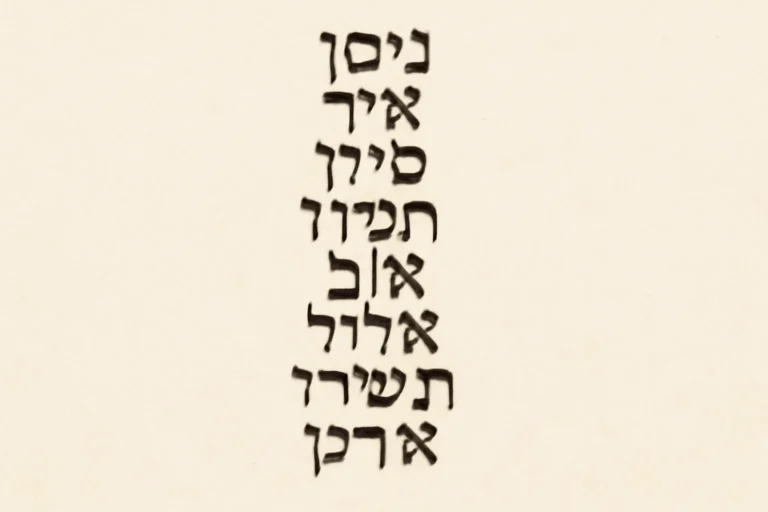
Month name identifies the position within the annual cycle (Nisan, Iyar, Sivan, Tammuz, Av, Elul, Tishrei, Cheshvan, Kislev, Tevet, Shevat, Adar/Adar I/Adar II).
Day of month ranges from 1 to 29 or 30, depending on the month and year length.
Year number identifies the current Hebrew year and is crucial for determining holiday dates and ritual readings that occur on specific calendar years.
Because the Hebrew calendar is not purely fixed to the Gregorian dates, converting a Hebrew date to a Gregorian date (and vice versa) requires a reliable algorithm or a credible lookup table. Modern software, online converters, and smartphone apps implement these rules so that families can plan weddings, religious observances, and travel well in advance.
How the calendar aligns with seasons and daily life
The Jewish calendar’s design reflects a deep intertwining of timekeeping with the rhythms of nature and agriculture. Although the majority of Jewish life today is urban and disconnected from ancient agrarian cycles, the calendar preserves the memory of a land-centered calendar. The months, the leap years, and the timing of holidays ensure that:
Holidays like Passover remain in spring, aligning with harvest time and the symbolism of renewal.
Rosh Hashanah inaugurates a period of reflection that leads into Yom Kippur and Sukkot, creating a fall-focused cluster of sacred time that also aligns with the change of seasons in the northern hemisphere.
Hanukkah, in the depth of winter, offers a pattern of light and resilience during the darkest days of the year.
Purim and the spring festivals emphasize community, memory, and renewal as the year moves toward its agricultural midpoint.
While the modern world uses the Gregorian calendar for civil life, the Hebrew calendar continues to shape religious observances, synagogue calendars, and the timetable of Jewish life. The interplay between sacred time and everyday life is a distinctive feature of this calendar, reinforcing a sense that time is not merely a sequence of dates but a framework for moral, liturgical, and communal meaning.
Common questions about the Hebrew calendar
Many learners ask how the calendar can be learned, used, and interpreted in contemporary life. Here are some common questions and concise answers.
Why does Adar II exist in leap years? It is a solution to keep Passover in spring and to prevent the calendar from drifting out of step with the solar seasons. This extra month ensures that lunar months stay in near alignment with the solar year over long timeframes.
Can holidays shift from year to year? Yes, the exact Gregorian date of Hebrew holidays shifts from year to year, even though their Hebrew-month anchors remain constant (for example, Passover is always in Nisan, Sukkot in Tishrei).
Are there fixed rules that govern the start of the year? Yes. The start of the year is determined by complex rules that take the molad, the day of the week, and the postponement rules into account to ensure appropriate weekdays and festival structure.
How do leap years affect the length of a year? Leap years add an extra month, increasing the total number of days in the year by about 30-31 days, and reshaping how the year’s days are distributed across months.
Variations and variations in naming: semantic breadth of the calendar
In scholarly and lay discussions, you’ll encounter several terms that describe aspects of the same system. Recognizing these variations can help in understanding texts, software, and community practices:
Hebrew calendar vs. Jewish calendar – standard interchangeable terms referring to the same calendar system.
Lunisolar calendar – a technical description emphasizing the calendar’s reliance on lunar months with solar adjustments.
Religious calendar vs. civil calendar – the religious calendar is rooted in ritual observance, while the civil or secular calendar refers to the year count for societal purposes.
Hebrew year vs. Jewish year – both denote the current year in the Hebrew calendar, typically written as 5784, 5785, etc.
Getting started with learning the calendar
If you’re new to the Hebrew calendar, a few practical steps can help you begin using it with confidence:
Consult a reliable Hebrew calendar source or software that implements the calendar rules accurately.
Learn the standard month names and their rough time frames (for example, Nisan in spring, Tishrei in autumn, Kislev around late autumn/winter).
Familiarize yourself with the key holidays and their approximate dates in the Hebrew calendar (see the lists above).
Practice converting a few dates from Hebrew to Gregorian dates using a trusted tool to build familiarity with how the calendar shifts year to year.
With practice, you’ll begin to sense the calendar’s rhythm: a repeating structure that nonetheless reveals subtle variations in length from year to year. The pleasure of this system is not only in planning religious observance but in experiencing time as a framework that links memory, ritual, and community.
Conclusion: a living, enduring timekeeping tradition
The Hebrew calendar stands as a remarkable achievement in timekeeping: a lunisolar system that preserves ritual integrity, seasonal awareness, and long-term predictability. It is a calendar that invites study, but it also offers an intuitive sense of cadence—an annual cycle of seasons, holidays, and life-cycle moments that are woven into daily life. From the rhythm of the Shabbat to the powerful moments of Rosh Hashanah and Yom Kippur, and from the winter glow of Hanukkah to the spring awakening of Passover, this calendar sustains a continuum of time that connects generations, places, and communities.