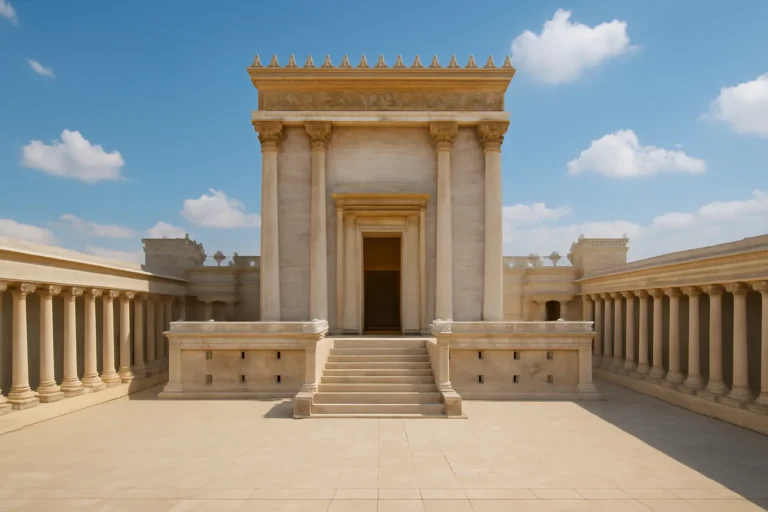
Herod’s Temple in Jerusalem: History, Significance, and Archaeology
Herod’s Temple in Jerusalem, often referred to as the Herodian Temple or the Second Temple sanctuary rebuilt and expanded under Herod the Great, stands as one of the most consequential religious and architectural projects in ancient history. This monumental complex, set on the Temple Mount, operated as the center of Jewish worship for nearly six decades before its destruction by the Romans in 70 CE. The term Herod’s Temple in Jerusalem invites multiple degrees of meaning: it designates the principal sanctuary that housed the divine presence for a broad segment of the Jewish world, while also signaling a unique period of construction, urban renewal, and political symbolism in late antiquity. In this article, we explore its history, its significance for religion and society, and the archaeology that preserves hints of its former grandeur.
Historical context and the project of reconstruction
The story of Herod’s Temple begins in the broader arc of the Second Temple period, a era initiated after the return from exile and the rebuilding of the temple authorized by Cyrus the Great. The earlier structure, often termed the Zerubbabel Temple, stood as a smaller sanctuary that served a growing and increasingly diverse Jewish community in the late Persian and Hellenistic ages. When Herod the Great took the throne of Judea, he inherited a fragile political landscape: client rule under Rome, rival priestly factions, and a deeply rooted sense of sanctity surrounding the Temple precinct. The decision to undertake a sweeping architectural transformation was both a religious statement and a political one. It aimed to legitimize the Hasmonean legacy in a new era while showcasing a grand, publicly financed project that could bind diverse groups to a single sacred space.
The core motive of this rebuilding was to expand and beautify the sanctuary more than to replace it. The plan called for enlarging the entire temple complex, upgrading its approaches and courtyards, and gilding or dressing the exterior with costly materials. The result was not merely a rebuilt building; it was a redesigned urban center that reshaped the skyline of Jerusalem and redefined the relationship between sacred space and political power. The work began in the late 20s BCE and continued into the early first century CE, with different components completed over several decades. The timeline reflects a convergence of religious zeal, architectural ambition, and dynastic prestige, and it helps explain why the temple complex became the most important symbol of Jewish life in the ancient world.
In turning to the broader historical panorama, it is essential to recognize that the temple in this era operated within a framework of ritual practice, city planning, and imperial oversight. The Temple Mount was not only a sacred precinct but also a carefully engineered platform that supported a sprawling complex of courtyards, gates, and annexes. The scale of the undertaking was a statement about continuity and renewal: a rebuilt sanctuary that sought to attract pilgrims from across the Jewish diaspora while reaffirming the central authority of the Jerusalem priesthood, particularly the high priestly family and their allies.
Architectural layout and design principles
What distinguished Herod’s Temple in Jerusalem architecturally was a combination of grandeur, functional complexity, and adherence to ritual requirements. The temple complex is best understood through its layered arrangement of spaces: outer courtyards, processional avenues, and the inner sanctuary where the divine presence was traditionally conceived to reside. The design elements reflected Jewish liturgical needs, Roman political realities, and the mastery of Herodian masonry.
Zones of access and ritual progression
Visitors and worshippers moved through a sequence of graded spaces that regulated access to increasingly sacred zones. The outermost area was the Isaelites’ court, followed by the Court of the Gentiles, which, while expansive, was still a protected, sacred boundary. The next steps included the Court of the Women, the Court of Israel, and the Court of the Priests, culminating in the precinct surrounding the Holy of Holies, the most sacred space within the temple precincts. Each transition embodied a specific set of ritual requirements and constraints that organized the flow of pilgrims during major festival periods.
The external elevations of the temple complex were celebrated for their splendor. Gold plating on interior elements, meticulously carved stones, and a sophisticated use of columns and porticoes gave the complex a radiance that was visible to the city and the surrounding countryside. The Herodian masonry—notably the white, finely dressed stones with impressive margins—still inspires admiration as a hallmark of ancient building technique. A defining characteristic was the platform’s massive retention walls, which created a large podium that supported both the main sanctuary and the expansive courtyards.
The Holy of Holies and liturgical implications
The Holy of Holies, or the Most Holy Place, stood at the heart of the sanctuary. In Jewish tradition, this chamber housed the divine presence and was accessible only to the High Priest on the Day of Atonement, and only once a year. Although direct access to this space is not evidenced by excavations, its conceptual importance permeates all late Second Temple period religious life. The architecture of the temple complex reflected this central idea: the nearer one approached the innermost chamber, the more restricted the rituals, the more elaborate the purification rites, and the more pronounced the sense of mystery surrounding divine presence.
Artifacts and decorative programs
Among the most remarkable features connected to the Jerusalem temple complex were inscriptions, ceremonial implements, and decorative programs that spoke to the breadth of its religious economy. While many interior artifacts have not survived or remain contested in interpretation, the surrounding monuments—friezes, acroteria, and decorative motifs—offer glimpses into the aesthetic vocabulary that defined the Herodian project. The architecture was as much a pedagogical instrument as a liturgical space, teaching the faithful about ritual order, purity laws, and the city’s sacred geography.
Religious significance and liturgical life
The Jerusalem temple was not only a monumental building; it was a living center of worship. The practice of sacrifice, prayer, festival observance, and priestly administration gave the temple its daily rhythm. The introduction of grander facilities under Herod’s renovation aimed to accommodate larger crowds during pilgrimage festivals such as Passover, Shavuot, and Sukkot. The expanded courts and improved approach routes transformed the sanctuaries into a magnet for Jews from the diaspora and local populations alike.
Ritual life and sacrificial cult
The temple complex was the locus of the sacrificial system that defined ancient Israelite worship. The Temple’s sacrificial cult included offerings brought by individuals, community rites conducted by priests, and various ritual services that structured the liturgical calendar. Although the precise inner rites remain a matter of scholarly debate, it is clear that the temple served as the primary locus for atonement, festival observance, and communal identity. The architectural layout supported the choreography of these rites, from purification rituals in the outer precincts to the intense, solemn ceremonies near the Holy of Holies.
Administrative and religious leadership
Political and religious authority within the Jerusalem temple complex rested with the priestly aristocracy, led by the high priest and the governing council known as the Sanhedrin in some periods. The Herodian refurbishment reinforced this centralization, while also creating a public identity for the city as a beacon of religious life in the eastern Mediterranean. The pairing of royal patronage with priestly governance produced a temple that functioned as both a sacred center and a political symbol—one that communicated stability and continuity at a time of regional tension.
Pilgrimage and diaspora connections
For many Jews in the diaspora, the Jerusalem temple complex represented the most tangible link to ancestral worship and covenantal memory. Festivals drawn thousands of pilgrims to the city, a phenomenon that amplified the temple’s economic, social, and religious significance. The public architecture, urban space, and ritual programs collectively reinforced a sense of unity among dispersed communities, even as local factions within Jerusalem debated ritual practices and priestly authority.
Herod’s project is inseparable from the wider political dynamics of the era. The rebuilding and expansion of the temple complex occurred under a regime that balanced cooperation with Rome with demands for local legitimacy and identity. This risk-laden architectural program helped cast the temple as a symbol of Roman-era autonomy in Judea, even as it ultimately stood within a provincial system that was subject to imperial oversight. The temple’s grandeur was thus a double-edged political statement: it proclaimed Jewish continuity and grandeur while acknowledging imperial sovereignty and the need to maintain public order in a volatile city.
Public relations and prestige: The scale and beauty of the project communicated wealth, stability, and devotion to both local residents and visiting pilgrims.
Economic and urban impact: The construction and ongoing maintenance spurred economic activity, labor markets, and the transformation of urban space in Jerusalem.
Religious pluralism and tension: The temple precincts reflected intra-Jewish diversity in priestly families, sects, and ritual preferences, sometimes generating tension within the city’s religious leadership.
Timeline and key events in the life of this sanctuary
The earlier Second Temple stood on the same sacred precinct, established after the return from exile in the late 6th century BCE and expanded in subsequent centuries.
Herod the Great begins a monumental rebuilding around 20–19 BCE, envisioning a renovated sanctuary with more expansive courtyards and adorned façades.
Primary sanctuary improvements and platform expansion progress over the next decades, with various components completed by the early first century CE.
The temple complex remains a focal point of Jewish religious life through the first century CE, attracting pilgrims from across the Mediterranean world.
In 66–70 CE, the Roman campaign culminates in the destruction of the temple and the temple mount complex, leaving behind a profoundly altered urban and religious landscape.
These moments illustrate a long arc: from a modest sanctuary to a monumental Herodian temple complex that stood as a symbol of endurance, authority, and faith, and ultimately to a dramatic turning point in Jewish history when the city and its sacred center were overturned by war and empire.
Archaeology, evidence, and the material record
Because the central sanctuary and most of its inner precincts were built on an already sacred site, direct archaeological access to the interior of Herod’s Temple is limited. The Temple Mount precinct has long been a sensitive area, and modern archaeology has faced significant restrictions. Yet the surrounding material record—from the visible Herodian masonry of the platform walls to subterranean discoveries in adjacent neighborhoods—provides crucial clues about the scope and character of the project.
What the excavations and surveys reveal
Outside the temple proper, archaeologists have uncovered structures and artifacts dating to the late Second Temple period that help illuminate daily life, ritual practices, and urban planning. In the vicinity of the Western Wall and the City of David, researchers have found drainage systems, ritual baths (miqvaot), reused stones with distinctive Herodian cut masonry, and inscriptions that indicate the city’s administrative complexity. While none of these artifacts directly reveal the interior rites of the Holy of Holies, they illuminate the broader sacred landscape around the temple complex.
The Temple Mount remains one of the most contested and studied sites in the modern world. Its archaeology is entangled with religious sensitivities, political realities, and the continuous growth of the city over two millennia. Nevertheless, the research that is possible—surveying platform construction, examining retained earthwork, and interpreting related finds—supports a coherent picture of a vast, multi-layered sanctuary that required meticulous urban engineering and careful ritual design. The evidence points to an ambitious program of enlargement, improved ceremonial routes, and a public-facing aesthetic that reinforced the sanctity of the space.
Important lines of inquiry for scholars
Architectural sequence: separating what is ceremonial from what is administrative, and understanding how each supported the other.
Materials studies: dating and sourcing of stonework, metal elements, and decorative motifs to refine the construction chronology.
Ritual geography: mapping the movement of worshippers through the court systems and how architecture regulated access.
Contextual comparisons: examining similar temple reforms elsewhere in the Hellenistic world to better understand Herodian choices.
In sum, the archaeology of the Herodian sanctuary in Jerusalem gives texture to the historical narrative. While the interior mysteries of the Holy of Holies remain outside the scope of contemporary excavation, the surrounding precincts, the quantitative scale of the platform, and the material culture of the Second Temple period collectively illuminate the magnitude and meaning of this monumental project.
Legacy, memory, and modern relevance
Even after its destruction, the Jerusalem temple complex and its memory continued to shape religious thought, political discourse, and architectural imagination. For Jews, Christians, and scholars, the temple in its Herodian form stands as a touchstone for debates about covenant, divine presence, and the city’s sacred geography. The remaining stones and the enduring association with the Western Wall reflect a continuing tradition of reverence, lament, and memory that has persisted through centuries of upheaval.
Influence on religious liturgy and pilgrimage
Although the temple is no longer standing, its influence persists in liturgical and devotional practices. In Jewish tradition, the longing for a reconstructed temple remains a recurring motif in prayers and rabbinic discussion, especially within historical memory of the festival cycle. In Christian tradition, the temple’s imagery—its architecture, rituals, and symbolism—often informs theological interpretations of Jesus’ relationship to fulfillment of the law and the prophets. The temple’s history continues to inform contemporary debates about sacred space, reverence for place, and the complex relationship between faith communities and urban landscapes.
Conservation, education, and public memory
Modern efforts to teach and preserve the legacy of Herod’s Temple focus on museums, scholarly publications, and carefully curated exhibitions that explain its historical context, architectural innovations, and religious significance. Education programs highlight how this monumental project reflected imperial ambitions, local religious life, and the intense devotion of thousands who engaged with the space across generations. The memory of this sanctuary also raises questions about access, heritage management, and the responsibilities of custodianship when sacred spaces intersect with contemporary political realities.