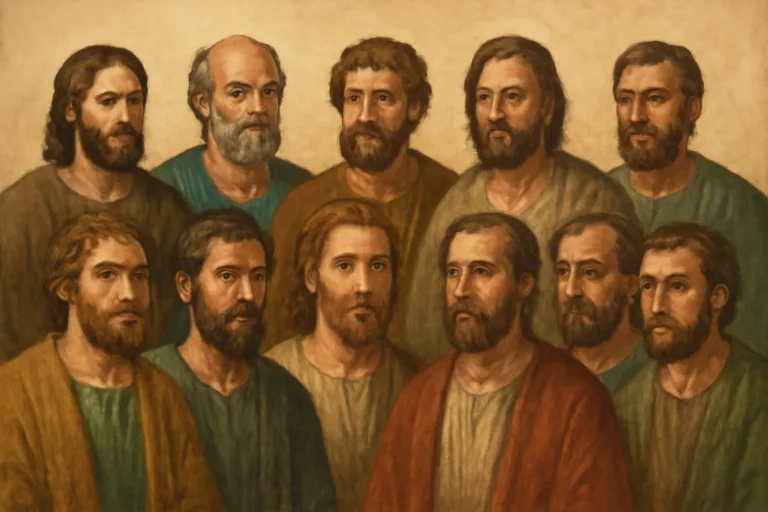
What Were the Apostles’ Real Names? Birth Names and Identities Explained
Names carry meaning and memory. For the apostles, the names by which they are most commonly known in Christian tradition do not always reflect their birth name or the language of their homeland. This article explores what were the apostles’ real names, tracing birth identities, aliases, and how those names traveled through Hebrew, Aramaic, Greek, and Latin texts. We will consider the Twelve, the issue of Matthias replacing Judas Iscariot, and Paul the Apostle’s distinctive naming and role. The aim is to provide a careful, data-driven account of birth names and identity in early Christian sources, while highlighting how scholars handle variations across the Gospel lists and Acts.
What Were the Apostles’ Real Names? Birth Names and Identities Explained
Before turning to the individual names, it helps to note two broad patterns. First, the term apostle in the New Testament often attaches to a role as messenger or witness rather than a fixed family surname. Second, the names we meet in Gospel lists come in several languages—Hebrew/Aramaic for Jewish users, Greek for the Hellenistic milieu, and Latin in later manuscripts. The result is a spectrum of forms for each man that can be confusing if read in isolation. The key is to distinguish birth name (the name a person would have borne in their native language) from the public name or title that later tradition emphasizes.
The Original Twelve: Birth Names and Official Names
The Twelve apostles—the core group commissioned by Jesus—have names that scholars often present in two layers: a birth identity (in Hebrew/Aramaic or their Greek forms) and the later Christian names or nicknames that appear in lists. Below are the most widely accepted renderings, along with notes about variations and the cultural context that shapes them.
Peter: Birth name, aliases, and personal designation
Birth name: Simon (Simeon in some English renderings), a common Jewish given name in the period.
Family/lineage reference: Simon, son of Jona/Jonah or Simon, son of John in some Gospel readings, reflecting the father’s name in different traditions.
Why the variation: The Gospel authors sometimes preserve Aramaic or Hebrew naming practices (son of X) while other times presenting the more general Greek form of the name.
Public name and title: Peter (Petros, a Greek form meaning “rock” or “stone”) and Cephas (an Aramaic term meaning “rock” or “stone”) used by Jesus and early Christian writers.
Significance: The dual emphasis on “rock” in the Christ-event language signals a particular role in church foundations and leadership. The shift from Simon to Peter highlights a transition from a common name to a distinctive mission-based identity.
Andrew: Sibling of Peter with a consistent identity
Birth name: Andrew (Greek Andreas), a name that carries a sense of “manly” or “brave” in Greek contexts.
Relationship: Brother of Peter, which situates him in a famous sibling pair within the earliest Christian circles.
Aliases: There are not common, widely used alternative names for Andrew in the canonical lists, but his role as an apostle is frequently described in association with Peter as a pair.
Identity note: Andrew’s presence in the Gospel narratives is often seen as foundational to the spread of early missionary activity in the northern and coastal regions of the ancient world.
James, son of Zebedee: The Great or the elder among the brothers
Birth name: James (Greek Iakobos), usually paired with his father’s name in various lists to distinguish him from James, son of Alphaeus.
Aliases and epithet: James the Great (to distinguish him from James son of Alphaeus), reflecting a traditional labeling in Latin as Iacobus Maior.
Identity note: His brother John is often mentioned in tandem, and both belong to the inner circle associated with important turning points in the gospel narratives.
John: The beloved disciple and the enduring identity
Birth name: John (Greek Ioannes), from the Hebrew Yohanan, meaning “Yahweh is gracious.”
Aliases: John is also described as “the beloved disciple” in the Gospel of John, a title reflecting his intimate standing within the Johannine tradition.
Identity note: While the public naming is consistently John, the Gospel tradition emphasizes his unique relationship with Jesus and his role in shaping early Christian theology.
Philip: A name with philosophical and geographical reach
Birth name: Philip (Greek Philippos), which can imply “lover of horses” in evaluative etymology, though that sense is more traditional than literal for a person’s life.
Aliases: In most lists, Philip does not carry a well-known alternate form tied to a single nickname; his identity remains primarily as Philip the apostle.
Identity note: Philip’s presence in the Gospel narratives is tied to direct interactions with Jesus that mirror a practical, mission-focused approach to discipleship.
Bartholomew: Nathanael and the family of Bartholomew
Birth name: Nathanael (Hebrew/Nabi-like form Nathanael), meaning “God has given.”
Aliases: The name Bartholomew appears in some lists as a patronymic form: Bartholomew = “son of Talmai/Talmai” (often rendered as Bar-Talmai in Aramaic traditions).
Identity note: The pairing of Nathanael with Bartholomew in early tradition reflects the way local naming could incorporate a family identifier or a patronymic alongside a given name.
Birth name: Thomas (Greek Thomas or Didymus in some sources). The term Didymus is the Greek equivalent of “twin.”
Aliases: The Gospel tradition uses both forms: Thomas and Didymus, sometimes to emphasize his role across linguistic communities.
Identity note: Thomas’s famous doubt narrative and subsequent confessional utterances reflect a cautious but deeply attentive disciple who nevertheless speaks plainly about his faith journey.
Matthew (Levi): A tax collector with a dual name
Birth name: Levi (the Aramaic/Hebrew name often associated with the priestly lineage and Leviite clans).
Public name: Matthew (Greek Maththaios), which the Gospel writers use as a canonical designation for the apostle who authored the Gospel of Matthew in some traditions.
Identity note: The dual naming—Levi and Matthew—highlights the transition from a traditional Jewish identity to a Christian, mission-centered identity that crosses cultural boundaries.
James, son of Alphaeus: The Less and a more obscure lineage
Birth name: James (often referred to as Iacobus in Latin traditions), with the patronymic Alphaeus to distinguish him from James, son of Zebedee.
Aliases: He is commonly called James the Less (Iacobus Minor) to distinguish him from James the Great.
Identity note: Little is explicitly known about his life beyond his inclusion among the Twelve, but his presence underscores the diversity of the group and the range of backgrounds among the earliest followers.
Simon the Zealot: Identity in political and religious terms
Birth name: Simon (often in Greek as Simeon), a common given name in the period.
Aliases: He is frequently described as Simon the Zealot, with the term “Zealot” sometimes interpreted as his political-religious leaning or as a geographic label (some traditions read him as “Simon the Canaanite,” a reference to the land of Cana or to a tribal naming).
Identity note: The precise sense of “Zealot” or “Canaanite” is debated, but both readings emphasize the varied social backgrounds present among the apostles and the range of expectations about Jesus’s movement.
Judas Iscariot: The betrayer with a surname that marks lineage
Birth name: Judas (often transliterated as Judah), a common Jewish given name in the period.
Aliases: Iscariot is a surname-like identifier indicating origin from Kerioth (a town in Judah) or, by some readings, a term related to a region or occupation. The name appears in the Gospel lists as Judas Iscariot.
Identity note: The pairing of “Judas” with “Iscariot” is historically significant because it marks an individual whose path diverged from the rest of the Twelve. The term Iscariot helps readers distinguish him from Judas Thaddaeus or Judas son of James in some textual traditions.
Judas Thaddaeus (the Judas not Iscariot): A name with multiple forms
Birth name: Jude/ Judas (the same root as Judas Iscariot in some lists; in others, “Judas Thaddaeus” is used to distinguish him).
Aliases: Thaddaeus is one form, and in some manuscripts he is also identified as Lebbaeus (a transliteration of a name that may carry a meaning like “beloved” or “heart”).
Identity note: The presence of multiple forms—Judas, Thaddaeus, Lebbaeus—reflects textual variation among early witnesses and the practice of pairing a given name with a patronymic or epithet.
Matthias: The replacement apostle and his identity
Birth name: Matthias carries a Greek form suitable for the broader Mediterranean world.
Role: He is chosen to replace Judas Iscariot after the betrayal, ensuring that the number of the apostles remains twelve.
Identity note: In early Christian tradition and some manuscripts, Matthias is also associated with the name Justus, or with the idea of being identified through a patronymic or community role. The variety in naming here illustrates how early lists sometimes diverged while preserving a core identity.
Paul the Apostle: From Saul to a universal apostolic voice
Birth name: Saul (Hebrew Shaul or Sha’ul), a name deeply rooted in Jewish heritage and meaning often discussed as “asked for” or “prayed for.”
Adopted name in the Greek-Roman world: Paul (Latin Paulus), used across the Mediterranean in his missionary writings and letters.
Identity note: Paul’s role is a key example of how a single individual could become a pivotal “apostle” of the Gentiles without being one of the original Twelve. His conversion narratives and travels are foundational for Christian theology and practice in the late first century.
Why Do Apostles Have Multiple Names? Etymology, Language, and Tradition
The variations in the apostles’ names arise from several interlocking factors. First, many of the Twelve lived in a multilingual world where Hebrew/Aramaic, Greek, and Latin forms all circulated. Second, the Gospel writers and early translators often switched between birth names and habits of address, sometimes using a formal name and sometimes a nickname or descriptor that reflected a person’s role or origin. Third, some lists preserve different traditions about who belonged to the Twelve, leading to overlap and discrepancies in the names used. Together, these features illustrate how birth identities and public names traveled through communities that spoke different languages and worshipped in varying settings.
Birth names (often Hebrew/Aramaic in origin) provide the historical-cultural anchor for each apostle’s life in first-century Palestine/ Galilee.
Greek forms (for many names) reveal how the early church communicated with a Hellenistic world and how translators rendered those names into the common language of the day.
Nicknames and descriptors like Cephas, the Great, or the Lesser show how communities used a second layer of identity to distinguish people who shared common given names.
Origin-based surnames such as Iscariot (from Kerioth) or the Zealot broadcast something about place, politics, or affiliation that mattered to early readers.
Birth Names, Identity, and the Canonical Lists
One of the most interesting features of this topic is how canonical lists—the Gospel accounts and the Acts of the Apostles—present the apostles in slightly different ways. Some lists name certain individuals in one order and add or omit others in another. Some traditions pair a birth name with a surname, while others emphasize a particular character trait or a regional origin. A careful reading reveals that the core dozen individuals are consistently recognized, but the surface forms of their names vary. This reality helps biblical scholars understand why some modern translations present multiple variants for certain apostles’ names.
Judas Iscariot is consistently named in association with the act of betrayal in the narrative arc, making his surname a marker of origin or identity that readers use to distinguish him.
Thomas, as a twin (Didymus in Greek), shows how linguistic layers carry a natural descriptor into the public memory of a person’s identity.
Bartholomew and Nathanael demonstrate how two different names for the same person can coexist in early Christian communities—one a patronymic, one a given name tied to a providential attribute.
Levi and Matthew illustrate a common Old Testament-type dual naming pattern: a birth name tied to Jewish identity and a later, mission-oriented name used in the broader church context.
Matthias: The Replacement Apostle and the Shaping of the Twelve
The appointment of Matthias to replace Judas Iscariot is a notable moment in the apostolic narrative. It demonstrates how the early Christian community sought to preserve the number twelve—a symbolic figure with deep resonance in Jewish tradition and early Christian identity. In some manuscripts, Matthias is associated with alternative forms like Justus, underscoring the diversity of early naming practices and how different Christian communities preserved different traditions about the same figure. This episode helps explain why later readers encounter multiple names for a single apostle in some traditions.
Paul the Apostle: The Case of a Non‑Twelve Apostle with a Mission‑Driven Name
Paul is a useful case study for understanding how naming and identity function in the broader Christian world. While not one of the original Twelve, Paul is often counted among the authoritative apostles in tradition because of his decisive missionary work and his own self-designation as an apostle in his letters. He represents a bridge between birth identity rooted in his Jewish upbringing and mission identity shaped by his calling to the Gentiles. The shift from Saul to Paul marks not a mere linguistic change but a transformation in vocation, geography, and audience. This is one of the strongest examples in early Christian history of how a person’s name can symbolize a comprehensive reformulation of purpose and community.
How to Read the Names Today: Practical Tips for Students and Readers
For readers seeking to understand who the apostles were and how their names function in the texts, here are some practical guidelines. These pointers help map birth names to traditional identifiers and to the roles these figures played in the formation of early Christian communities.
Start with the core twelve: Identify the twelve as Peter, Andrew, James (son of Zebedee), John, Philip, Bartholomew, Thomas, Matthew, James (son of Alphaeus), Simon the Zealot, Judas Iscariot, and Thaddaeus (also called Judas not Iscariot or Lebbaeus in some traditions).
Note replacement names: Matthias replaced Judas Iscariot; this is a key juncture in the narrative and explains why some lists include Matthias while others do not.
Remember Paul’s special case: Paul is widely recognized as an apostle in practice, but he was not part of the original Twelve. His birth name, Saul, and his subsequent name Paul reflect both ethnicity and a trans-cultural mission field.
Pay attention to language transitions: Names move between Hebrew/Aramaic, Greek, and Latin forms. A given name like Simon may appear as Shimon, Simeon, or Simon depending on the source language and tradition.
Distinguish epithet from birthplace: Epithets such as the Zealot, the Great, or geographic marks like Iscariot (from Kerioth) help readers identify which individual is meant in a given text.
Summing Up: The Real Names Behind the Apostles’ Identities
The question “What were the apostles’ real names?” invites a layered answer. It is not only a matter of one birth name per person but of how those names migrated across languages, how epithets and patronymics operated in early communities, and how apostolic identity evolved over time. The Twelve—Peter, Andrew, James the Greater, John, Philip, Bartholomew, Thomas, Matthew, James the Less, Simon the Zealot, Judas Iscariot, and Thaddaeus—each carry a set of forms that reflect their Jewish roots, their roles within Jesus’s ministry, and the ways later Christians remembered them. Matthias’s addition and Paul’s rise as a missionary apostle further illustrate the fluidity and complexity of naming in early Christianity.
For readers, the main takeaway is that birth names anchor these figures in their native cultural frames, while later names and epithets connect them to the evolving identity of the Christian movement. The study of their names is more than trivia; it illuminates how early communities understood authority, lineage, and spiritual vocation. When you encounter lists of the apostles in a Bible or a scholarly work, you are seeing layers of history embedded in language—layers that tell a story about language, geography, culture, and faith.
As you continue exploring biblical names, you’ll encounter many of the same patterns: the coexistence of a birth identity with a mission-oriented name, the snappy clarity of epithet-based labels used by early communities, and the way multilingual contexts shape how a single person can be known in multiple ways. The project of reconstructing birth names and identities for the apostles is ongoing, but the core picture remains stable: a circle of twelve, a few name shifts, and the emergence of an apostolic movement that would span centuries and continents.