Revelation Timeline: A Comprehensive Guide to Prophecy Chronology
The revelation timeline is a map for understanding how prophetic events are traditionally arranged in many religious and scholarly traditions. This article offers a structured exploration of the major milestones, sequences, and interpretive frameworks that shape the study of prophecy chronology across different eras and cultures. By tracing the arc of the prophetic narrative, readers can gain clarity about how ideas of time, sequence, and symbolism interact in the most discussed collection of sacred literature.
A working grasp of the eschatological timeline starts with recognizing that most readers approach revelation chronology as a multi-layered scaffold. At its core, the timeline attempts to answer questions such as: When do major signs occur? How do overlapping visions relate to one another? What is the order of events that lead to ultimate restoration? Even within diverse interpretive traditions, many scholars agree on the value of a chronological frame to organize the imagery of catastrophe, judgment, rescue, and renewal.
Instead of treating the apocalyptic sequence as a string of isolated pictures, practitioners often see it as a narrative with progressive tension. The revelation timeline emphasizes cause and effect, cause-and-effect relationships between divine acts and human responses, and the way hope emerges through trial. In this sense, the study of chronology is not merely about predicting dates but about clarifying what the images signify within a larger spiritual drama.
Core Components of Prophecy Chronology
The structure of the prophetic timetable is usually parsed through a few recurring units. These units appear in various orders depending on the interpretive approach, but most frameworks agree on certain recurring themes: revelation through visions, symbolic judgments, cosmic struggles, and the climactic triumph of good over evil.
The Book of Revelation as a Narrative Timetable
The final book of a major canon is frequently treated as a coded itinerary. The chronology of revelation is less about precise dates and more about a logical progression from unveiling to fulfillment. Key motifs recur in what many call a prophetic ladder: from seals to trumpets to bowls, the progression intensifies, and each stage amplifies the stakes faced by the world.
Seven Seals: A sequence that initiates visible events in the natural and spiritual realms, often interpreted as representing increasing human rebellion and divine response.
Seven Trumpets: A set of judgments that intensify the disruption and demonstrate divine sovereignty in history and cosmos.
Seven Bowls (or Vials):
The cosmic dragon and the Beast: The forces arrayed against righteousness, representing spiritual and political power opposing divine purposes.
The Lamb and the Bride: The counterpoint to judgment, focusing on salvation, communal worship, and the ultimate reconciliation of creation.
In addition to these primary segments, the timeline often includes interludes that provide interpretive lenses, such as perspectives on the Dragon’s deception, the witness messengers, and the call to perseverance. These interludes help readers keep the broader arc in view even as the narrative moves through intense scenes of judgment and deliverance.
Interpreting the Structure: Approaches to the Revelation Timeline
Since readers come from different theological backgrounds, several dominant schools have proposed ways to interpret the end-times chronology. Each approach offers a set of tools for reading the imagery, recognizing patterns, and connecting the prophetic timeline to history and contemporary events.
Futurist, Historicist, Preterist, and Idealist Perspectives
These four interpretive lenses illuminate how scholars describe the sequence of prophetic events:
Futurist readings tend to locate the primary fulfillment of prophetic signs in the future, especially when concerning the end-time events. The revelation timeline, from this view, unfolds as a near-future sequence involving the Tribulation, the Antichrist, and the Second Coming.
Historicist approaches map the symbolic events onto a broad sweep of church history. The chronology becomes an ongoing drama that unfolds across centuries, with different eras embodying parts of the prophetic narrative.
Preterist readings emphasize that most events described have already occurred in the first century or in ancient contexts. The revelation timeline, in this sense, decodes the book to reveal historical fulfillments rather than future predictions.
Idealist (or symbolic) interpretations treat the chronology as timeless archetypes, illustrating enduring spiritual principles rather than specific dates. The focus is on ongoing spiritual conflicts and eventual cosmic renewal rather than on a fixed historical timetable.
Each approach speaks to different audiences and priorities. For some readers, a narrow, tightly dated sequence is compelling; for others, a broad, symbol-rich map that illuminates moral and spiritual lessons is more important. The study of the prophecy chronology often borrows tools from literary analysis, historical context, and systematic theology to navigate these divergent perspectives.
Key Sequences: From Seals to Creation of a New Creation
An accessible way to engage with the revelation timeline is to walk through its major segments and observe how they build toward a climactic outcome. Here is a structured outline that many scholars recognize, along with notes on how different traditions may situate each phase within the overall drama.
The Seals: Opening the Scroll of Destiny
The opening of the Scroll and the subsequent opening of the seven seals set the stage for a cascading sequence. Each seal often corresponds to a distinct judgment, challenge, or sign. While some readers see a linear march, others detect overlapping concerns—political upheaval, natural disasters, moral decay, and renewed calls to repentance.
The first seal introduces anticipation and calls for spiritual readiness.
The second and third seals often emphasize conflict and scarcity, highlighting how human affairs escalate under pressure.
The fourth seal reflects a broader scope—a global perspective on judgment and consequence.
The fifth through seventh seals deepen the sense of cosmic drama and divine sovereignty, culminating in the eventual unfolding of the remaining visions.
The Trumpets: Warnings and Witnesses
The seven trumpets widen the lens from personal and local concerns to planetary and cosmic dimensions. Each trumpet announces a new act of divine judgment that affects both the land and its peoples. The trumpet cycle is frequently read as a sequence that tests endurance, calls for repentance, and reveals the limits of human power when faced with the divine purpose.
First trumpet: ecological disturbances and disruptions that affect land and people.
Second and third trumpets: seas and rivers suffer, affecting commerce, travel, and lifeways.
Fourth trumpet: celestial phenomena that illuminate the cosmic dimension of the drama.
Subsequent trumpets intensify the effects, often seen as accelerating the pace toward ultimate confrontation with evil.
The bowls (or vials) represent the most acute judgments, poured out with a focus on finality and purification. Interpreters who emphasize the intensification of judgments often view this phase as preparing the world for a decisive victory by the forces of good and the establishment of a new order.
Bowl judgments intensify the afflictions already present in the prior sequences.
The culmination of bowls leads to the downfall of the great adversary and a transition toward restoration.
Ritual and cosmic order are ultimately restored when the Lamb’s victory is realized.
The Dragon, the Beast, and the False Prophet: Cosmic Conflict
A core element of the end-times sequence is the portrayal of spiritual resistance in human and cosmic dimensions. The Dragon, the Beast, and the False Prophet symbolize opposing forces arrayed against divine purposes. The narrative emphasizes allegiance, perseverance, and ultimate deliverance, showing that true power is found in fidelity to the divine plan.
The Millennium and the New Creation
Many readers turn to the climactic portion of the prophecy to explore how humanity is transformed and how justice is realized. Debates about the length and nature of the millennial reign—whether literal or symbolic—shape how one interprets the timeline from the middle to the end. The sequence commonly concludes with the Final Judgment, the defeat of evil, and the creation of a new heaven and a new earth.
The Role of Symbols and Numbers in Dating and Ordering
A distinctive feature of the apocalyptic timetable is the heavy use of symbols and numerical patterns. Numbers such as seven, twelve, and 666 are more than numerological curiosities; they function as literary devices that invite readers to recognize patterns, themes, and correspondences across different parts of the narrative.
Interpreters stress that symbolic language is often provisional, inviting readers to interpret in light of the broader biblical story. Some scholars emphasize symbolic universality—the idea that the numbers point to enduring spiritual realities rather than fixed dates. Others explore historical numerology, attempting to link numbers to historical reigns, calendars, or political periods. Either way, numbers serve to organize the chronology of revelation in ways that extend beyond literal predictions.
The Relationship Between Daniel and Revelation
The intersection of prophecy and chronology is enriched by comparing related prophetic streams. The Book of Daniel has many overlaps with the imagery in Revelation, including beasts, kingdoms, and an ultimate conflict between oppressive powers and the becoming of God’s eternal kingdom. Scholars often study these texts side by side to discern how the end-time chronology develops across different literary genres and historical contexts.
How Scholars Use Chronology to Interpret Current Events
Because the revelation timeline is a dynamic framework rather than a fixed timetable, interpreters often apply it to current conditions with care. The goal is not to sensationalize but to illuminate how enduring patterns—oppression, persecution, spiritual warfare, and restoration—appear in contemporary life. Some readers translate the major segments of the chronology into current events, while others stress the timeless moral and theological lessons embedded in the sequence.
In this process, the term prophetic timetable is used to describe how present-day observers might understand signs, warnings, and opportunities for repentance. The emphasis tends to be on discernment, ethical action, and hopeful anticipation rather than on speculative prognosis. The revelation timeline thus functions as a lens for interpreting history’s pressures and for affirming resilience within communities that seek justice and mercy.
Practical Study Tools: Timelines, Charts, and Fact Sheets
Engaging with the chronology of prophecy benefits from concrete study tools. Below are practical methods that readers and students can adopt to build a coherent understanding of the end-times sequence.
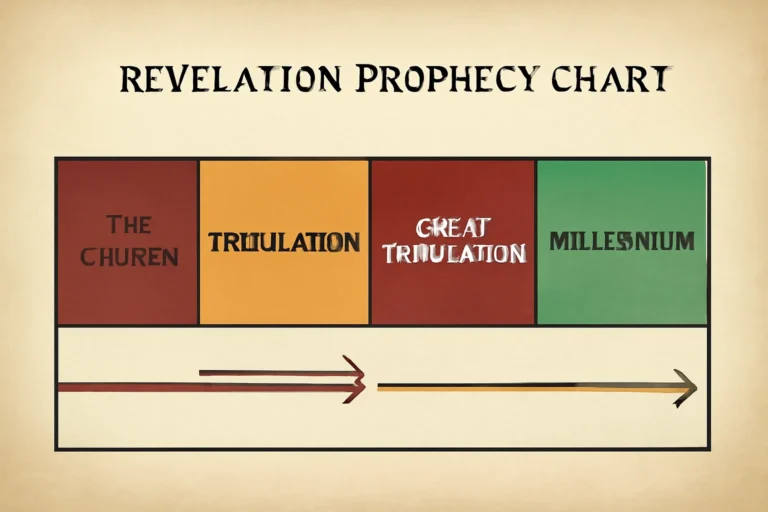
Timelines and Gantt-style charts: Visual displays that place major events along a horizontal axis, indicating approximate order and interdependence. Some charts include parallel tracks to show symbolic vs. literal readings.
Event cards: Condense each major stage (seals, trumpets, bowls, etc.) into a card with key features, expected outcomes, and common interpretive notes. This aids memorization and cross-referencing.
Cross-references: Create links between Revelation passages and related verses from Daniel, Ezekiel, and other prophetic books to highlight thematic connections and shared imagery.
Glossaries: Compile terms such as Armageddon, Tribulation, Millennium, and New Jerusalem, noting their various meanings across schools of thought.
Study questions: Develop questions that probe the moral and theological implications of each stage, rather than focusing solely on chronology.
Practical study encourages flexibility. A healthy approach acknowledges the diversity of interpretation while maintaining a coherent framework for the prophecy chronology. Timelines can be adjusted as new insights emerge, yet the core expectation remains: to illuminate how the narrative guides believers through trials toward ultimate restoration.
Common Misunderstandings and How to Avoid Them
The study of the end-time narrative is frequently fertile ground for misunderstanding. Here are frequent missteps and suggestions for clearer comprehension:
Assuming a single, fixed date for all events. Reality: many readers emphasize symbolic timeframes or a multi-layered fulfillment that unfolds across generations.
Treating every vision as a literal forecast. Reality: symbolic imagery often conveys spiritual truths more than precise schedules.
Conflating political events with prophetic signs without context. Reality: historical interpretation requires careful attention to literary genre and historical circumstance.
Overemphasizing sensational readings. Reality: the scholarly aim is to explore the structure and meaning of the timeline, not to sensationalize it.
Awareness of these patterns helps maintain a balanced approach to revelation chronology, ensuring that study remains thoughtful, historically informed, and theologically responsible.
Future Outlook: The Ongoing Relevance of the End-Time Timeline
Even as interpreters debate the exact sequencing and the degree of futurist or historicist fulfillment, the broader purpose of the eschatological timeline remains clear: to encourage vigilance, ethical living, and faithful endurance. The revelation timeline invites communities to reflect on suffering, justice, mercy, and hope. It emphasizes that history is not meaningless and that divine sovereignty remains the ultimate reference point for human affairs.
For scholars, pastors, and lay readers alike, the study of the chronology of revelation offers a disciplined way to engage with complex imagery. The aim is not merely to predict the future but to interpret how the prophetic message speaks to present concerns while remaining faithful to the integrity of the text.
Glossary of Key Terms
To help readers navigate the vocabulary of this field, here is a concise glossary of frequently used terms related to the revelation timeline.
Revelation timeline: The ordered sequence of visions and judgments described in the biblical book of Revelation, often treated as a map of end-time events and divine purposes.
Prophecy chronology: A general term for the study of how prophetic material is arranged in time, including symbolic and historical readings.
Eschatology: The branch of theology dealing with the end times and ultimate destiny of humanity and creation.
Apocalyptic imagery: Symbolic language and symbols used to convey cosmic conflict, divine judgments, and redemption.
Millennium: A debated term referring to a future or symbolic thousand-year reign mentioned in Revelation 20.
Armageddon: A prophetic name for a final battle or climactic confrontation between good and evil within the prophetic framework.
Closing Reflections: How to Engage with the Revelation Timeline Thoughtfully
The study of prophecy chronology invites readers to approach the literature with curiosity, humility, and a willingness to engage deep questions about meaning, justice, and hope. By examining how the revelation timeline is constructed, readers gain a better appreciation for both the text’s literary artistry and its moral vision. The narrative’s ultimate goal is not merely to forecast, but to fortify faith, nurture perseverance, and illuminate a path toward a renewed world where peace and righteousness prevail.
Whether you approach this topic as a scholar, a student of theology, or a curious reader, consider building your own compact study plan. Start with a clearly defined scope, identify your preferred interpretive framework, map the major segments, and test your understanding against cross-references in Daniel, Ezekiel, and the Gospel narratives. In doing so, you engage in a constructive practice that respects the richness of the tradition while also fostering personal and communal growth.