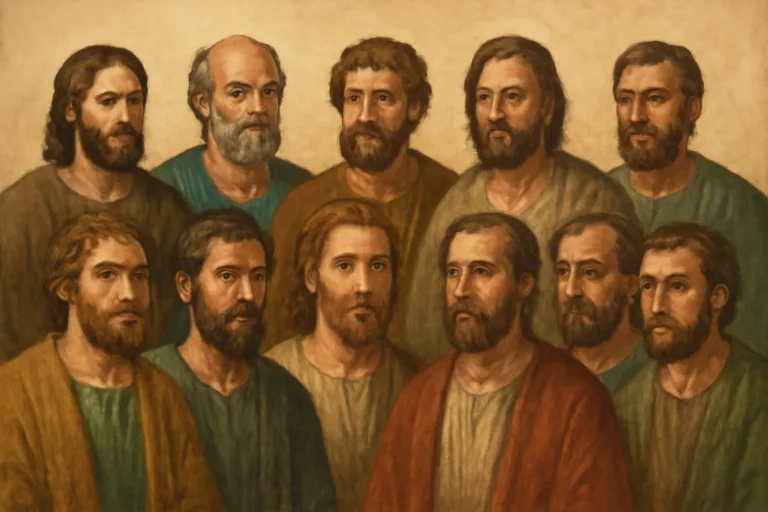
What Were the Occupations of the Twelve Disciples? A Comprehensive Biblical Analysis
The question of what were the occupations of the twelve disciples invites more than a simple inventory. In the Gospel narratives, the twelve are introduced not only as followers of Jesus but as people whose everyday livelihoods intersect with a transformative calling. Some of the disciples are named with explicit trades, while others are described more by their role in the narrative than by their craft. This article surveys the biblical data, distinguishes explicit professions from uncertain ones, and considers what these backgrounds reveal about the mission Jesus entrusted to his apostles. The study also places their vocational diversity in a broader theological and social context, showing how the call to be a disciple redefines ordinary work into a shared mission.
To grasp the scope of the question, it helps to think in terms of two major strands: the trades that are clearly identified in Scripture, and the occupations that remain unnamed in the biblical texts but are inferred from context, early Christian tradition, or plausible historical scenarios. In both cases, the reframing of work becomes part of the larger narrative about discipleship, leadership, and the way Jesus chose a diverse group to fulfill a common purpose. Below, you will find a structured examination that mixes textual references, historical background, and thematic observations about how the occupations of the twelve inform their witness and their ministry.
Explicitly Identified Occupations: The Fishermen and the Tax Collector
Among the twelve, several are named with a specific trade that anchors their identity in the social and economic world of first-century Galilee. The Gospel writers emphasize these occupations to ground the disciples in real life before they are commissioned to spiritual work. The following entries summarize the explicit identifications and the verses that connect each name to a trade.
Simon Peter — fisherman. Peter is repeatedly described as a fisherman from Galilee, and his profession is integral to the call narrative in which Jesus invites him to leave the nets and become a “fisher of men” (e.g., Matthew 4:18-19, Luke 5:1-11). The fishing boat and nets are central images in the early chapters of the Gospel, representing an everyday livelihood that becomes the platform for a radical vocation. Peter’s leadership role among the apostles is inseparable from his roots as a working fisherman and from the intimate knowledge of the Sea of Galilee that his earlier life provides.
Andrew — fisherman. Andrew, Simon Peter’s brother, is likewise identified through his family connection to the fishing economy of Bethsaida and Capernaum. In the Gospel of John, Andrew’s early encounters with Jesus culminate in his bringing others to Jesus, notably Peter (John 1:40-42). This kinship in occupation reinforces the sense that the twelve came from similar circles of common labor, even as they were called to a new kind of work—ministry and mission.
James, son of Zebedee — fisherman. James, the elder son of Zebedee, shares the family trade that his brother John also shares. In the Synoptic Gospels, James is part of the group working on boats and nets, and together with John, he becomes part of Jesus’ inner circle. The fidelity and boldness of James become evident later in the narrative, but the fishing backdrop is a consistent feature of his origin story.
John, son of Zebedee — fisherman. John’s identity as a fisherman is linked with his brother James and their family business. John is often described as the “beloved disciple,” yet his early context is still grounded in the ordinary economy of fishing. His later role as a key preacher and writer in the Johannine community grows out of that foundational experience.
Matthew (Levi) — tax collector. Matthew’s occupation as a publican situates him in the finance and administration of Roman-occupied Judea. His conversion is immediately contextualized by a dramatic social reversal: a tax collector who follows Jesus becomes a witness to the Kingdom. The gospel account explicitly notes Matthew’s calling at the tax booth (e.g., Matthew 9:9). This trade carries a charged social stigma in Jewish society, making Matthew’s decision to follow Jesus a striking element of the narrative about Jesus welcoming outsiders and transforming social boundaries.
Philip — occupation not explicitly stated. In the biblical texts, Philip is introduced as a follower and later as a member of the Twelve; however, the canonical narratives do not record a specific trade for him. Some later traditions attempt to fill in gaps, but in the primary sources, Philip’s occupation remains undefined or unnamed, making him one of the figures whose vocational backdrop is not documented in the Scriptures.
Bartholomew (Nathanael) — occupation not explicitly stated. Bartholomew, identified with Nathanael in John’s Gospel, is not given a clear trade in the canonical texts. While Nathanael’s surname or origin is sometimes discussed in patristic writings and later traditions, the Bible itself does not specify a craft or profession for him. He stands as one among several apostles whose vocational background is not part of the explicit narrative.
Thomas — occupation not explicitly stated. Thomas becomes notable for his “Doubting Thomas” episode, but the texts do not record a particular trade for him either. He appears in the Gospel lists as a disciple, yet his professional background remains unrecorded in canonical Scripture.
James, son of Alphaeus — occupation not explicitly stated. Also called James the Less, this disciple is part of the Twelve with minimal additional background in the Gospels. The absence of a stated trade means that his vocational history is not laid out in the biblical record.
Simon the Zealot — occupation not explicitly stated. Simon’s designation as a Zealot suggests a political or ideological association, but the text does not provide a clear occupational description. The term “Zealot” is often interpreted as indicating a political leaning rather than a precise craft, which places Simon in a different category of background than the fishermen and Matthew the tax collector.
Judas Iscariot — treasurer and moneyhandler. Judas Iscariot is described as the keeper of the money bag among the Twelve, indicating a role in finances and stewardship within Jesus’ circle (e.g., John 12:6). His eventual betrayal of Jesus complicates the portrait of his life and vocation, but the text clearly identifies him as the one who managed the funds.
Judas, son of James (Jude, Thaddaeus) — occupation not explicitly stated. In the lists that include Judas Thaddaeus (also called Jude), the biblical material does not record a specific craft for him. Like several of the other apostles, his exact trade remains undisclosed in the canonical narratives.
In sum, the four disciples with clearly identified trades are the four fishermen—Peter, Andrew, James, and John—and Matthew the tax collector. The rest—Philip, Bartholomew/Nathanael, Thomas, James the Less, Simon the Zealot, Judas Iscariot, and Judas Thaddaeus—are not given explicit occupations in the four Gospels. This divergence invites a careful look at what the tradition surrounding these figures can teach about the nature of discipleship and the scope of Jesus’ mission.
Disciples with Unspecified Trades: Tradition, Context, and Possibilities
When Scripture does not name a concrete occupation for a given apostle, scholars and readers often turn to early Christian tradition, cultural context, and the general social setting of first-century Palestine to infer plausible backgrounds. It is important, however, to distinguish clearly between what the text states and what plausible inference might suggest. The following subsections summarize the positions most often discussed by scholars, while keeping explicit biblical claims separate from later traditions.
Philip: A Followership Without a Stated Occupation
In the Gospel records, Philip is introduced as a disciple who speaks and acts within the narrative of Jesus’ ministry but without a recorded trade. Some readers and commentators have suggested that Philip, like several other disciples, may have been a craftsman, merchant, or other common laborer. Nevertheless, there is no definitive biblical evidence that names Philip’s occupation. The absence of a stated craft does not diminish his role as a trusted member of the Twelve; it simply reflects the text’s focus on his witness and his interactions with Jesus and other disciples.
Bartholomew/Nathanael: A Figure Grounded More in Identity than Craft
Nathanael, identified with Bartholomew in the synoptic lists, appears in the Gospel of John as a seeker who acknowledges Jesus’ identity when Jesus speaks of seeing him under the fig tree. The canonical record does not supply a trade for Bartholomew/Nathanael. In some later Christian tradition, Bartholomew has been linked with various trades or missionary roles, but these connections are not present in the core Gospel texts. As such, Bartholomew’s occupation remains one of the biblical figures whose vocational background is not documented in the Scriptures themselves.
Thomas, James the Less, Simon the Zealot, and Judas Thaddaeus: Unspecified Occupations in the Texts
Thomas is famous for his doubt, James the Less is known primarily by distinction from James the son of Zebedee, and Simon the Zealot is named for a political designation that may indicate allegiance or ideology more than a craft. Judas Thaddaeus, often identified with Jude, also lacks a stated line of work in the New Testament. For all of these, the lack of explicit vocational data invites careful distinction between what the text says and what later tradition asserts. When approaching their backgrounds, readers should foreground the biblical record while remaining aware of the broader historical setting of first-century Galilee and Judea.
The Call to Discipleship and the Transformation of Work
Beyond cataloging trades, the occupations of the Twelve illuminate a central theme of the Gospel: the invitation to leave one’s ordinary way of life behind in order to join a divine mission. This is most vividly seen in the call narratives that accompany several of the fishermen and the tax collector. Jesus’ invitation often frames work as a path to a higher vocation—one that serves the purposes of the Kingdom rather than purely personal or economic ends. The phrase “I will make you fishers of men” (most notably in Matthew 4:19) functions as a theological hinge: the fishermen’s nets become a symbol of outreach and evangelism, while Matthew’s tax booth becomes a place of moral and spiritual reorientation. In this sense, the occupations themselves are not merely background details; they are integral to the narrative arc of each apostle’s transformation.
The call stories also reflect a broader message about accessibility: Jesus did not choose only the educated, the powerful, or the religious elite. He invited ordinary laborers, merchants, and even politically affiliated individuals into a shared mission. This social plurality reinforces the early Christian claim that the Kingdom of God breaks across expected boundaries, reclaiming everyday work for divine purposes. The Gospel writers emphasize this by placing the Twelve in scenes that juxtapose ordinary labor with extraordinary vocation, making the disciples’ occupations part of their witness rather than mere identifiers.
The Theological and Social Significance of their Occupations
Examining the occupations of the Twelve also yields insights into the social world of early Christians and how that world approached the figure of Jesus. Several themes emerge from a careful reading of the texts and their traditional interpretive history:
Economics and credibility: The presence of fishermen and a tax collector among the Twelve anchors the movement in the real economy of Galilee. It signals that Jesus called people who managed livelihoods and interacted with the broader Roman economy. This grounding helps early readers see discipleship as compatible with ordinary life rather than opposed to it.
Social boundaries and inclusion: Matthew’s role as a tax collector juxtaposes a marginalized social position with Jesus’ inclusive call. By incorporating a publican into the circle of Jesus’ closest followers, the narrative communicates a radical redefinition of community and loyalty.
Gendered and regional contexts: The fishermen from the shores of Galilee reflect a regional identity and a certain social status. The varied backgrounds of the Twelve suggest a deliberate cross-section of Jewish and Galilean society, highlighting the message that the gospel is not limited to a single class or vocation.
Mission as redefinition of work: The transformation of “nets” into “nets of men” introduces a missionary dimension to work. The disciples’ professional identities become instruments of spiritual labor, illustrating how faithful work can integrate with divine purposes when guided by Christ’s call.
Understanding the apostolic occupations, or the lack thereof, has practical value for readers today. It helps in a few concrete ways:
Contextualizing the call: Recognizing the fishermen’s background makes the call to discipleship more accessible and credible, showing that Jesus approached people where they were—physically and socially—and invited them into a new kind of labor for God’s Kingdom.
Interpreting the mission: The tax collector’s inclusion clarifies that the mission is not purely spiritual or ethereal; it intersects with public life, governance, and economic systems. This broadens the scope of what “ministry” entails in the early church and in contemporary contexts.
Dialoguing with tradition: The disjunction between explicit biblical data and later tradition invites readers to weigh sources carefully, distinguishing what is stated in the Scriptures from what is inferred by later writers or by cultural memory. This exercise in discernment is itself a valuable practice for readers interpreting any ancient text.
The following compact guide offers a snapshot of the twelve, highlighting the clearly stated trades and marking the others as unspecified in the canonical texts. For scholars and curious readers, the list provides a ready reference to the main emphases found in the Gospel narratives.
Peter (Simon Peter) — fisherman (Bethsaida/Capernaum region); call and leadership in the Gospels; key phrases: “I will make you fishers of men.”
Andrew — fisherman; brings Peter to Jesus; early disciple with a role in witness and outreach.
James, son of Zebedee — fisherman; part of the inner circle; dies as a martyr in tradition (not stated in the Gospels themselves).
John, son of Zebedee — fisherman; the “beloved disciple”; prolific author within the New Testament tradition.
Matthew — tax collector; Gospel writer; example of social reversal and inclusion.
Philip — occupation not explicitly stated.
Bartholomew (Nathanael) — occupation not explicitly stated.
Thomas — occupation not explicitly stated.
James, son of Alphaeus — occupation not explicitly stated.
Simon the Zealot — occupation not explicitly stated.
Judas Iscariot — treasurer; keeper of the money; accuser and betrayer in the Passion narratives.
Judas, son of James (Jude/Thaddaeus)
Beyond discrete facts about occupations, the broader pattern contributes to how readers understand the commissioning of the Twelve. The diverse background of the Apostles—ranging from skilled tradespeople to those whose trades are unnamed—mirrors the inclusive scope of Jesus’ message. It also foreshadows the missionary outreach that would textually emerge in the book of Acts, where people from various socioeconomic backgrounds hear the same call to repentance and faith. The fishermen’s first-hand knowledge of water, boats, and the rhythms of a coastal economy metaphorically prefigures the apostles’ later vocation to “cast nets” of proclamation across nations. The tax collector’s presence signals the church’s rising engagement with governance, institutions, and economic life in the broader Greco-Roman world. Taken together, the occupations (and their lack in some cases) illustrate a deliberate strategy: Jesus invites ordinary people to join an extraordinary project, and in doing so, he reframes daily work as a sphere for divine collaboration.
For readers studying the occupations of the Twelve, the core message remains consistent: the call to discipleship is not anchored in a single credential or pedigree. Instead, the diversity of backgrounds functions as a theological statement about accessibility, inclusion, and the universal reach of the Gospel. The early church took this message to heart by forming a leadership core that cut across economic and social lines. As a result, the Twelve became a symbolic microcosm of the Christian mission: ministry is not reserved for a select class but entrusted to a community composed of differing experiences, acknowledged strengths, and even unresolved questions about what people did for a living before they met Jesus.
In the end, the question “what were the occupations of the twelve disciples?” yields a nuanced answer. Some disciples clearly practiced fishing or taxation, while others enter the narrative without a stated craft. The significance lies not in enumerating trades alone but in recognizing how Jesus treated ordinary life as the arena for extraordinary purpose. The occupations—whether explicit, inferred, or undeclared—help readers appreciate the breadth and depth of the apostolic witness and invite modern readers to consider how their own work might participate in a higher vocation within the story of faith.
As you reflect on these biblical portraits, consider how your own profession or daily activity—like nets, boats, ledgers, or other work—could be a setting for a deeper engagement with meaning, service, and the mission of following Christ. The apostles’ vocational diversity offers a timeless reminder: God often works through the ordinary, to accomplish the extraordinary, for the sake of proclamation, transformation, and the expansion of the Kingdom.