Length of Jesus’ Earthly Ministry: A Concise Overview
The question of how long Jesus’ public, earthly ministry lasted is a topic that sits at the intersection of biblical chronology, gospel interpretation, and historical reconstruction. Scholars, theologians, and students of the New Testament commonly discuss the duration in terms of a span rather than a single precise date. The prevailing view among many scholars is that Jesus’ public ministry stretched over roughly three years, with some estimates ranging slightly longer or shorter depending on how one reads the gospel accounts and harmonizes their timelines. This article surveys the main options, the textual cues that scholars use to build a timeline, and the implications of different duration theories for how we understand the mission itself.
Why the duration of the ministry matters
The length of Jesus’ earthly ministry matters for multiple reasons. First, it frames the rhythm of his teaching, healing, and travel. Second, it intersects with expectations about prophecy and fulfillment: if Jesus began his ministry at a particular historical moment, the chronology helps determine when certain prophecies were understood as fulfilled. Third, the duration influences how we comprehend the pace of Jesus’ work—from the intimate moments with a handful of disciples to large public confrontations in the temple and in the countryside. Finally, the timeline has implications for the interpretation of key events, including the sequence of Passover visits, the order of miracles, and the timing of the Passion narrative. In short, knowing or at least appreciating the various positions about the length of Jesus’ ministry helps readers engage with the text in a historically informed way, without reducing the Gospel accounts to a single, simplistic timetable.
Core markers scholars use to estimate duration
When scholars attempt to gauge the length of Jesus’ ministry, they look for a few recurring markers that can be cross-checked across the four canonical Gospels. These markers include the sequence of major public events, the appearance of certain feasts (notably Passover), and the geographic advance of Jesus’ activity—from Galilee to Judea and Jerusalem. The combination of these signals provides a framework within which researchers assemble plausible timelines. It is important to note that not every marker is equally explicit in every Gospel, and some markers are interpreted differently by various scholars.
Baptism and the official start of Jesus’ public ministry: Most accounts place the start at or after his baptism by John the Baptist, a moment that marks the inauguration of his public work and the calling of the first disciples.
Galilean ministry: The early phase of Jesus’ preaching, teaching, and miracles in places like Capernaum, Nazareth, and surrounding towns is consistently described as part of the opening stretch of his ministry.
Journeys southward toward Judea and Jerusalem: The Gospels describe a movement from Galilee toward the regions around Jerusalem, with certain episodes (such as confrontations in the temple, teaching in Judea, and travel between towns) that indicate a broader geographical scope.
Feasts and calendar markers: The Gospels occasionally ground events in Jewish festival years, notably Passover, which helps scholars infer the number of years spanned by Jesus’ ministry.
The final week and the Passion narrative: The week culminating in the crucifixion is presented in multiple Gospel strands, culminating in the Resurrection. The way this week is narrated in the synoptic gospels and John interacts with the length of the earlier ministry.
Estimated durations in scholarly consensus
Three-year framework
The most common, mainstream view among biblical scholars is that Jesus’ public ministry lasted roughly three years. This framework is supported by the following lines of reasoning:
Three Passovers in John: The Gospel of John highlights at least three Passover feasts during the long arc of Jesus’ ministry (John 2:13; John 6:4; John 11:55). That sequence suggests a span of roughly two to three years between the start of his ministry and his crucifixion, depending on how one counts and correlates the other Gospel events.
Synoptic indicators of multi-year activity: The Gospels of Matthew, Mark, and Luke present a sequence of teaching circuits, travels, and ministry episodes that, when harmonized, yield a timeline that stretches beyond a single year. Events such as successive preaching tours, repeated miracles in different regions, and repeated episodes of opposition imply a substantial period of public activity.
Discipleship and formation: The calling and training of the Twelve is portrayed as a process that unfolds over a meaningful stretch of time, not as a brief, single-season apprenticeship. A multi-year ministry allows for the maturation of the disciples and the commissioning in the later episodes of the Gospel narratives.
Within this framework, the sequence typically traced is: a start around the baptism and early Galilean ministry, a move toward Judea and Jerusalem with escalating teaching and conflict, and a climactic series of events leading to the Passion and Resurrection.
Two-year framework
There is a well-reasoned minority view among scholars that the earthly ministry could have lasted around two years, or perhaps a little more than two years. Support for this position rests on several considerations:
Passover cadence: While John mentions three Passovers, some readers argue that the gap between the first and second Passovers might be shorter than a full year in certain calendars, or that not all Passovers imply full-year gaps. In this reading, Jesus’ public ministry could be condensed into roughly two Passover cycles plus incremental months in between.
Episode pacing: The pace of miracles, teachings, and conflicts in some redactional or harmonized readings could plausibly fit into a two-year period if one emphasizes a tighter sequence of city-to-city ministry with less long-range travel.
Harmonization considerations: Some scholars who emphasize literary and redactional differences among the Gospels propose that the Synoptic accounts and John’s account may be telling the same ministry with overlapping episodes that could be read as a two-year arc, depending on how one aggregates the chronological markers.
Proponents of the two-year view often stress that a shorter timeline remains consistent with the textual data if one is flexible about how certain episodes connect and how feasts are counted. It is important to recognize that two years is not a universally accepted standard, but rather a defensible alternative in the broader scholarly conversation.
Other duration possibilities
A few scholars have explored shorter or longer spans than the canonical three-year model. Some proposals include:
Just over one year if one interprets the Gospel calendar as capturing a condensed set of events with minimal gaps.
Between two and three years as a range that allows room for annual festival cycles while not insisting on a precise three-year count.
Longer than three years in studies that view certain episodes as disjointed or that interpret the Gospel chronology in a way that introduces more seasonal cycles and travel in between major events.
Each of these proposals is debated in scholarly circles, and none—no matter how well argued—claims universal consensus. The diversity of readings reflects the inherent complexity of harmonizing four different gospel accounts that were written to convey theological messages as well as historical recollection.
Harmonization approaches: how scholars try to fit the pieces
To discuss the length of Jesus’ ministry in a meaningful way, many scholars attempt to harmonize the four Gospels. Harmonization is a method, not always a consensus, that seeks to reconcile divergent timelines into a coherent narrative passage order. Below are some common approaches used in these discussions:
Canonical cross-check: Researchers compare the sequence of events across Matthew, Mark, Luke, and John to identify overlaps such as congregational gatherings, miracles, parables, controversies, and key journeys. By aligning these events, they infer plausible timing markers and gaps.
Festival-centered frameworks: Some scholars place particular emphasis on Jewish festival calendars (Passover, Tabernacles, Pentecost) as anchors in the chronology, using them to structure the ministry into discrete seasons or cycles.
Geographic progression: The movement from Galilee through Samaria and into Judea and Jerusalem functions as a narrative backbone. By tracing when Jesus moves from one region to another, researchers approximate how many seasons or years pass between major episodes.
Thematic pacing: Beyond strict dates, some approaches weigh the thematic intensity of Jesus’ teaching and confrontation, recognizing that the Gospel writers sometimes compress or expand sequences to emphasize theological points rather than a strict chronological ledger.
In practical terms, harmonization often yields a plausible window in which Jesus’ ministry could have occurred over a multi-year span, with a consensus leaning toward roughly three years in many mainstream discussions, while remaining open to plausible shorter timelines in other scholarly sub-scholarships. This openness reflects the complexity and the interpretive nature of ancient narrative sources.
A customary timeline: a common three-year scenario
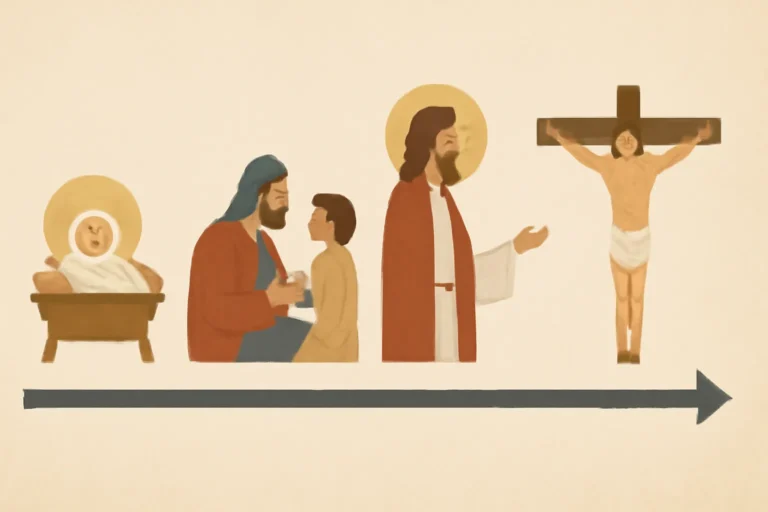
For readers seeking a concrete, narrative sketch, a standard three-year timeline can serve as a helpful guide. The following outline presents a concise account of events and phases, without presuming an exact date but illustrating the progression that many scholars find to be the most coherent when harmonizing the gospels.
Year 1: Baptism, Galilean beginnings, and early opposition — Jesus is baptized by John, publicly identified by the Father’s voice, and begins preaching in Galilee. The early phase includes calling the first disciples, performing initial miracles, and teaching in synagogues and open-air settings. This period establishes his authority and gathers followers while facing skepticism in his hometown of Nazareth and other communities.
Year 1 to Year 2: The expanded Galilean ministry — Jesus travels among towns in Galilee, delivers famous sermons (such as the Sermon on the Mount in Matthew’s account and parallel material in Luke), performs miracles that demonstrate authority over disease and nature, and confronts skeptical opponents who question his authority and origins. This stretch emphasizes the regimens of teaching, healing, and the training of the Twelve.
Year 2 to Year 3: Movement toward Judea and Jerusalem — The focus shifts southward; Jesus engages more directly with Jewish leaders, travels toward Jerusalem for significant gospel events, and faces mounting opposition. This phase includes public teachings in Judea, debates, and increasingly prophetic announcements about his impending suffering and death.
Final week and the Passion — The sequence culminates in the last week of Jesus’ life, including a dramatic entry into Jerusalem, canonical confrontations in the temple, the Passover departure, his arrest, trials, crucifixion, and subsequent resurrection appearances. This climactic period occupies a concentrated portion of the narrative and holds central place in Christian faith and theology.
This three-year scenario aligns with the broad expectations of how the Gospel narratives unfold while respecting the textual cues provided by the narratives. It also accommodates a plausible cadence of seasons, feasts, and public teaching opportunities that would be difficult to compress into a single year without losing essential elements of the story.
Implications of the ministry duration for interpretation
The estimated length of Jesus’ ministry influences how readers interpret several core aspects of the Gospels. Some of the practical implications include:
Prophetic fulfillment timing: If the ministry spanned about three years, the timing of key prophetic fulfillments and the pace at which Jesus explained his mission can be read as a longer arc that builds toward the Passion in a deliberate sequence.
Discipleship and formation: A multi-year arc allows for a more gradual formation of the Twelve, their misunderstandings and corrections, and the development of a mission that includes sending the disciples to preach after the Resurrection.
Calendar and festival symbolism: A longer period accommodating multiple Passovers enables readers to see how Jesus’ ministry intersects with the Jewish calendar, highlighting themes of obedience, Sabbath rest, and the fulfillment of the Law.
The tempo of confrontation: A longer timeline gives room for repeated confrontations with religious authorities, growing opposition, and the gradual erosion of public support that are central to the Passion narrative.
Different duration theories also influence how scholars understand theological emphases in the Gospels. For instance, portrayals of Jesus’ authority, insistence on his messianic path, and the timing of his teachings about his own death can be seen in light of how long his public ministry lasted. In short, the duration debate is not merely a matter of chronology; it shapes interpretation of who Jesus is, what he did, and what he taught over the span of his public life.
Common questions about the length of Jesus’ ministry
Was Jesus’ ministry only a year or two long?
Some readers encounter the question, often prompted by a desire for a tidy timeline. The evidence in the Gospels can be read in a way that yields a shorter duration, particularly when one emphasizes certain textual reads or treats festival references as representing shorter cycles. However, the majority of scholarly treatments maintain that the broader arc likely extends beyond a single year, with multi-year implications for teaching, travel, and the formation of the disciples.
Why do the Gospels mention multiple Passovers?
The Gospel of John explicitly mentions several Passover feasts, which many scholars take as a chronological signal pointing to more than a single year of ministry. Yet scholars also discuss the possibility that some references to feasts might be interpreted in varied ways—either as calendar anchors or as narrative devices to structure episodes—and that other textual cues may adjust the precise count. The presence of multiple Passovers is a key piece of the scholarly conversation, but it does not, by itself, settle the exact duration.
Do the synoptic gospels and John agree on the length of the ministry?
The synoptic Gospels (Matthew, Mark, Luke) and John present overlapping material but with different emphases and sequencing. Because each Gospel writer tailors the narrative to its own theological aims, achieving a perfectly synchronized timeline is challenging. Most scholars acknowledge that the two-tradition approach yields a plausible, heterogeneous, but coherent picture: the core events occur within a multi-year window, with each Gospel contributing essential but nonidentical markers.
Scholars persist in debating the duration of Jesus’ ministry because the question intersects with how one reads ancient historical memory, how the Gospel authors organized their material, and how we understand the calendar in first-century Judea. The discussion reveals several important features of biblical interpretation:
Complexity of ancient chronology: Unlike modern historians who rely on multiple, precise data points, ancient writers often structured narratives around theological aims and thematic arcs, making precise dating a nuanced task.
Gospel diversity: The four Gospels do not present identical schedules of events. Their differences can illuminate different theological emphases and community concerns, not merely calendar discrepancies.
Historical and literary layers: The dating problem sits at the crossroads of history and literature. Reading with an eye to both aspects helps readers appreciate why a single, definitive duration is elusive.
In this sense, the question of how long Jesus’ public ministry lasted is less about pinning an exact number on a timeline and more about understanding how early Christian communities framed the life, message, and mission of Jesus across time. The duration, whatever its precise length, remains central to the story of Jesus’ public activity and its significance for early Christian faith and practice.
Practical notes for readers and students
When engaging with the question of the length of Jesus’ earthly ministry, consider the following practical guidelines to navigate the topic thoughtfully:
Keep the focus on the central events: The most important elements are the core episodes—baptism, preaching, miracles, conflict with authorities, Passion, death, and Resurrection—rather than an exact year-by-year tally.
Appreciate the Gospel diversity: Different Gospel writers emphasize different episodes and sequences. A holistic reading honors these perspectives while recognizing their shared purpose.
Distinguish chronology from theology: Chronology is significant, but each Gospel’s primary aim is to present a theological portrait of Jesus as the Messiah, the Son of God, and the bringer of the Kingdom.
Use cautious language when debating dates: In academic discussions, phrases like “approximately three years” or “likely two to three years” reflect the best understanding while acknowledging uncertainty.
Closing reflections: the broader significance of a lengthened ministry
Readers and scholars alike often find that the exact number of years is less crucial than the arc of Jesus’ mission that the Gospels convey. Whether one subscribes to a three-year, two-year, or another model, the outline of Jesus’ work remains remarkably rich: a public ministry marked by teaching that unsettled the conventional religious authorities, a pattern of healing that signified the Kingdom of God breaking into the present age, and a culminating act of self-giving that frames Christian faith and practice. The question of duration invites readers to think about how time is used in proclamation and how a life’s work can be measured not solely by its length but by its impact, its fidelity to the mission, and its transformative power for those who encountered Jesus in his day.
In this sense, the study of the length of Jesus’ earthly ministry is less about producing an exact calendar than about engaging with the story’s enduring themes: revelation, invitation, sacrifice, and the invitation to follow. The discussions surrounding the duration help illuminate how early Christians understood the significance of Jesus’ public activity and how they remembered it in communities that would carry the message forward for centuries.
Whether you adopt the conventional view of a roughly three-year ministry or explore alternative timelines, the essential point remains the same: Jesus’ earthly work, as recorded in the Gospels, presents a coherent and compelling portrait of a teacher, healer, and savior who, in a finite and intensely focused period, inaugurated a new understanding of God’s kingdom and its implications for humanity.