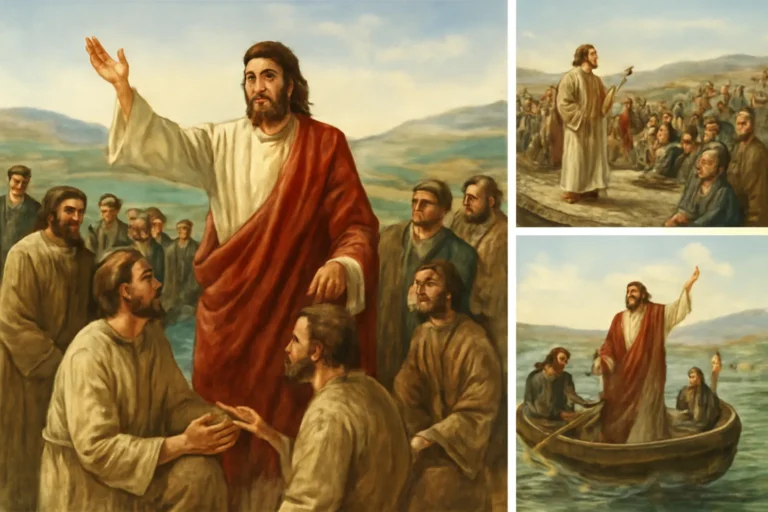
Age of Jesus When He Began Preaching: How Old Was He?
The question of the age of Jesus when he began preaching sits at the intersection of biblical text, historical dating, and theological interpretation. Most Christian traditions hold that Jesus launched his public ministry after his baptism by John the Baptist, and that this moment occurred when he was about thirty years old. But how firm is that number? What does the biblical text actually say, and what can we know with any confidence about when Jesus started to teach, heal, and proclaim the kingdom of God? This article explores the evidence, the competing chronologies, and the broader historical context that help illuminate the age of Jesus when he began preaching, often phrased in various ways as the starting age of Jesus’ ministry, how old Jesus was when he started his mission, or the age at the onset of Jesus’ public teaching.
What the Bible Actually Says About the Age of Jesus
The primary biblical datum for this question appears in the Gospel of Luke. In Luke 3:23, the text states that Jesus, when he began his ministry, was about thirty years old. This is commonly rendered in English as “Jesus, when he began his ministry, was about thirty years old” or “he was about thirty years of age.” The phrase is notable for indicating an approximate age rather than a precise birth date and it places the onset of Jesus’ public activity at a specific, recognizable life stage. The language is intentionally rounded: the author is not presenting a mathematical birth certificate, but situating Jesus in a stage of life that would have signaled readiness for leadership in a first-century Jewish setting.
The other Gospels do not supply a precise age for the start of Jesus’ ministry. Mark 1:14–15 describes the beginning of Jesus’ public proclamation in general terms—“The time is fulfilled, and the kingdom of God is at hand; repent, and believe the gospel”—but it does not mention a number. Matthew’s account likewise records activities and sermons without stating an age. The lack of a second explicit age reference means that Luke’s “about thirty” becomes the key anchor for this particular question, while readers must be mindful of the broader narrative and historical context to avoid over-precision.
It is important to recognize that the dating of Jesus’ birth — a separate but connected issue — heavily influences how we calculate the starting age of his ministry. The traditional scholarly consensus places Jesus’ birth in the period commonly known as the late reign of Herod the Great, often dated to around 4 to 6 BCE. If Jesus was born in 6 BCE and began preaching at age about 30, the kickoff of his public ministry would be in the late 20s CE; if born closer to 4 BCE, the starting point would be a couple of years later. Because the calendar system transitions from BCE to CE, and because the Gospel authors do not give an exact birth date, the exact year is not fixed. What remains fairly robust in the historical record is the roughly late first century BCE to early first century CE window for Jesus’ birth and the roughly mid-to-late 20s CE or early 30s CE as the time when he began teaching publicly according to Luke’s dating.
Why the Phrase “About Thirty” Is Meaningful
The expression “about thirty” serves several purposes in Luke’s gospel and in later Christian interpretation. First, it signals a typical age for entering a leadership phase in ancient Judaism. The age of thirty is associated with a stage of maturity, authority, and responsibility. In some Judean and Galilean contexts, men were considered suitable for certain religious or civic roles around that age. Luke’s wording aligns Jesus with a mature, rabbinic-prophetic profile, rather than a child prodigy or a political revolutionary who would be out of step with the cultural norms of his own time. Second, the rounded age allows for a reasonable range given the uncertainties surrounding precise birth dates and the dating of John the Baptist’s ministry. The text acknowledges the uncertainty, while still giving readers a concrete marker by which to situate Jesus’ public life in the narrative timeline.
From a semantical perspective, the phrase also acknowledges that the Gospels are not modern biographical chronicles with exact birth-to-death statistics. Their goal is theological and pastoral: to present Jesus as the Messiah and the Son of God who receives an anointing for ministry, and to frame the events of his life in a way that resonates with readers who are seeking to understand who Jesus is and what his message entails. In that sense, the approximate age at the beginning of ministry is part of a larger narrative rhythm rather than a precise archival datum. Nevertheless, scholars use the phrase “about thirty” to anchor a date range for the onset of Jesus’ public ministry that fits with other historical cues in the Gospels and in contemporary history.
Dating the Birth and the Beginning of Public Work
To understand how the age at the onset of Jesus’ preaching is inferred, it helps to situate two related dates: the likely year of Jesus’ birth and the year when his public activity began. The birth date is debated because the Gospel narratives involve a birth in Bethlehem during the period of Herod the Great, who died around 4 BCE. Modern chronology thus typically places Jesus’ birth in the window 6–4 BCE or thereabouts. If Jesus was born in 6 BCE and began preaching at about 30 years old, the starting year would be approximately 24–27 CE, depending on the exact year of birth and the exact year Jesus marked as the moment he began his ministry.
Another important piece is the dating of John the Baptist’s ministry, which Luke situates closely before Jesus’ own ministry. John’s activity is often tied to the approach of the “fulfillment of time” before the proclamation of the gospel. If John the Baptist’s preaching and subsequent imprisonment occurred in the late 20s CE or around 28–29 CE in some scholarly estimates, then Jesus’ public ministry would begin soon after, consistent with Luke’s “about thirty” age marker. In that sense, the dating of John’s work helps calibrate the likely starting point of Jesus’ preaching, even as the precise year remains debated among scholars and theologians.
It is common to present a range rather than a single year when discussing the initiation of Jesus’ ministry. A cautious chronology might place Jesus’ public work in the interval mid-to-late 20s CE to early 30s CE, with his baptism and the beginning of his preaching occurring within a matter of months of each other. This window accommodates uncertainties about the year of birth, the length of John’s ministry, and the pace at which the gospel narratives present events. Importantly, even though dates are approximate, the relative sequence is clear: Jesus begins preaching after his baptism by John, in Galilee, and this marks the official start of his public ministry as described by the Gospel writers.
The Baptism and the Initiation of Public Ministry
A focal point in understanding the onset of Jesus’ preaching is the baptism event. The Gospels describe Jesus approaching John at the Jordan to be baptized, an act that inaugurates his public life. The moment of baptism is depicted as a turning point, with the Spirit’s descent and the voice from heaven signaling divine commissioning. While the biblical text does not specify Jesus’ exact age at this moment, Luke’s later statement that Jesus began his ministry when he was about thirty years old works in tandem with the baptism as the formal initiation of his preaching and teaching work. The baptism is thus conceptually linked to the start of his public mission rather than to birth or infancy, underscoring the significance of the age at which a teacher and prophet enters that phase of public service.
In historical terms, the baptism narrative helps bridge the gap between the hidden years (the so-called “hidden years” in Nazareth) and the open proclamation of Jesus’ message in Galilee. The baptism is not simply a ritual act; it is presented as the moment of divine approval and empowerment. This helps readers understand why the age at the start of ministry mattered in the Gospel accounts: it signals readiness for authority, authority grounded in divine commissioning, and the beginning of a ministry that would be marked by preaching, teachings, miracles, and ultimately crucifixion and resurrection.
Scholarly Perspectives on the Age Jesus Began Preaching
Scholars approach the question from different angles, including textual criticism, historical dating, and cultural context. The core point of consensus is that Luke’s “about thirty” is a cue for a mature, rabbinic-figure status rather than a precise calendar age. Beyond that, there is a spectrum of plausible chronologies.
Traditional-late dating: Birth in the late 6 BCE to early 4 BCE period, with the beginning of ministry around 27–29 CE when Jesus would be approximately 27–33 years old. The phrase “about thirty” is treated as a rounded indicator that aligns with Luke’s narrative purpose.
Earliest possible start: If one places Jesus’ birth closer to 4 BCE, then a 30-year-old start could place the beginning of ministry around 27 CE, which matches some external historical cues about John the Baptist and the political-religious climate of Jerusalem and Galilee.
Late-start hypothesis: Some scholars propose a slightly later initiation, perhaps in the early 30s CE, depending on the dating of John the Baptist’s ministry and the pace of Jesus’ own activities as presented in Mark and Luke. Under this view, the phrase “about thirty” still functions as a general marker rather than a precise year.
In addition to these broad views, several nuanced considerations complicate a single, precise answer:
Biographers’ purposes: The Gospel writers arranged events to convey theological truths about Jesus as the Messiah. They did not aim to supply a modern, exact biographical timeline; thus, the age figure should be understood in narrative and theological terms.
Dating the Baptist’s ministry: The dating of John the Baptist’s work affects the inferred starting point for Jesus’ ministry, because the Gospel sequence presents John as the forerunner and Jesus as the successor who begins after John’s public ministry intensifies or concludes.
Historical markers: The broader historical context—Roman governance, Herodian rule in the region, and the social and religious dynamics in Judea and Galilee—helps frame the plausibility of certain dates but does not fix the exact year of Jesus’ public initiation.
What the Dead Sea Scrolls and Other Texts Contribute
While the Dead Sea Scrolls do not provide a direct birth date for Jesus, they illuminate the Jewish world in which Jesus lived: expectations about prophetic voices, messianic hopes, and the rhythms of religious leadership. These texts help scholars understand why a public figure could emerge at a particular life stage and how audiences might interpret that emergence. Other early Christian writings, such as the Acts of the Apostles and the Epistles, also contribute to the overall chronology of the apostolic period, though they do not supply a definitive year for Jesus’ baptism or the start of his preaching. Taken together, the external sources support a generally consistent timeline: Jesus’ public ministry occurred in the first century CE, within a few decades of the traditional estimate of his birth, and the “about thirty” marker remains a plausible way to describe the onset of that ministry within the Gospel narratives.
From a methodological standpoint, scholars use a combination of textual analysis, cross-referencing gospel harmonies, and historical inference to build plausible ranges rather than a single date. This approach respects the literary and theological aims of the gospel writers while seeking to align their accounts with known historical markers such as the reigns of Herod and Pilate, the Roman calendar, and Jewish festival cycles. The resulting picture is not a single moment in history but a coherent window in which the public life of Jesus likely began, with the age marker of “about thirty” serving as a guidepost within that window.
Cultural and Historical Context: Why 30 Was Not an Arbitrary Number
In first-century Judaism and Galilean society, age mattered for leadership, authority, and spiritual responsibility. Although Jesus was not a priest serving in the temple, the notion of stepping into public leadership around the age of thirty would have resonated with audiences familiar with Jewish and broader Near Eastern norms. Several points help illuminate the cultural significance of the number:
Priestly and prophetic expectations: While priests began service at a young age in some cases, the full trust in leadership roles often matured around the early 30s, when a person was seen as having enough life experience and spiritual authority to guide communities.
Public teaching and authority: In the Synagogue and in itinerant ministry settings, display of wisdom, authority, and instruction typically occurred after a span of years in which a teacher could develop credibility with listeners. The age of thirty would be within a range where a teacher could begin to hold audiences and articulate a distinctive interpretation of Scripture.
Rhetorical and social expectations: The Gospel writers place Jesus in continuity with the prophetic and teaching traditions of Israel. The age marker helps audiences recognize Jesus as a legitimate public figure rather than a minor or a peripheral teacher.
Roman and local governance: The social climate of Galilee and Judea under Roman oversight produced a sense that leadership would emerge from a person who had reached a mature phase in life, capable of bearing responsibility and delivering a message that might challenge established norms.
These cultural cues do not fix a date, but they help readers understand why Luke would mention a definite, approximate age for the start of Jesus’ ministry. The age signal communicates a sense of legitimacy, maturity, and readiness to fulfill a serious mission under divine commissioning, aligning Jesus with other recognized religious figures who begin their public work at a correspondingly mature stage of life.
The Historical Window: How the Dating Affects Chronology
Placing the onset of Jesus’ preaching in a particular year matters for historical chronology, but it does not negate the theological significance of the events. The timeline of Jesus’ ministry interacts with other biblical events, such as the call of the apostles, the sequence of temptations, the cleansing of the temple, the Passion narrative, and the Resurrection. The following considerations help accompany a more nuanced view:
Length of the ministry: The Gospels suggest a ministry that lasted a matter of months to a few years, not a single, extended decade. Most scholars allow for a period of roughly one to three years from the start of preaching to the crucifixion. Hence, even if the exact year is debated, the duration of Jesus’ public work is generally agreed to be relatively short compared to the length of his life overall.
Regional emphasis: Jesus’ proclamation begins in Galilee, with key episodes in towns like Nazareth, Capernaum, and surrounding villages. The early phase in Galilee is a significant portion of the narrative, and the move toward Jerusalem marks a climactic arc in the gospel accounts.
Temple confrontations and Passover journeys: The Gospel narratives place the culmination of Jesus’ public ministry near Passover in Jerusalem, which helps anchor events within a yearly festival cycle that would have shaped the audience’s perception of his authority and mission.
In sum, the dating of Jesus’ birth and the approximate starting point of his preaching are not just academic exercises; they influence how readers understand the coherence and sequence of gospel events. The likely window places the initiation of his public ministry in the late first century BCE to late first century CE, with the age marker of “about thirty” functioning as a heuristic to help readers situate Jesus in his historical and cultural milieu, while also signaling maturity and readiness for prophetic leadership.
What This Means for Biblical Chronology and Faith
For readers who are exploring the question “how old was Jesus when he began preaching?”, several practical implications emerge. First, the age figure emphasizes the transition from ordinary life in Nazareth to a public ministry marked by teaching, healing, and controversy. It underscores that Jesus entered a phase of responsibility and mission rather than a mere ceremonial existence in his youth. Second, the approximate age is a reminder that the biblical authors did not intend to provide a modern-day passport-style chronology. Their aim was to convey a theological arc: Jesus is the Messiah, the Son of God, who begins his public work with divine commissioning evident at baptism and carried forward through his preaching in Galilee and Jerusalem. Third, accepting a range rather than a single year helps readers appreciate the complexities of ancient dating systems and the uncertainties inherent in reconstructing precise timelines from ancient texts. This approach respects both the historical circumstances and the faith-based significance of Jesus’ ministry.
From a pastoral perspective, the age marker can be encouraging for readers who are looking for models of spiritual formation and readiness. The idea that one begins public ministry or leadership at a mature age, after years of preparation, resonates with many people who are called to serve in various roles within faith communities. The narrative thus provides a pattern of discernment, preparedness, and obedience that transcends a precise calendar date.
Common Misconceptions About Jesus’ Age at the Start of His Ministry
“Jesus started preaching as a child prodigy.” In the biblical text, there is no evidence that Jesus began teaching or performing public acts as a child. The Gospel narratives focus on his infancy and then rapidly move to the period of hidden years in Nazareth before a public commissioning in his early adulthood.
“The exact year is known.” While scholars offer plausible ranges based on historical cues, the exact year of Jesus’ baptism and the start of his ministry remains uncertain. The phrase “about thirty” is deliberately imprecise, reflecting a rounded estimation rather than a fixed year.
“All scholars agree on the birth year.” There is scholarly consensus that Jesus was born in a period around the late 4 BCE to 6 BCE, but the precise year is debated due to differing historical reconstructions of Herod’s death and calendrical conventions. Consequently, the age at the onset of ministry is likewise subject to uncertainty.
FAQ: Quick Notes on Jesus’ Early Mission
Was Jesus truly thirty when he began preaching?
Luke’s Gospel describes him as “about thirty years old” at the start of his ministry, which is best understood as a rounded, approximate age indicating maturity and readiness rather than a precise date.
Why is there uncertainty about Jesus’ birth year?
Historical markers such as Herod’s reign and the dating of Roman authorities provide bounds for Jesus’ birth, but exact years are difficult to pin down due to calendar changes and differing historical sources.
How long did Jesus’ public ministry last?
The Gospels imply a ministry lasting from roughly the late 20s CE to the early 30s CE, typically estimated as one to three years, though precise duration is debated.
What is the significance of baptism in this dating?
Baptism by John is treated as the formal initiation of Jesus’ public life, marking the transition from an anonymous period in Nazareth to a mission in the public sphere, and Luke ties this event to the age marker.
Takeaways: Key Points About the Onset of Jesus’ Public Ministry
The core biblical datum is Luke 3:23, which states that Jesus began his ministry when he was “about thirty years old.”
The exact year is uncertain. Most scholars place the event in the late 20s CE or early 30s CE, with birth dates commonly proposed in the range 4–6 BCE.
The dating of John the Baptist’s ministry and the historical timeline of Herodian and Roman governance influence the proposed window for Jesus’ public start, but do not yield a precise day, month, or year.
The phrase “about thirty” reflects a narrative choice that signals maturity and readiness for leadership, aligning Jesus with a recognized pattern of prophetic and teaching authority in first-century Jewish culture.
Understanding the age in context helps readers appreciate the Gospel writers’ aims and the historical setting, rather than treating the age as a modern, exact biographical datum.
Closing Reflections: Why the Age at the Start of Jesus’ Ministry Continues to Matter
The question of how old Jesus was when he began preaching is not just a date that punctuates a timeline. It is a lens through which we can view the intersection of history, theology, and faith. The age figure invites readers to reflect on what it means for a teacher and healer to emerge with authority at a mature point in life: a moment that is believable within the social and religious landscape of first-century Judea, and yet transformative in its implications for faith communities across the centuries. The “about thirty” marker becomes a bridge between an approximate historical dating and the lived experience of many believers who see in Jesus a model of responsibility, wisdom, and divine commissioning.
As you study the birth year debates, the baptism narrative, and the sequence of Jesus’ Galilean ministry, you may find it helpful to keep a few guiding ideas in view:
The exact year matters less for the theological message than the fact that Jesus was publicly proclaimed as the Messiah and commissioned for a mission that would redefine expectations for Israel and, later, for the world.
The age provides a culturally resonant marker, signaling readiness for leadership within a first-century context while acknowledging the narrative’s use of rounding and theological emphasis over precise chronology.
Understanding the complexities behind the dating can deepen respect for how biblical authors constructed their accounts to communicate meaning, not to deliver a modern-day calendar.
In sum, the consensus among many scholars is that Jesus began his public preaching in his early thirties, with Luke’s “about thirty” serving as a compact summary of a more complex historical-feast of clues. Whether one leans toward a birth year near 6 BCE or 4 BCE, and whether the ministry begins in the mid- to late-20s CE or slightly later, the essential claim remains intact: Jesus’ public ministry marks a pivotal moment in the history of religious thought, a moment that was initiated when he was perceived as prepared, commissioned, and empowered to proclaim good news, challenge established authorities, and invite listeners into a transformative vision of God’s kingdom.