Catholic Infant Baptism Explained: Meaning, Rite, and How It Works
Catholic infant baptism is a foundational moment in Christian initiation, marking a child’s entry into the Christian community and into the life of grace. In the Catholic Church, this sacrament is understood not merely as a ceremony, but as a divine action that brings new life in Christ, removes the stain of original sin, and initiates the child into the mystery of the Triune God. This article offers a comprehensive explanation of infant baptism in the Catholic tradition, including its meaning, the rite itself, the theological foundations, and practical details about how it works in parish life.
What is Catholic infant baptism and why is it important?
At its core, Catholic infant baptism is one of the principal sacraments of initiation through which a person is united to Christ and joins the Church. The child receives the gifts of grace that make possible a life of faith, hope, and love. Although the child is too young to profess faith themselves, the Church emphasizes the faith of the parents and godparents who stand in for the child and commit to guiding them in the faith until the child can decide for themselves as they mature.
To understand the significance, it helps to recognize several key meanings tied to the practice:
Entrance into the Church: Baptism incorporates the believer into the Body of Christ, the Church. The baptized person becomes part of the community that walks in faith together, from which they receive a corporate and personal identity as a member of God’s family.
Forgiveness and grace: The sacrament is the means by which God’s grace acts to cleanse from original sin and to open the way to a life lived in union with God. It is the introduction to a lifelong journey of holiness and discipleship.
New life in Christ: Baptism is often described as a new birth in the Holy Spirit—a rebirth that establishes the child as a child of God and a citizen of the Kingdom of Heaven.
Adoption into the family of God: Through baptism, the child becomes spiritually adopted by the Father and becomes a temple of the Holy Spirit, destined for eternal life with Christ.
Participation in the Sacraments: Baptism prepares the soul to receive the other sacraments. It is the first step in the sequence of initiation that includes the Eucharist and Confirmation, depending on the catechetical path of the child.
Different Catholic traditions emphasize different facets of the same reality. In practice, you will hear the phrase baptism as the gateway to the sacraments, or the idea that it is the door through which the believer enters the life of grace. Regardless of emphasis, the consistent thread is that infant baptism is about God’s action first, and the community’s response of faith and responsibility follows.
Historical and theological foundations: why infants are baptized in the Catholic Church
The Catholic understanding of infant baptism rests on a long theological tradition. While individual details have developed over centuries, the core convictions are rooted in Scripture, apostolic teaching, and the living memory of the Church. Here are some essential elements that illuminate the rationale behind infant baptism:
The universality of baptismal grace
Grace is offered to all humanity, and the Church teaches that God’s desire is that all be saved. Because the Church does not know the personal faith of an infant, the Community of Faith (parents, godparents, family, and parish) petitions and hopes for the child’s growth in faith. The Church trusts that God’s grace is at work even before the child can consciously respond.
The Church as a family and community of faith
Infant baptism emphasizes the communal dimension of salvation. Parents and godparents publicly profess the faith on behalf of the child, and the entire community pledges to educate and support the child in growing as a disciple of Christ. This communal act reflects the Church’s understanding that faith is passed on through generations and is sustained by both personal commitment and ecclesial belonging.
Scriptural reflections and early practice
While the New Testament does not provide a biblical command specifically about infant baptism as a universal practice, the Church points to instances where whole households received baptism in the early centuries (for example, households of Cornelius and Lydia) and to the Church’s early catechetical tradition that welcomed infants into the faith as part of the Church’s mission to bring all nations to Christ. The sacrament’s significance is thus grounded in the continuity between Scripture, apostolic tradition, and the lived reality of the Christian family and parish communities.
In short, the Catholic rationale for infant baptism rests on the conviction that God’s grace precedes human response, and the Church, as a mother and teacher, has the responsibility to introduce children to Christ and to bring them up in the faith.
The Rite of Catholic infant baptism: how the sacrament is celebrated
The church’s baptismal rite for infants is a carefully structured prayer service that combines the Word of God, the parish community, the prayers of the priest or deacon, and symbolic acts. While there can be some local variation, the essential elements are consistent across the Latin Church and most Eastern Catholic Churches. The rite is designed to be both nourishing for the child and instructive for the parents and sponsors.
Preparation and participants
Before the day of the baptism, the family meets with the parish priest to make arrangements, discuss the faith formation plan for the child, and select faithful and dependable godparents (sponsors). In Catholic practice, the godparents have the important role of bearing witness to the faith, supporting the parents, and guiding the child in living a Christian life. The ideal godparents are practicing Catholics who have received the sacraments of Baptism, Confirmation, and Eucharist, and who can clearly model a life of faith and service. In some circumstances, one godparent may be required to be a Catholic, though the Church recognizes the value of one Catholic sponsor and one Christian witness if necessary.
The ceremony is typically held in a parish church, often during a Sunday Mass or another liturgical occasion. In some places, private baptisms are permitted for families who have special needs or time constraints, but these also occur within the framework of Catholic liturgical norms and, ideally, in cooperation with the parish priest.
The water rite and the words
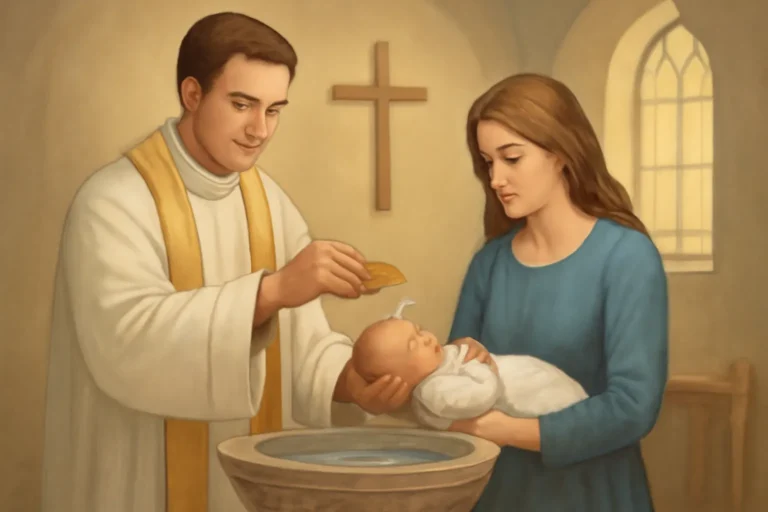
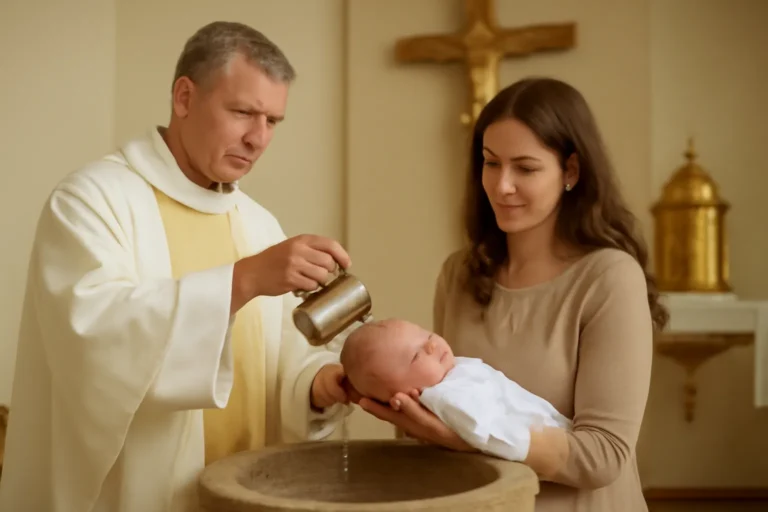
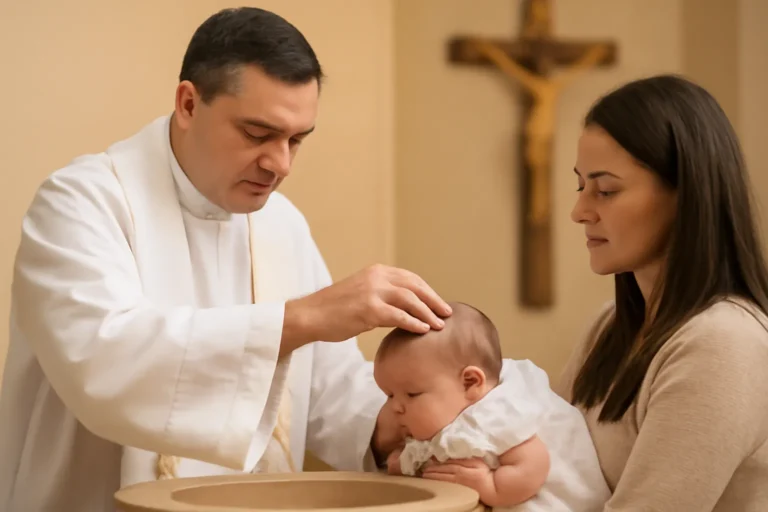
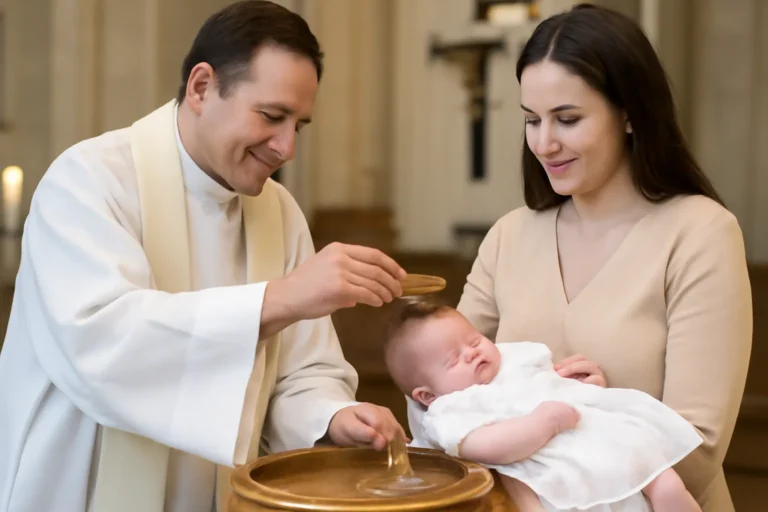
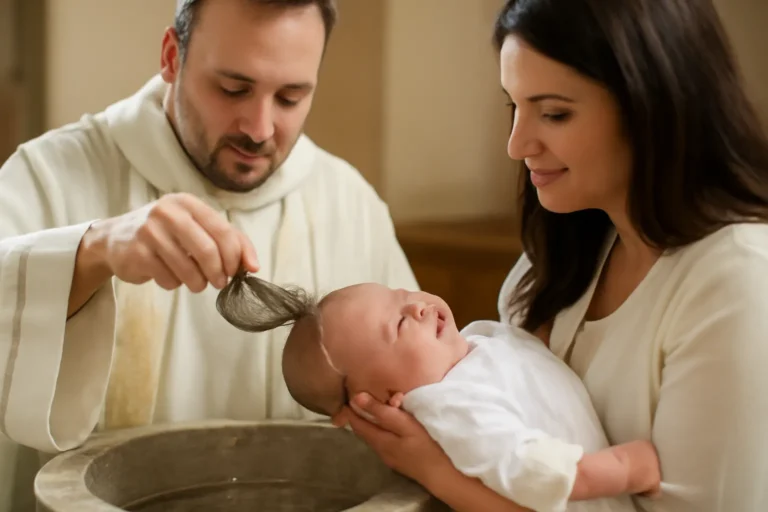
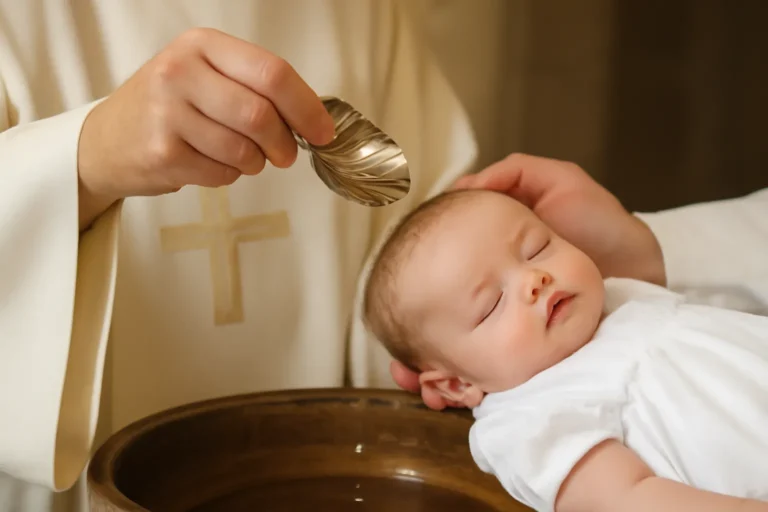
The central action of the baptism is the pouring of water or immersion with the invocation of the Holy Trinity. The minister prays over the water, asks God to sanctify it, and then uses the Trinitarian formula during the act: N N baptize you in the name of the Father, and of the Son, and of the Holy Spirit. This is the moment when the child is actually joined to Christ and incorporated into the Church.
The matter—water—is essential. Water has long been recognized as a powerful symbol of cleansing, new birth, and life-giving power. The form—the words spoken by the minister—constitutes the essential part of the sacrament and is fixed in the rite.
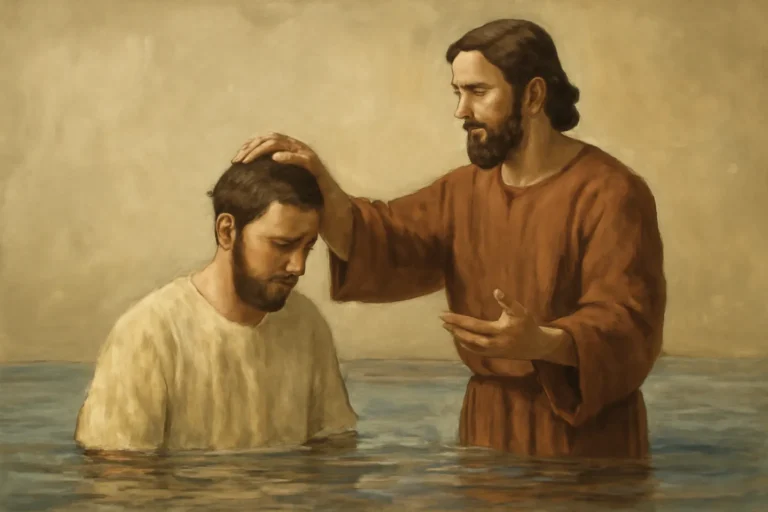
In the Catholic practice that is most common today in Western churches, water is poured on the head (affusion), though immersion is also historically acceptable and may be used in some communities. Both modes are valid as long as the intention is to confer baptism and the Trinitarian formula is employed. The Church’s emphasis is on the spiritual reality conveyed by the rite, rather than on the physical form of water application.
Post-baptismal rites and signs
After the baptism, several important rites and symbols reinforce the meaning of the sacrament:
The white garment—a sign of the child’s new life in Christ and a symbol of being clothed in righteousness.
The baptismal candle—lit from the Easter or baptismal candle to symbolize the light of Christ given to the child.
The lighted candle and the presentation of the light to the child’s family emphasize the call to walk in the light of Christ and to keep the flame of faith alive in daily life.
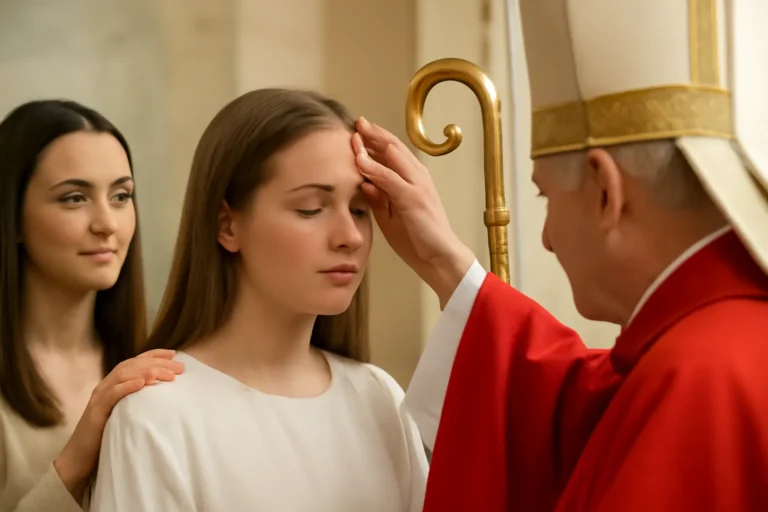
Anointing with Sacred Chrism on the crown of the head—this signifies the sanctifying gift of the Holy Spirit and the child’s incorporation into Christ’s royal priesthood, a rite that marks ongoing growth in faith and mission.
Anointing with the Oil of Catechumens (prior to the Baptism) in some rites as a sign of spiritual strength to resist temptation and sin, preparing the child for the new life in Christ.
The sequence of these rites—word, water, exorcisms and blessings, the baptism itself, then the post-baptismal anointings and signs—encapsulates the entire theology of Catholic infant baptism: renunciation of sin, profession of faith, new life in the Spirit, and incorporation into the Church.
Ritual symbols and their meanings in infant baptism
Every element of the baptism ceremony carries a symbolic weight that communicates spiritual realities to adults and children alike. Understanding these symbols helps to appreciate why the ceremony is so rich and why it matters for a Catholic family and parish community.
Water as matter
Water represents cleansing, birth, and life. The Church teaches that baptism cleanses from original sin and makes the person a new creature in Christ. It is not merely a symbolic gesture; it is a real participation in the death and resurrection of Christ, enabling the child to begin a life of faith under the guidance of the Holy Spirit.
The Sign of the Cross
Usually traced on the child’s forehead with holy water or the priest’s fingers, the Sign of the Cross is a reminder of the Paschal Mystery and a profession of belonging to Christ. It is a public mark that the child is claimed for Christ and protected by God’s love.
The white garment conveys the virtue of purity and the call to live as a new creation in Christ. It visually communicates that the baptized person has begun a life empowered by grace, set apart for holiness.
The baptismal candle
The candle lit from the Paschal candle or baptismal lamp is a symbol of the light of Christ entering the child’s life. It invites the family and community to nurture that light, guiding the child toward faith.
Oil and chrism
The use of oil—whether the Oil of Catechumens or Sacred Chrism—signifies strengthening by the Holy Spirit. The anointing marks the child as a participant in Christ’s mission, called to live as a member of the Church and an heir of the promises of God.
Infant baptism and the faith community: responsibility and ongoing formation
The baptism of a child initiates a lifelong journey of faith. The responsibility to form that life falls primarily on parents and sponsors, with the support of the parish community and the wider Church. Catholic teaching emphasizes that faith formation is a shared endeavor, not a one-time event in a church sanctuary.
Role of the parents
Parents are the child’s first and primary teachers in the faith. In the baptismal rite, they publicly profess the faith that they will now pass on to their child. The Church asks parents to commit to a routine of catechesis, prayer, and religious practice in the home, so that the child may grow in grace and knowledge of Christ.
Role of the godparents
Godparents accompany the parents as witnesses to the faith and as living examples of what it means to walk in the light of Christ. They pledge to support the child’s Christian education, encourage regular participation in the sacraments, and model a life of virtue and trust in God. The presence of reliable godparents reinforces the community dimension of baptism and the ongoing formation of the child in the faith.
Formation after baptism
Within Catholic parishes, the child typically enters a catechetical program (typically beginning in early childhood and continuing through adolescence) that leads to First Communion and Confirmation. Even for infants, baptism is the starting point of a lifelong formation that includes Scripture study, prayer, liturgy participation, service, and acts of charity. The parish often offers resources for families to practice devotion at home and to participate in church life together.
Practicalities: when, where, and how infant baptism happens
Understanding the practical side of infant baptism can help families plan and participate more fully in the process. There are common patterns, but local diocesan guidelines and parish customs may vary.
Timing and scheduling
Most Catholic parishes schedule infant baptisms on Sundays or during a specific portion of the Mass. The exact timing may depend on the parish’s liturgical calendar and the availability of the priest or deacon. It is common for families to plan the baptism within the first weeks or months after birth, provided there is a readiness on the part of the family and the child’s health allows it. Some parishes also offer baptism during weekdays for larger families or for special circumstances.
Requirements and documentation
Typically, families must provide the child’s birth certificate and a baptismal-preparation form completed by the parents. If godparents are from another parish, a sponsor certificate from the godparent’s parish may be required to verify that they are practicing Catholics in good standing.
Godparent qualifications
Godparents should be practicing Catholics who have received the sacraments of Baptism, Confirmation, and Eucharist, and who live consistent Christian lives. In some places, a non-Catholic who is properly prepared and who seeks to support the child’s faith life may act as a “Christian witness” alongside a Catholic godparent; however, this arrangement varies by diocese and parish policy. It is important to check with the local parish for the exact policy.
In cases where a family is facing particular challenges—such as illness, travel constraints, or special family circumstances—the parish may offer flexibility and pastoral guidance. The goal is to honor the sacredness of the rite while answering the needs of the family. The parish community is often equipped to walk with families through the process, answer questions, and provide catechesis so that parents and sponsors understand the meaning and responsibilities that accompany infant baptism.
Common questions and misunderstandings about Catholic infant baptism
Many people have questions about infant baptism, its theology, and its practice. Here are some frequently asked questions, along with clear Catholic explanations.
Is infant baptism necessary for salvation?
The Catholic Church teaches that baptism is the ordinary means by which a person enters into the life of grace and becomes a member of Christ and his Body, the Church. It is often described as necessary for salvation in the sense that God wills to grant salvation through baptism. However, God’s mercy is not limited by the sacraments. The Church also teaches that those who, through no fault of their own, do not know Christ but seek God with a sincere heart and follow the will of God as they understand it, may also be saved by grace. In practice, the Church invites parents to raise their child in the faith and trust in God’s providence for the child’s future path of salvation.
The Church’s norm is to celebrate baptism within the sacred space of a church and within the liturgical life of the parish. In emergency situations where danger of death exists, any person with the proper intention can baptize, using the correct form and with the water, even outside a church setting. This underscores the seriousness of the rite and its divine dimension, while also highlighting the Church’s understanding that baptism belongs to Christ’s Church, not merely to a private act.
What if one cannot find a sponsor?
Godparents are highly recommended for the fullness of the baptismal rite and for ongoing formation, but the Church understands real-life constraints. If a godparent cannot be found, families should speak with their pastor to explore available options. The important thing is the child’s spiritual formation and the family’s fidelity to the faith.
Is infant baptism compatible with belief in free will?
Yes. The Catholic tradition sees baptism as the sacramental gift of grace that strengthens the person to cooperate with God’s grace. The infant cannot consciously consent, but the Church places the decision in the communal faith of the family and the Church, trusting that God’s grace acts in the child’s life now and in the future as they grow in knowledge and love of the Lord.
Both modes are valid, and the local church determines what is customary. The Latin Church has predominantly used pouring (affusion) for practical reasons and historical development, while still recognizing immersion as licit where practicable. The essential element is the intention to baptize and the Trinitarian invocation, not the specific method of water application.
Variations in wording: different ways Catholics speak about infant baptism
When discussing infant baptism in Catholic terms, you will encounter several phrases that reflect different aspects of the same reality. Here are some variations you might see in church literature, catechesis, or parish bulletins:
Catholic baptism of infants and young children
Infant baptism in the Catholic Church and its meaning
Baptizing babies as a rite of initiation
Catholic initiation for children through baptism
Baptism of a child within the Catholic faith
Infant baptism explained in catechetical materials
These variations reflect the same core concept: that the child is initiated into the life of Christ and the Church through the baptismal sacrament, with the support of family, godparents, and the parish community. The language may emphasize different facets—grace, community, the sacramental act, or the role of the family—yet the substance remains the same.
Putting it all together: a practical guide for families seeking Catholic infant baptism
For families navigating the path to infant baptism, here is a practical guide that highlights the essential steps, spiritual meaning, and the pastoral support available in most parishes:
Meet with the parish priest or baptism coordinator to learn about the local rites, scheduling, and requirements.
Choose godparents who meet the Church’s requirements and who can actively support the child’s Catholic formation.
Prepare the baptismal program, including the Professional of Faith by the parents and godparents, and plan for the child’s liturgical reception.
Attend the parish’s pre-baptism catechesis or instruction if required; this session helps families understand the meaning of the sacrament and the responsibilities it entails.
Decide on the practical aspects of the rite—whether water will be poured or immersion will be used, the singing or prayers to be included, and the logistics of the ceremony within the Mass or outside of it.
Participate in the post-baptismal formation, continuing catechesis, and family prayer life to help the child grow in faith.
In all of this, the most important thing is a shared faith that goes beyond the moment of the rite. The Catholic Church teaches that baptism is the begining of a lifelong journey, not a single event. The parish community, the family, and the child together begin a path toward holiness, sanctification, and a life lived in communion with God and with one another.
In summary, Catholic infant baptism explained across its dimensions—meaning, rite, and ongoing life—reveals a coherent theology of grace and community. It is a sacrament of initiation that invites a child into a living relationship with God, within the Church’s life and mission. The ritual is rich with symbolism that points toward a future of faith formation, virtuous living, and participation in the life of the Church. Through water, words, light, oil, and the witness of parents and godparents, the child receives a gift beyond measure: participation in the life of Christ and incorporation into the people of God.