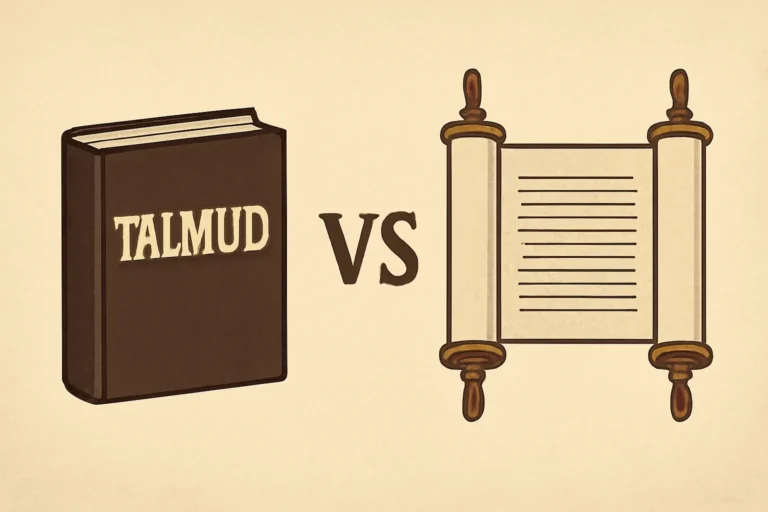
Talmud vs Torah: Key Differences and Their Meanings
In Jewish study and practice, the terms Torah and Talmud sit at the center of how people understand revelation, law, narrative, and ethical teaching. While these words are closely connected, they refer to distinct bodies of text, different kinds of authority, and separate modes of interpretation. This article offers an accessible guide to the key differences between the Written Torah and the Oral Torah, and to the larger rabbinic project embodied in the Talmud. We will explore how these two streams complement each other, how they have shaped Jewish life across centuries, and how scholars and practitioners today approach them in diverse communities.
The word Torah can be understood in two closely related senses. In one sense, it refers to the Written Torah, also called the Torah Shebikhtav or the Five Books of Moses: Genesis, Exodus, Leviticus, Numbers, and Deuteronomy. In another sense, the broader term Torah can denote the entire body of Jewish teaching as it derives from revelation, including both the narrative portions of the Bible and the commandments that regulate daily life. Most commonly, however, people distinguish between the Torah Shebikhtav as the canonical written text and the later rabbinic literature that interprets and applies it.
The Five Books themselves are a compound document: they contain sacred stories, genealogies, laws, and covenantal moments. They tell of creation, the patriarchs and matriarchs, the exodus from Egypt, the giving of the commandments at Sinai, the wanderings in the desert, and the early history of the Israelite people as it moves toward settlement in the land of Israel. Within these five books lie the directives that guide ritual, social practice, and moral conduct, such as the Sabbath, dietary laws, festival observances, and civil and criminal regulations. The Written Torah is considered divine revelation in a textual form that has been transmitted through generations, with a sense of authority rooted in the biblical narrative itself.
In scholarly and religious usage, you will also encounter terms like Torah Shebe’al Peh (the Oral Torah) and Torah Shebikhtav (the Written Torah). The distinction helps clarify how later rabbinic literature expands, interprets, and operationalizes the commandments found in the five books. Torah Shebikhtav sets the foundational framework of commandments and stories, while the Oral Torah explains how those commandments should be understood, practiced, and verified in daily life.
What is the Talmud?
The Talmud is a vast collection of Rabbinic discussions that arise from trying to understand, interpret, and apply the Torah in concrete situations. It is not a single book but a compilation that grew out of two related projects: the Mishnah and the Gemara.
Mishnah (completed around the year 200 CE) is a foundational text that organizes Oral Torah material into six orders, covering topics from agricultural laws to festival rules, from ritual purity to civil law. It represents an early attempt to codify the discussions that had been circulating among sages.
Gemara is the commentary on the Mishnah. It contains lively debates, methodologies for interpreting verses, and discussions about how to apply principles to new cases. There are two main Gemaras: the Bavli (Babylonian Talmud) and the Yerushalmi (Jerusalem Talmud). Together with the Mishnah, these components form the Talmud, which is sometimes called the Rabbinic literary corpus.
Within the Talmud, scholars distinguish between Halakhah and Aggadah. Halakhah refers to the legal material—rabbinic rulings about what sources permit or prohibit in daily life, ritual practice, and civil matters. Aggadah comprises non-legal material: stories, ethical reflections, theological ideas, and literary narratives that illuminate the values and worldview of the scholars. The Talmud is thus both a legal document and a rich treasury of Rabbinic storytelling and philosophy.
Written vs Oral: The Big Picture
One of the central themes in understanding these two streams is the relationship between what is written and what is spoken, fixed, and interpreted. The Written Torah is a text that exists in a fixed form, but it is interpreted through the lens of the Oral Torah, which comprises explanations, expansions, and clarifications handed down through generations. This interplay is sometimes described as a dynamic covenant: the divine text provides a foundation, while human sages elucidate, argue, and refine its practical meanings over time.
To scholars and many practitioners, the Oral Torah is essential for making sense of the commandments in the Written Torah. For example, the biblical commandment to observe the Sabbath appears in the Torah, but the specifics—what is allowed, what constitutes work, how to determine the Sabbath’s boundaries—are addressed in the Oral Torah. The Talmudic discussions in the Talmud shine a light on the interpretive process: they show how sages analyze verses, weigh opinions, and arrive at practical rulings that communities can follow.
Throughout Jewish history, different communities have placed varying emphasis on these streams. In some eras and jurisdictions, the study of the Written Torah with a focus on textual study is foregrounded; in others, the depth and breadth of the rabbinic discussions in the Talmud become central to religious education and legal authority. Regardless of emphasis, most traditions view the two as inseparable parts of a single project: understanding and living a life in accord with the divine intention encoded in the Torah.
Structure and Content: Key Differences
Foundational scope
The Written Torah provides the core commandments (mitzvot) and the overarching story of creation and covenant. It is finite in its books and chapters but expansive in its moral and theological themes. The Talmud, by contrast, is open-ended in its exploration: it contains a dense web of legal arguments, case studies, and questions that often extend beyond the content of the Written Torah. The rabbinic literature inhabits a different mode of discourse—one that thrives on analysis, disagreement, and gradual consensus.
Mission and mode
The Torah aims to present the framework of divine law and storyline. It is a canonical source that establishes what is expected in principle. The Talmud aims to translate those principles into concrete practice. It asks questions like: How can this commandment be observed in the modern world? What is the practical definition of a category of action? How do communities handle edge cases and evolving technologies? The rabbinic discussions in the Talmud provide multiple perspectives, often culminating in a decision about how to proceed in a given situation.
Language and presentation
The Written Torah is primarily in Biblical Hebrew, with some Aramaic phrases that appear within the text in the later prophetic and historical portions. The Talmud is mostly in a mix of Babylonian Aramaic and Hebrew, with a distinctive dialect that reflects its rabbinic contexts. The linguistic mix mirrors the two streams of tradition: the sacred text in ancient Hebrew and a living, iterative conversation in a later linguistic environment.
Content categories
The Torah includes narrative material, genealogies, laws (mitzvot), prophetic passages, and moral teachings. It is not primarily a legal code in the modern sense; rather, it presents the covenantal relationship between God and the people of Israel. The Talmud, however, divides into two main streams of content:
Halakhah—the practical legal rulings, procedures, and normative rules derived from the discussions. These are the rules that guide daily life, rituals, and social conduct.
Aggadah—the narrative, ethical, and theological material that provides context, motivation, and meaning to the legal discourse.
Because of this structure, you might study a passage in which a biblical verse is analyzed, a dispute about definitions is scrutinized, and then a practical ruling is stated. The flow from principle to practice is a distinctive feature of the Talmudic approach.
The Two Talmuds: Bavli and Yerushalmi
Within the rabbinic world, the word Talmud commonly points to two different compilations, each with its own historical development and geographic focus.
Talmud Bavli (Babylonian Talmud): compiled primarily in the academies of Babylonia (roughly present-day Iraq) and completed by the end of the 6th century CE. This is the more widely studied version today in most Jewish communities. It tends to be more expansive, with a broader coverage of legal topics and a later editorial layer that reflects the concerns of the Geonim and post-Greek-Roman era.
Talmud Yerushalmi (Jerusalem Talmud): compiled in the Land of Israel, around the 4th to 5th centuries CE. This version can be shorter and sometimes more concise, and it preserves different legal opinions and halakhic priorities from its Babylonian counterpart.
Both Talmuds present the same basic project: to examine and interpret the Oral Torah in dialogue with the Written Torah, but they do so with distinct communities, legal atmospheres, and methodological emphases. In practice, many rabbis and scholars rely on the Bavli as the primary source for legal decisions in contemporary Orthodox and Conservative circles, while the Yerushalmi remains an important witness to early Rabbinic thought and provides valuable comparative insights. The existence of both versions underscores a broader truth: the rabbinic project is pluralistic, often reflecting regional and historical differences while still operating within a shared framework.
Understanding how the Torah and the Talmud are treated in religious communities requires looking at questions of authority and transmission.
Canonical status: The Written Torah is a fixed canonical text that is revered as divine revelation. The Talmud has a different status: it is authoritative in the sense that later generations treat its rulings as binding or persuasive within a given tradition, but it is not considered revelation in the same way as the Torah. The authority of the Talmud rests on the chain of rabbinic scholarship and the conviction that the sages are entrusted with interpreting the covenant’s details.
Role of the sages: The rabbis who produced the Oral Torah and the ensuing Talmud are central to how Jewish law is understood today. Their debates function as a living dialogue that shapes practice. Different communities may weigh those debates differently, but the tradition emphasizes a continuous chain of interpretation.
Learning methods: In many communities, the study of the Talmud is a collaborative, dialectical process. Students and teachers, cohorts and chavrutot (study partners), examine passages, ask questions, challenge assumptions, and work toward practical conclusions. The mode of learning is not simply to memorize rules but to engage in analytic reasoning in the light of textual evidence.
Transmission across communities: The study of the rabbinic literature has diffused through diasporic communities, schools, yeshivas, and universities. In Orthodox settings, traditional study is often central to daily life; in Conservative and Reform circles, there can be broader engagement with critical scholarship, historical context, and ethical reflection, though the core respect for the Talmud remains in many cases.
It is important to note that the Torah and the Talmud are not separate sources for different faith traditions; rather, they represent two halves of a single religious conversation. The Written Torah provides the text of commandments and narratives; the Oral Torah provides the interpretive lens and the cognitive tools used to live by those commandments in changing circumstances.
How the Talmud Expands the Torah: Methods and Examples
The Talmud is famous for its method of analysis and argumentation. It does not simply restate the commandments from the Torah; it wrestles with their implications, explores edge cases, and creates frameworks for applying ancient law to new situations. Several recurring methodological patterns illustrate how the rabbinic project works in practice.
Case-based reasoning: The Talmud often asks concrete questions: What happens if a situation slightly deviates from the case described in the Torah? How should one observe a command in a modern context? These questions generate layered debates and multiple rulings.
Dialogue and disagreement: The text preserves competing opinions, sometimes presenting several options without collapsing them into a single verdict. This dialectical approach is a central feature of Talmudic study, teaching students to examine evidence, weigh competing claims, and recognize valid perspectives.
Legal derivation: The Halakhah section of the Talmud shows how scholars derive practical rules from verses in the Written Torah and from precedents in the Mishnah. That chain of reasoning is a hallmark of how Jewish law is constructed.
Aggadic illumination: The Aggadah portions offer ethical, theological, and narrative insights. They help people connect legal obligations with moral and spiritual aims, showing how laws fit into a broader vision of human conduct and divine purpose.
Historical and pedagogical notes: The Talmud situates arguments within stories about sages, communities, and historical circumstances. These contextual notes often shed light on why particular rulings emerged and why certain debates persisted for generations.
Because of these methods, the Talmud is often described as a living conversation rather than a fixed code. Its richness comes from the way it invites readers to participate in a tradition of thinking, arguing, and refining interpretation. This is why many scholars and teachers emphasize the Talmud’s role in teaching not only what to do, but how to think about ethical, ritual, and civil questions.
The distinction between the Written Torah and the Talmud has practical consequences for Jewish life. The Torah provides the foundational laws and stories that guide ritual life, calendar events, dietary rules, and the codes of purity and purity-related observances. The Talmud supplies the interpretive apparatus for applying those laws in ever-changing social, economic, and technological contexts.
Daily practice: The combination of the Written Torah commands and the Halakhic rulings derived in the Talmud shapes how individuals observe Shabbat, kashrut, prayer, and seasonal festivals. The Talmud’s logic often resolves questions about what counts as work, what materials may be used on the Sabbath, and how to observe holidays when circumstances differ from the biblical scenario.
Ritual and civil law: The mitzvot in the Torah are complemented by the Talmudic discussion that determines whether, how, and to what extent those mitzvot apply in a given community. This includes questions about land ownership, marriage and divorce, inheritances, oaths, and business ethics.
Ethical reflection: The Aggadah in the Talmud often inspires ethical reflection and humility. The stories about sages, the tendencies of human behavior, and the idea of continual learning cultivate a mindset of growth and responsibility in the face of new moral challenges.
Across Jewish history, different movements have engaged with the balance between text and tradition in distinct ways. Orthodox communities tend to emphasize the authority of the rabbinic tradition and the central place of the Talmud in legal reasoning. Conservative communities often preserve the Talmud as a critical source while encouraging historical-critical study of its development. Reform communities may reinterpret or reframe certain rabbinic authorities, yet many still value serious study of the rabbinic literature as a way to understand tradition and ethics.
Common Questions and Misconceptions
Is the Talmud the same as the Bible? No. The Torah (as part of the Written Torah) is foundational, but the Talmud is a later, expansive collection of debates and commentary on how to live by those biblical commands. It is not a standalone scripture but a companion literature that interprets and applies the biblical text.
Does the Talmud replace the Torah? Not at all. The Talmud is meant to illuminate and operationalize the teachings of the Written Torah, not to supplant it. The two streams function together in a dialogical system of law and ethics.
Why are there two Talmuds? The Bavli and the Yerushalmi arose from different geographic and intellectual centers. They present overlapping but sometimes divergent legal opinions, reflecting the diversity of Rabbinic life in the Jewish world.
Is study of the Talmud accessible to everyone? Communities differ in emphasis and approach. While traditional study often involves rigorous analytic methods, modern programs and translations have made many portions accessible to a broader audience, including beginners and lay readers.
The Written Torah; the five books of Moses that constitute the canonical text.
Torah Shebe’al Peh
The Oral Torah; the body of interpretation, explanations, and legal reasoning handed down through generations.
Mishnah
The foundational written compilation of the Oral Torah, organized into six orders, forming the core text of rabbinic law.
Gemara
The rabbinic discussion and commentary on the Mishnah, which, together with the Mishnah, constitutes the Talmud.
Talmud Bavli
The Babylonian Talmud; the primary edition studied in many communities, known for its extensive legal discussions.
Talmud Yerushalmi
The Jerusalem Talmud; a parallel Rabbinic compilation that reflects opinions from the Land of Israel.
Halakhah
Rabbinic legal rulings and procedures derived from the Talmud and related texts.
Aggadah
Non-legal material in the Talmud, including legends, ethical teachings, and theological reflections.
Oral Torah
The tradition of interpretation and elaboration of the Written Torah’s commandments.
Written Torah
The canonical, narrative, and legal text of the five books of Moses in the Hebrew Bible.
Further Reading and Learning Resources
Introductory guides to Torah study that explain the difference between Torah Shebikhtav and Torah Shebe’al Peh.
Overviews of the Talmud Bavli and Talmud Yerushalmi with diagrams showing how the Mishnah, Gemara, and Aggadah fit together.
Beginner-friendly translations and commentaries that present classic halakhic discussions in accessible language.
Academic and religious perspectives on the historical development of Rabbinic literature and its reception in modern Jewish communities.
Conclusion: A Living Dialogue through Time
Although this article avoids headings that say “Introduction” or “Conclusion,” it bears noting that the relationship between the Written Torah and the Oral Torah has always been a living dialogue. The Talmud represents one of the most sophisticated expressions of that dialogue, a written record of dynamic interpretive work that seeks to translate divine command into lived reality. The two streams—Torah in its canonical form and the expansive, debated, ever-adapted Talmud—together sustain a tradition that values study, ethical reflection, and communal responsibility. For students and practitioners alike, exploring both streams offers a fuller understanding of what it means to engage with sacred text, to learn with others, and to seek wisdom that can illuminate everyday life while remaining anchored in a long and storied covenantal history.