Hebrew Calendar Months in Order: Names and Sequence
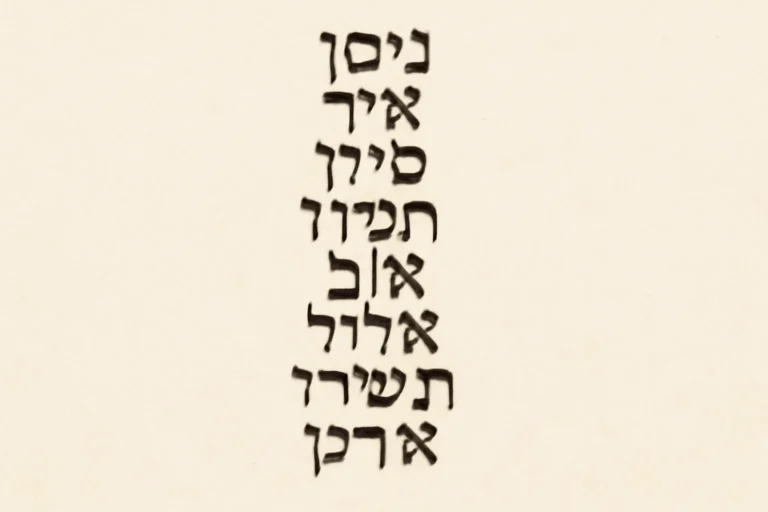
The Hebrew calendar is a lunisolar system used to set the dates of Jewish religious events and civil timekeeping. Its months follow a fixed sequence most years, but it includes a notable adjustment in leap years when an extra month is inserted. The names of the months come from ancient biblical times, and over centuries they have acquired multiple transliterations and spellings in English. In this article, we explore the names and order of the months, explain variations in spelling, and describe how the months align with seasons and holidays. You will encounter common variants such as Nisan (also Nissan), Iyar (often Iyyar), and the more flexible month around the year’s end, Cheshvan (also Heshvan or MarCheshvan). We also discuss how leap years introduce Adar I and Adar II, changing the sequence slightly but keeping the same essential rhythm.
Common Year Month Order: 12 Months in Sequence
Common year (non-leap): Adar as the final month
Nisan — also spelled Nissan in some sources; the first month of the ecclesiastical year. In many traditions, Nisan begins the spring season in the biblical land and carries the weight of Passover celebrations. The 15th day of Nisan marks the festival of Pesach (Passover), a central event in Jewish liturgy and memory. The Omer counting runs from day one after Pesach, linking Nisan to the next month.
Seasonal context: Springtime in the Northern Hemisphere; agricultural motifs in ancient Israel are echoed in liturgy and ritual imagery.
Key observances: Pesach (Pesach Sheni in some contexts), Matzah imagery, Leaven-free meals, and symbolic liberation narratives.
Iyar — also rendered Iyyar or Iyár in some transliterations. The second month of the ecclesiastical year often follows Nisan with a more introspective, counting-focused rhythm. Iyar tends to sit in the latter portion of spring in many climates and forms the bridge to Sivan.
Seasonal context: Late spring into early summer—mild weather in parts of Israel and many diaspora communities.
Key observances: The ongoing Omer count, which connects Passover to Shavuot. Lag BaOmer is celebrated on the 18th of Iyar in many communities, providing a festive pause within the Omer period.
Sivan — also written Sivan (some older texts use alternate spellings). The third month in the ecclesiastical sequence leads toward the festival of Shavuot.
Seasonal context: Early summer in many regions, with wheat harvests in biblical memory.
Key observances: Shavuot, celebrated on 6–7 Sivan, with Torah readings, dairy foods, and late-night study in many communities.
Tammuz — also known as Tamuz or Tammuz. The fourth month in the sequence continues the spring-to-summer arc and is often associated with heat and transition.
Seasonal context: Onset of hotter days in many climates; practical rhythms of the agricultural year begin to recede.
Key observances: 17th of Tammuz, a fast day observed by many communities, marking historical events that led to later lamentations and spiritual reflection.
Av — sometimes called Av and sometimes referred to in older texts as the heart of the summer fast. The ninth of Av in the civil calendar has deep historical resonance for Jewish communities.
Seasonal context: Summer heat, with various communities drawing on historical memory as the year moves toward late summer.
Key observances: Tisha B’Av on the 9th of Av, a major fast day that commemorates the destruction of the First and Second Temples; intensifications of mourning rituals for many communities.
Elul — the month of preparation and reflection before the Days of Awe. Elul serves as a spiritual lead-up to the new year, and many communities add extra prayer and introspection during this period.
Seasonal context: Late summer; a time for self-examination and readiness for the upcoming year.
Key observances: Selichot prayers (special penitential prayers) begin in earnest in many communities; fewer public holidays, more personal and communal prayer.
Tishrei — a deeply centric month that anchors the Jewish holiday year. In many calendars, Tishrei is the start of the civil year in the diaspora and the focal month for the most solemn and celebratory days.
Seasonal context: Autumn in the Northern Hemisphere, with leafy colors and harvest imagery.
Key observances: Rosh Hashanah (two days), Yom Kippur, Sukkot (and Shmini Atzeret, Simchat Torah). Each festival has distinctive liturgy, rituals, and customs—memorial prayers, shofar blasts, sukkah dwellings, and Torah readings.
Cheshvan — also called Heshvan or MarCheshvan in some traditions. This month is notable for its flexibility in length and its role in balancing the calendar.
Seasonal context: Late autumn into early winter; often a comparatively quiet month liturgically.
Key observances: In many years there are no fixed holidays in Cheshvan; its length (29 or 30 days) helps set up Kislev and Tevet for upcoming observances.
Kislev — frequently linked to the festival of Hanukkah, which often falls in Kislev and can spill into Tevet depending on the year. Kislev’s length—29 or 30 days—affects when Hanukkah starts in some years.
Seasonal context: Early winter; lights and songs characterize many communities during Kislev.
Key observances: Hanukkah, a festival of lights with candle lighting, special foods, and songs celebrating rededication of the Temple.
Tevet — the eleventh month, often bringing colder weather and a quiet pace in many communities.
Seasonal context: Winter in many places; a period of transition toward Tu BiShvat and late winter.
Key observances: Ta’anit Tevet, a minor fast day observed by some communities.
Shevat — the twelfth month in the ecclesiastical year; Tu BiShvat (the New Year for Trees) is a major festival in this month, associated with planting and environmental reflection.
Seasonal context: Deep winter giving way to early hints of spring in parts of the land of Israel.
Key observances: Tu BiShvat, a day of plant-based symbolism, fruit foods, and environmental awareness in many communities.
Adar — in a common year, Adar is the last month of the cycle and is strongly tied to the festival of Purim. In leap years, this month splits into Adar I (Adar Rishon) and Adar II (Adar Sheni), with Purim typically celebrated in Adar II.
Seasonal context: Late winter into early spring; a festive counterpoint to the solemn days of winter.
Key observances: Purim (and associated acts of charity, gifts of food, and festive readings). In leap years, Purim often falls in Adar II, while some communities host events in Adar I as a lead-up.
The Hebrew calendar follows a 19-year cycle with leap years that insert an extra month, Adar II. In those leap-year years, the order shifts by inserting Adar I before Adar II. The month Adar II holds the Purim observance in most communities, while Adar I is primarily a preparatory month that contributes to keeping Jewish holidays in their correct seasonal window. This leap-year adjustment is essential for aligning the lunar months with the solar year, ensuring that festivals tied to the seasons — especially Passover in spring — occur at roughly the same time each year.
Nisan — (see common year for description)
Iyar — (see common year for description)
Sivan — (see common year for description)
Tammuz — (see common year for description)
Av — (see common year for description)
Elul — (see common year for description)
Tishrei — (see common year for description)
Cheshvan — (see common year for description)
Kislev — (see common year for description)
Tevet — (see common year for description)
Shevat — (see common year for description)
Adar I — Adar Rishon; present only in leap years; begins the extra-month sequence.
Adar II — Adar Sheni; Purim is typically observed in this month; the leap-year shift preserves seasonal alignment.
Across different communities and languages, the month names show a rich tapestry of transliteration variants and historical spellings. You will encounter both Nisan and Nissan, Iyar and Iyyar, and the broader family of names that map onto the same months. The months also carry regional flavors: Sephardic, Ashkenazic, and modern Hebrew pronunciations influence how the names sound in everyday use. The list below captures the main variants you might see in sources, liturgy books, and calendars:
These variants reflect historical usage, religious traditions, and modern Hebrew usage in Israel and the diaspora. The order remains consistent even when the spelling shifts, which makes it easier to recognize the sequence across sources that use different transliterations. Understanding the variations helps readers read calendars, liturgical guides, and historical texts with confidence, without losing sight of the underlying structure.
Seasonal and Festival Highlights by Month
Each month carries its own set of festivals, fasts, and liturgical readings that shape Jewish life. While the core order is fixed, communities often personalize the way they observe these dates. Here is a concise map of some of the major observances and how they typically relate to the months in order. This section uses bold for festival names to provide quick reference for readers scanning the calendar.
Nisan to Sivan: Passover, Pentecost, and the early summer arc
Nisan — Pesach (Passover) on 15 Nisan; the Omer count begins after Pesach; the Exodus narrative is central to liturgy and biblical readings.
Iyar — Omer count continues; Lag BaOmer on 18 Iyar is a festive day in many communities.
Sivan — Shavuot on 6–7 Sivan celebrates the giving of the Torah; customs include staying up late to study and eating dairy foods.