Chronological Old Testament: A Comprehensive Guide to the Bible’s Timeline
Chronological Old Testament is a way of approaching the Hebrew Bible that emphasizes how its books fit together across history. In this guide, we explore the Old Testament chronology, a timeline that helps readers see how events in Genesis, Exodus, the prophetic books, and the historical narratives relate to one another. By presenting the material in a roughly sequential order, we can track the movement from creation-era themes through the formation of a people, the rise and fall of kingdoms, exile, and the post-exilic return. This article uses variations of the term chronological Old Testament and related phrases to demonstrate the breadth of this approach, from Old Testament chronology to the timeline of the Hebrew Bible and beyond.
Understanding the framework of the Hebrew Bible’s timeline
Any attempt at a biblical chronology rests on two kinds of information: the biblical text itself and the surrounding historical scholarship. The Hebrew Bible presents a narrative flow that many readers translate into a working timeline. Yet dates from ancient Near Eastern history are often approximate or debated. As a result, a chronological overview typically offers date ranges rather than precise numbers. To honor both tradition and scholarly caution, this guide presents a dual emphasis: (1) core events with commonly cited ranges and (2) notes about alternative datings used in different traditions or by critical scholarship.
Foundations: primeval history and the patriarchs
Primeval narratives and creation accounts
The opening sections of Genesis establish themes rather than fixed dates. Many readers encounter two overlapping frame narratives: the creation accounts and the antediluvian/postdiluvian genealogies. While these chapters form the theological backdrop for the entire Bible, they are not easily pegged to a single historical moment in the same way later events are. In a timeline of the Old Testament, these lines are often treated as foundational narratives that frame later human history.
The Patriarchs: Abraham, Isaac, Jacob, and Joseph
Abraham and his immediate family appear in the narrative around the early second millennium BCE in traditional dating, with a common traditional anchor around 2000–1800 BCE.
Isaac and Jacob (also named Israel) figure in the same broad era, often placed a generation or two after Abraham and continuing to around 1800–1700 BCE in traditional timelines.
Joseph, who travels to Egypt, is commonly dated to the late 18th century BCE or early 17th century BCE in traditional schemes, with modern scholarship offering a range that reflects the lack of unanimity about early patriarchal dating.
In the context of a chronology of the Old Testament, the patriarchal period is typically treated as a bridge between the patriarchal promises and the later liberation narrative. It is less about precise days and more about how the covenantal relationships begin to shape the people of Israel.
From slavery to nation: the Exodus, wilderness, and settlement
The Exodus and the giving of the Law
The deliverance from Egypt and the receiving of the Law are central to the formation of Israel’s identity. Dating this event is controversial, with two widely cited windows: the early date around 1450 BCE (the traditional early Exodus) and the late date around 1260 BCE (a later Exodus scenario).
Regardless of the precise date, the event leads to the giving of the Sinai Covenant, the giving of the Law, and the establishment of ritual and social order that will shape the nation for generations.
In any chronological Old Testament overview, this era marks the transition from family and clan dynamics to national identity, with the framework of law and worship becoming central pillars of life in the desert and beyond.
Wilderness wanderings and the conquest of Canaan
The Israelites’ sojourn in the wilderness is traditionally dated to a forty-year period following the Exodus. In a working timeline of the Hebrew Bible, this duration is often placed in the second half of the second millennium BCE or the early first millennium BCE, depending on the dating scheme.
The entry into Canaan and the subsequent settlement under leaders such as Joshua are treated as transitional moments, laying the groundwork for the later tribal confederation and, eventually, a centralized monarchy.
Because archaeological data and biblical texts tell different parts of the story, readers of the Old Testament chronology frequently encounter range-based dating: some readers emphasize a mid-second-millennium frame, others a late-second or early-first-millennium frame. The important point remains clear: the settlement of Canaan becomes the geopolitical backdrop for the subsequent leadership period.
The era of the Judges and the rise of the United Monarchy
Judges and tribal leadership
After Joshua, the people of Israel experience a period of judges, a series of regional leaders who deliver, judge, and guide the tribes as they navigate threat and opportunity. This era is often dated roughly from 1200–1020 BCE, though precise dating varies by source.
The book of Judges emphasizes cycles of sin, oppression, repentance, and deliverance, movements that shape the collective memory of Israel and set the stage for expectations of centralized leadership.
Saul becomes the first king of a united Israel, establishing a pattern for monarchy that historians and readers of the chronological Old Testament timeline often place around 1050–1010 BCE.
David ascends to the throne and expands the kingdom, with a reign commonly dated roughly 1010–970 BCE. The consolidation of power and the expansion of political and religious institutions mark this era as a pivot in the biblical narrative.
Solomon follows, often dated 970–931 BCE. His reign is associated with monumental building projects, including the First Temple in Jerusalem, and with a flourishing of poetry and wisdom literature that some scholars attribute to this period.
In the timeline of the Hebrew Bible, the united monarchy represents a high point in political unity and religious centralization. It also sows seeds of division that will become prominent in the subsequent section of the narrative.
The Divided Kingdom and the prophetic era
Division and decline: Israel and Judah
After Solomon’s death, the kingdom splits into the northern kingdom of Israel (also called Samaria) and the southern kingdom of Judah. This division is dated around 931 BCE.
The two kingdoms experience different fortunes: Israel falls to the Assyrians in 722 BCE, while Judah endures longer, facing Assyrian pressure and later Babylonian conquest.
Prophetic voices and messages during the monarchy
Major prophets such as Isaiah, Jeremiah, and Ezekiel address events from the late 8th century BCE through the exile and return. Their messages engage with royal responsibility, social justice, and faithfulness to the covenant.
The minor prophets (Hosea through Malachi) contribute a diverse tapestry of messages about loyalty to God, judgment, hope, and restoration across the same broad period.
In terms of the Old Testament chronology, this era is key for understanding the push and pull between religious reform, political power, and prophetic critique. The prophetic literature often functions as a counterpoint to the political timeline, offering theological interpretation of historical events.
Exile, return, and the post-exilic period
The exile and the shaping of identity
The destruction of Jerusalem and the Temple, and the exile to Babylon, anchor the central turning point of the narrative in the late 6th century BCE. A common dating is 586 BCE for the destruction of the temple and the deportation of leaders and skilled artisans to Babylon.
During and after the exile, the community reflects on covenant faithfulness, temple worship, and the preservation of tradition. This period gives rise to much of what later readers call the post-exilic or return-to-Jerusalem phase.
The return and rebuilding under Zerubbabel, Ezra, and Nehemiah
The return from exile begins under the Persian decree and continues with leaders such as Zerubbabel, Ezra, and Nehemiah.
The reconstruction of the temple (the Second Temple period) and the rebuilding of the city walls are central milestones. A typical dating places the initial return around 538–520 BCE, with the temple completed roughly a couple of decades later, around 516 BCE, and the wall rebuilt under Nehemiah in the mid-5th century BCE.
Within the larger frame of the Old Testament chronology, the exile and return define a shift from national to religious reform as the dominant historical pattern. The prophetic literature in this era often addresses issues of purity, temple worship, and the renewal of a faithful community.
Putting the timeline together: a working chronology across eras
When assembling a coherent chronology of the Old Testament, many readers use a multi-layered approach that blends historical events with literary genres. Here is a compact, working outline that emphasizes major milestones and the approximate ranges that scholars commonly propose. Note that the dates are quoted as ranges or approximate anchors and reflect both traditional and critical perspectives.
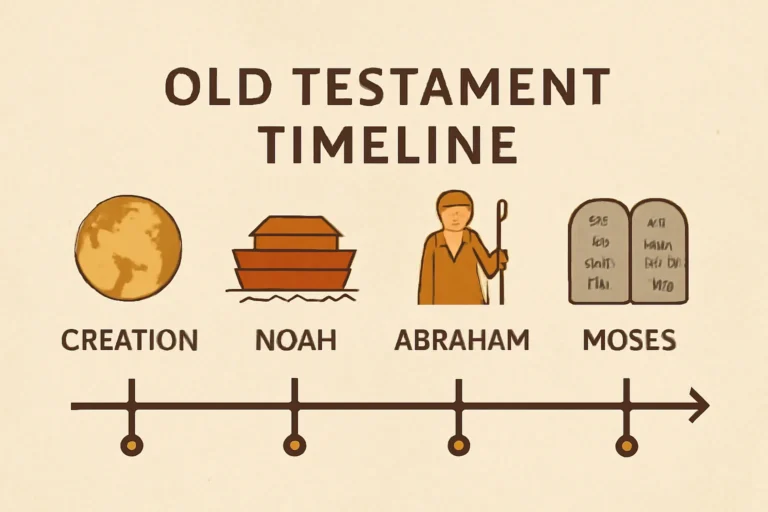
Primeval and patriarchal era: Creation narratives to the emergence of the families that become the tribe of Israel; traditional anchors place Abraham around 2000–1800 BCE, with later eras bridging toward the conquest.
Exodus and wilderness: Slavery in Egypt, the Exodus, Sinai covenant, and the giving of the Law; commonly dated within 1450–1260 BCE depending on the betting tradition used.
Conquest of Canaan and the period of the Judges: Settlement of the land, tribal leadership, and intermittent cycles of deliverance; roughly 13th–11th centuries BCE.
United monarchy: Saul, David, and Solomon; centralization of worship and political power; commonly dated to 1050–931 BCE.
Divided monarchy: Israel and Judah exist as separate kingdoms; major prophetic activity intensifies; dates span approximately 931–586 BCE.
Babylonian exile: Fall of Jerusalem, deportation, and the beginning of a reflective, reform-minded community; commonly dated to 586–538 BCE.
Return and restoration: Rebuilding the temple and walls, reforms, and the shaping of post-exilic identity; dates typically 538–332 BCE.
As you study, you will notice the chronological Old Testament timeline emphasizes connection points: how the promises to the patriarchs unfold into the nation’s formation, how the covenant shapes worship and law, and how exile becomes a catalyst for renewed faith. Each era offers a different lens on the same throughline: covenant fidelity and the struggle to remain faithful within changing political circumstances.
Canonical order versus historical sequence: reading the timeline wisely
One common challenge in Old Testament chronology is reconciling the canonical order of books with a linear historical sequence. The Bible places books in a literary order that reflects themes, genres, and the development of the covenantal story rather than a straightforward day-by-day history. For example, the historical narratives (Joshua, Judges, Samuel, Kings) are interwoven with prophetic writings and wisdom literature. As a result, readers often create a hybrid timeline that uses the logical progression of events alongside the canonical arrangement. This approach helps you see how the timeline of the Hebrew Bible develops in stages and how prophetic voices respond to specific historical moments within that timeline.
How to read a chronological chart of the Old Testament
When you encounter a timeline chart for the Old Testament, keep these practical tips in mind:
Look for the major eras first: primeval history, patriarchs, exodus/wilderness, conquest and judges, united monarchy, divided monarchy, exile, and return.
Note the major events that anchor each era: the Covenant at Sinai, the establishment of the Temple, the fall of Jerusalem, and the return under Persian rule.
Track major figures across eras: Abraham, Joseph, Moses, David, Solomon, Zerubbabel, Ezra, and Nehemiah.
Understand that dates are approximate and vary by tradition. Use ranges rather than precise numbers when you compare different sources.
Recognize the interplay between political history and theological themes. Chronology is not only about what happened when; it is about how Israel interpreted its past in relation to God’s covenants and promises.
Although the Bible is a collection of many books with distinct purposes, certain books serve as anchors in a chronological Old Testament framework. Here are examples of how some core books contribute to the timeline:
Genesis and Exodus establish the patriarchal promises, the germinal covenant, and the formation of the nation.
Leviticus, Numbers, and Deuteronomy lay out the law and the wilderness generation’s experiences, which shape later worship and civil life.
Joshua and Judges narrate the initial entry into the land and the cycle of leadership that precedes the monarchy.
Samuel and Kings trace the rise and fall of the united and then divided kingdoms, capturing the political arc of Israel and Judah.
Ezra and Nehemiah document the return from exile and the rebuilding effort that reconstitutes religious life and community structures.
Isaiah, Jeremiah, Ezekiel, and the minor prophets provide the prophetic voices that contextualize events within a covenantal frame and describe visions of future restoration and judgment.
Common pitfalls and how to interpret chronology carefully
Readers new to biblical chronology sometimes encounter a few pitfalls. Being aware of them helps you study more accurately and responsibly:
Assuming a single, fixed date for complex units like the Exodus or the Patriarchs. In reality, there are multiple plausible dates, and scholars differ on the exact years.
Confusing literary chronology with historical chronology. Some chronological signals come from the text’s structure and theological aims, not from a precise historical dating system.
Overemphasizing a single dating scheme. A robust view of Old Testament chronology recognizes divergent timelines while maintaining a cohesive overall story.
Ignoring the influence of external history. The biblical timeline interacts with surrounding empires (Egypt, Assyria, Babylon, Persia), which provide context for the events described in the prophetic books and the historical narratives.
How chronological study enhances understanding of biblical themes
A well-constructed timeline of the Old Testament does more than place events on a calendar. It illuminates the growth of central themes, such as covenant fidelity, the role of worship and the temple, and the dynamics of power and exile. Here are a few examples of how chronology deepens comprehension:
Seeing how the covenant evolves from a familial promise to a national framework helps explain why laws, temple worship, and priestly duties become central in later books.
Understanding the exile as a turning point clarifies why post-exilic writings emphasize identity, reform, and the reordering of religious life around non-temple-centered texts such as Ezra-Nehemiah and certain prophetic writings.
Tracing the prophetic voices across the same historical arc reveals how prophets respond to the same events with different emphases—social justice, national security, and hope for future restoration.
Variations in dating and how to navigate them
When you consult different chronological Old Testament resources, you will encounter a spectrum of dating. To navigate these differences, consider these guidelines:
Recognize that dating is often approximate and depends on the scholarly framework (traditional, critical, or canonical timelines).
Use comparative timelines to see how different scholars arrange the same events. This can help you appreciate why certain events are linked to specific kings, empires, or exilic periods.
Remember that the Bible itself sometimes presents chronology in a theological rather than strictly historical sense. A good study respects both modes of reading.
Here are practical methods to build your own robust timeline of the Old Testament in study or teaching contexts:
Create an eras-based map. Start with broad eras (Primeval, Patriarchs, Exodus/Wilderness, Judges, United Monarchy, Divided Monarchy, Exile, Return) and then place key events within each era.
Pair books with eras. For instance, place Joshua and Judges in the entry-into-Canaan period; Samuel and Kings in the monarchy era; and Ezra and Nehemiah in the post-exilic return.
Annotate with political and theological themes. Indicate where worship practices, temple rededication, or prophetic critique appear to interact with political events.
Note alternate dating. When a source presents a different date for a major moment (e.g., the date of the Exodus or the fall of Jerusalem), include both ranges and briefly explain the reason for the divergence.
The following bullets highlight the major turning points in the chronological arc of the biblical story. They are presented with their typical date anchors and a brief note about their significance within a timeline of the Hebrew Bible:
The Exodus and the Sinai revelation — pivotal for covenantal identity; traditional anchors suggest 15th–13th centuries BCE.
The Conquest and settlement in Canaan under leaders such as Joshua — a foundational step in forming national life; commonly placed in the 13th–12th centuries BCE.
The period of the Judges — cycles of deliverance and rebellion shaping collective memory; dated roughly 12th–11th centuries BCE.
The United Monarchy under Saul, David, and Solomon — the height of political unity and temple-building; commonly dated 11th–10th centuries BCE.
The Divided Kingdom — Israel and Judah operate separately; major prophetic activity and political upheaval; 931–586 BCE.
The Babylonian exile — the destruction of Jerusalem and the temple, deportation, and a reimagining of community life; commonly 586–538 BCE.
The Persian period and the return — the rebuilding of the temple and walls, religious reform, and the reconstitution of life in Jerusalem; often dated 538–332 BCE.
Adopting a chronological perspective in discussing the Old Testament chronology helps teachers and students connect the dots between diverse literary genres and historical moments. It clarifies why certain prophetic messages arise in particular eras, how priests and kings influence worship and law, and why exile becomes a turning point for identity formation. A robust approach to the chronology of the Bible also fosters careful reading and a more informed sense of how ancient authors understood time, memory, and destiny under the sovereignty of God.
To support readers working through a timeline of the Old Testament, here are key terms frequently used in chronology-focused discussions. Each term is bolded to highlight its central role in the narrative:
Patriarchs: The founding fathers of Israel—Abraham, Isaac, and Jacob—whose stories establish the oath-bound relationship with God.
Covenant: The binding agreement that shapes how Israel relates to God and to one another, evolving through the Law and the temple system.
Exodus: The deliverance from Egypt and the liberation that leads to the wilderness journey and Sinai covenant.
Sinai Covenant: The moment when the law is given and a distinctive communal life is defined.
Temple worship: Central religious institution in Jerusalem that anchors ritual life during much of the monarchic and exilic periods.
Prophetic literature: The writings that interpret events in light of covenant faithfulness, often addressing social justice, repentance, and future restoration.
Exile: The diaspora experience in Babylon that reshapes religious consciousness and identity for post-exilic writers.
Return: The era of rebuilding under leaders like Zerubbabel, Ezra, and Nehemiah, reestablishing worship and community life in Jerusalem.
Ultimately, the chronology of the Old Testament presents a cohesive theological arc: a people called into relationship with God, living within a covenant framework, facing moments of crisis and reform, and enduring through exile into a renewed post-exilic community. The timeline is not merely a ledger of dates; it is a narrative device that helps readers see how the biblical authors understood history as a field in which divine purposes unfold across generations.
For learners who want a quick reference, here is a compact outline of the major chronological checkpoints, keeping in mind that dates are approximate and vary by tradition:
Origins and patriarchal foundations: traditional anchors around 2000–1800 BCE.
As you explore the Old Testament chronology, you will notice the interplay between war, diplomacy, worship, and prophecy. Each era reveals how faith, law, and memory are preserved and reinterpreted in response to new circumstances. Whether you approach the Bible as a religious text, a literary archive, or a historical document, the chronological Old Testament framework offers a powerful lens for understanding how the narrative of Israel unfolds across centuries, informing later Jewish and Christian reflections on time, purpose, and hope.