Genesis Timeline: Chronology of Creation and Early Biblical History
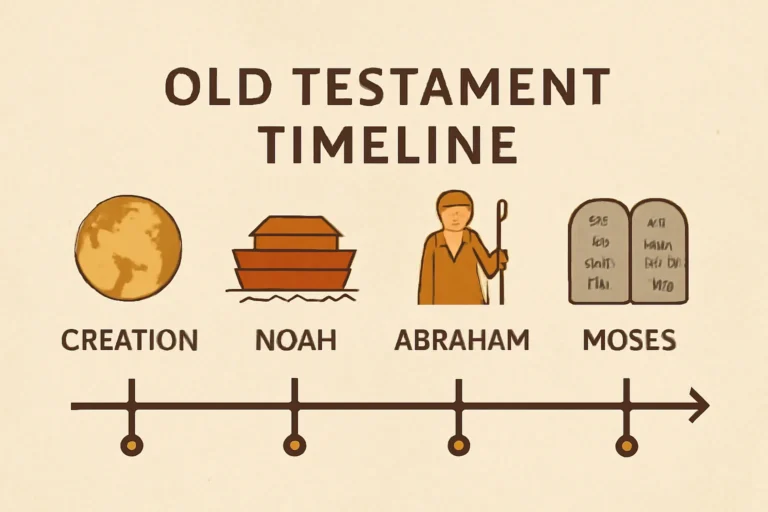
The Genesis timeline offers a framework for understanding how the earliest events of biblical history unfold. This article surveys the sequence from the initial act of Creation to the formation of the patriarchal narratives that shape the rest of the Hebrew scriptures. Rather than presenting a single, rigid chronology, the timeline emphasizes pivotal moments, key figures, and enduring themes that recur across generations. Readers will encounter the layered structure of Genesis—the ordered days of creation, the pre-Flood generations, the Flood and its aftermath, the dispersion at Babel, and the rise of the Patriarchs—as a single, coherent arc that informs later biblical history.
The Creation Narrative: Chronology of Creation
The Genesis creation account is organized into a seven-day framework, followed by a divine rest. This portion of the timeline establishes the basic categories of time, space, and life that ground the entire biblical story. Each day presents a new realm or form of life that God brings into being, culminating in a sacred rhythm that informs later Israelite theology and worship.
The Days of Creation: A Day-by-Day Outline
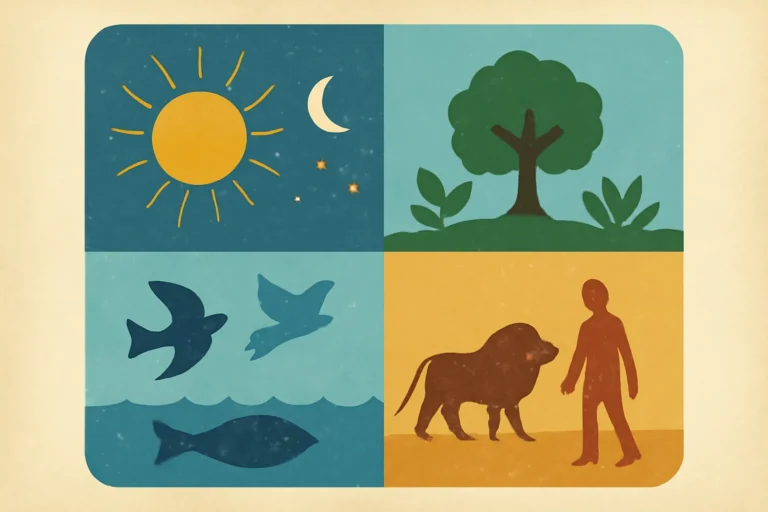
Day 1: Light is separated from darkness. The firm statement “Let there be light” marks the beginning of time and marks the creation of day and night. The purpose is not merely illumination but the establishment of temporal order—the cadence of evening and morning that frames the week.
Day 2: The heavens are formed, creating the firmament to divide the waters above from the waters below. This separation introduces the structure of the sky and the seaward and celestial domains that we inherit in the biblical imagination.
Day 3: Dry land appears, seas gather, and vegetation springs forth—plants bearing seed and fruit trees. The world takes on a visible geography: land, seas, and a biosphere prepared to sustain life.
Day 4: The sun, moon, and stars are set in place to govern day and night, marking seasons, days, and years. Light-bearing bodies become markers of time and signs of divine order within the created cosmos.
Day 5: Creatures of the sea and birds of the air populate the skies and waters. Life proliferates in the waters and in the air, moving the creation toward ecological fullness.
Day 6: Land animals are formed, and humanity is created in the divine image. People are given dominion over other creatures, and a distinct moral and relational capacity is introduced—humans as bearers of the Imago Dei.
Day 7: God rests, blessing and sanctifying the seventh day. The pattern of work and rest becomes a foundational rhythm for human life and for Israelite practice in later centuries.
The creation week is not only a sequence of facts about origins; it is a theological statement about order, purpose, and relationship. The repeated verdict “And God saw that it was good” underscores that each stage fulfills a divine purpose, culminating in the advent of humanity as the pinnacle of the created order. The biblical author uses this framework to speak about truth, responsibility, and care for the world that follows in the rest of Genesis and into the wider scriptural narrative.
Theological Threads Embedded in the Creation Account
Imago Dei: Humanity bears the divine image, which has ethical and relational implications for human dignity, responsibility, and stewardship of creation.
Order and Sabbath: The six-day pattern followed by rest emphasizes purpose and rhythm in human life and worship.
Goodness and blessing: Creation emerges as a gift with inherent value, and God blesses human beings to flourish in a well-ordered world.
From Creation to the Flood: The Antediluvian Generations
As the Genesis timeline moves beyond the initial act of Creation, it enters a long stretch of human generations that populate the pre-flood world. This section traces notable figures and key developments from Adam to Noah, highlighting genealogies, moral questions, and the deepening sense of human ruin that leads to divine judgment and renewal.
Adam and Eve as the first humans, whose disobedience introduces sin into the world and shapes the life of every successor.
Seth, born after Abel’s death, seen as a restoration of the line that will lead toward righteous descendants.
Early generations unfold with lifespans that stretch into centuries, creating a sense of antiquity and continuity in the human story.
Enoch, a figure notable for walking with God and being taken up, signaling a divine invitation beyond mortal limits.
Noah, a pivotal figure who, despite widespread corruption, is found righteous in his generation and becomes the instrument through which humanity is preserved after the Flood.
The antediluvian period culminates in a dramatic turning point: the rapid escalation of human wickedness, God’s decision to judge the world with a flood, and the preservation of a remnant through the ark. This transition is not merely a historical pivot but a theological hinge, connecting the pre-Flood world with the post-Flood promise that God will govern creation with mercy and fidelity to the covenant.
The Flood and Its Aftermath: A Reboot of Humanity
The flood narrative forms a central axis in the Genesis timeline. It dramatizes judgment, mercy, and renewal in a way that reshapes the human horizon. The ark becomes a symbolic vessel of salvation, carrying Noah, his family, and representatives of animal life through a cataclysm that alters the course of creation. The flood narrative contains several moving parts: divine instruction, obedience in construction, a period of judgment, and a post-flood covenant that redefines God’s relationship to humanity and the animal kingdom.
The Flood Timeline in Brief
God observes human violence and corruption, determining to judge the earth.
Noah is commissioned to build an ark according to precise dimensions and materials, demonstrating obedience and trust in divine λόγος (word) and design.
The floodwaters rise and cover the earth, absorbing all thought of human arrogance, while the ark preserves life within its protective enclosure.
The waters eventually recede after months, and the ark comes to rest on mountains in the region of Ararat. Gradually, the ground dries, enabling Noah and his family to re-enter the world and repopulate the earth.
Noah sacrifices to God, and a covenant is established with a sign—the rainbow—affirming a lasting relationship between God, humanity, and the natural world, with the exhortation to curb violence and bloodshed.
The covenant after the Flood reframes human purpose by stressing restraint and responsibility. It also introduces a new cosmology in which human beings interact with the animal kingdoms and the elements under clear divine governance. The post-Flood world presents humanity not as a blank canvas but as a renewed canvas with a stronger emphasis on obedience, neighborliness, and discernment about violence and power.
The Post-Flood World: The Table of Nations and the Babel Event
Following the flood, Genesis 9–11 traces a transitional era in which the human family grows into distinct nations, languages, and cultural centers. This section highlights the genealogical bridge from Noah’s sons to future patriarchs, and it culminates with the story of Babel, a landmark event that explains linguistic and cultural diversity while underscoring the social dynamics of pride, unity, and divine intervention.
Descendants and the Nations
Shem, Ham, and Japheth emerge as the three major lines, spreading across regions that will be inhabited by diverse peoples and tribes in later biblical texts.
The Table of Nations (Genesis 10) maps out the genealogies and geographic distribution of the world’s peoples, illustrating how a single family expands into a mosaic of cultures.
Despite differences, a common divine purpose remains: the world is to be inhabited and stewarded under divine sovereignty, yet human pride and disobedience can disrupt this order, as the Babel episode shows.
The Tower of Babel: Linguistic Dispersal and Social Consequences
The Babel incident occurs when humanity united in one language attempts to build a city and a monumental tower to secure lasting fame. God confuses their language, causing them to scatter across the earth. This narrative introduces a crucial foundation for understanding cultural diversity and the formation of distinct communities. It also raises questions about ambition, worship, and collective identity in the face of divine intention.
The Call of Abram: A New Phase in the Genesis Timeline
With the dispersion of nations, the scriptural focus narrows to the family of Abram (later named Abraham). The Genesis timeline pivots from broad anthropological themes to intimate, covenantal relationships that redefine blessing, land, and promise. The call of Abram marks the emergence of a people who will become the vehicle for God’s purposes in the world. The terms of the Abramic Covenant establish enduring motifs that recur in later biblical history: land, offspring, and a mission to be a blessing to all nations.
The Call, Promise, and Covenant
Abram’s call to leave his homeland and trust in the unseen God who promises a great nation, a blessed lineage, and a universal vocation.
The promises regarding land (Canaan), offspring (descendants more numerous than the stars), and blessing for all nations through Abram’s line.
Sign of the covenant in circumcision, making the people physically marked as belonging to the divine purpose and community.
The narrative of Abraham’s family unfolds through episodes of testing, hospitality, and interaction with neighboring peoples, all framed by the overarching covenant that God will maintain fidelity to the chosen line even when human frailty appears. The genesis of the patriarchs gradually shifts the timeline from a universal creation-oriented perspective to a particularist story about blessing, land, and people formation that historians and theologians continue to discuss and interpret.
Isaac, Jacob, and the Shift to the Patriarchal Focus
The next phase of the Genesis timeline centers on Isaac, Jacob, and Joseph, each contributing to the unfolding drama of a family that becomes a nation. Isaac’s role is often viewed as a bridge between the calling of Abraham and the more expansive narratives surrounding Jacob and Joseph. Jacob’s life is rich with experiences—struggling with divine calls, crafting family alliances, and wrestling with faith under pressure. Joseph’s journey—betrayal by his brothers, ascension in Egypt, and the preservation of his family during famine—offers a dramatic arc of personal virtue and providential care that resonates deeply in Jewish and Christian readings of Genesis.
Isaac: The Covenant Continues
Isaac inherits the promises given to Abraham and becomes a conduit of the covenant through whom the next generation is affirmed.
The narrative emphasizes the continuity of divine faithfulness across generations and the ways in which parental faith shapes the spiritual landscape of descendants.
Jacob: The River of Destiny
Jacob acquires the birthright and blessing through a set of countercultural choices, signaling a shift toward a family-centric drama rather than a purely national narrative.
The twelve sons of Jacob become the progenitors of the tribes of Israel, and their stories explore themes of siblings’ rivalry, reconciliation, and divine guidance in human affairs.
A pivotal moment is Jacob’s encounter with the divine figure at Bethel, often recalled for the dream of the ladder and the ongoing confirmation of a divine plan for his descendants.
Joseph: Providence within a World Power
Joseph’s experiences—from betrayal by his brothers to his ascent in Egypt—illustrate how the Genesis timeline threads personal virtue, political dynamics, and survival under pressure into a story of sustenance and rescue for the ancestors.
His interpretation of dreams, his administrative gifts, and his steadfastness under trial culminate in a dramatic reunion with his family, ensuring the survival of the line that will eventually become the people of Israel.
The arc from Abraham to Joseph shows a deliberate narrowing of focus toward a family lineage that will bear the seed of blessing for all nations. The Genesis timeline thus shifts from broad cosmological themes to intimate narratives about faith, promise, and perseverance in a world that is often hostile or uncertain about divine plans.
Synthesis: Reading the Genesis Timeline as a Whole
Viewed as a single, integrated arc, the Genesis timeline presents several persistent motifs that recur in later biblical literature. Notice how creation provides a template for order and purpose, how sin disrupts that order yet invites divine mercy, and how covenant, rather than mere law, becomes the instrument by which God sustains a relationship with humanity. Across the seven days of creation, the flood, the Babel episode, and the journey through the patriarchs, readers encounter a sequence that combines dramatic narrative with theological reflection. The timeline is not only about when things happened; it is about what those happenings reveal regarding God’s character, humanity’s vocation, and the ongoing conversation between heaven and earth.
How to Use the Genesis Timeline for Study and Reflection
For students, teachers, and curious readers, the Genesis timeline offers a practical framework for approaching the text with clarity and depth. Here are some effective approaches to engage with the material:
Chronological study: Trace events across chapters to see how one episode leads to another and how themes evolve from creation to Abrahamic faith.
Thematic study: Focus on key motifs—covenant, blessing, obedience, faith under pressure, and divine judgment and mercy—and observe how they appear in multiple sections of the timeline.
Character studies: Examine the major figures—Adam, Noah, Abraham, Isaac, Jacob, and Joseph—and explore how their choices contribute to the overall trajectory of Genesis.
Literary analysis: Consider how the narrative devices (dreams, genealogies, covenants, and symbolic acts) structure the timeline and invite interpretive layers beyond a simple sequence of events.
Theological reflection: Reflect on how the creation account grounds moral vision, how the flood reframes human responsibility, and how the patriarchs model faith and ethical commitments in community life.
Glossary of Key Terms in the Genesis Timeline
To help readers navigate the material, here is a brief glossary of terms that recur throughout the Genesis narrative and beyond. Bold terms indicate especially important concepts within the timeline.
Creation – the act of bringing the cosmos into existence, establishing order, purpose, and the foundational rhythm of time.
Imago Dei – the divine image in which humans are created, conferring dignity, responsibility, and relational vocation.
Covenant – a binding, enduring promise between God and humanity, often accompanied by a sign or ritual (e.g., the rainbow after the Flood, circumcision with Abraham).
Ark – the vessel of salvation built by Noah to preserve life through the Flood; a symbol of divine rescue and faithfulness.
Patriarchs – the male ancestors of Israel (e.g., Abraham, Isaac, Jacob) whose stories shape the early genetic and spiritual lineage of the people of God.
Table of Nations – the genealogical account that maps the spread of peoples after the Flood, linking families to geographic regions and cultural identities.
Tower of Babel – the narrative explaining the diversification of languages and cultures, highlighting human pride and divine sovereignty.
Abram/Abraham – the central progenitor whose calling and covenant inaugurate the shift from universal creation to a focused mission for a chosen line.
Descendants – the offspring through whom divine promises extend and through whom the future of Israel is secured in the Genesis timeline.
Why the Genesis Timeline Matters Today
Beyond ancient history, the Genesis timeline provides a lens for contemporary debates about creation, ethics, and community life. It invites readers to reflect on the nature of work, rest, and responsibility in a world that faces ecological and social challenges. It also raises perennial questions about trust in the divine plan: How does one respond to uncertainty? What does it mean to live in a covenantal relationship with God and with others? How do individual choices ripple through generations? These questions persist in every era, and the Genesis timeline offers a vocabulary and framework for exploring them with integrity and curiosity.
Continuing the Journey: From Genesis to the Rest of the Bible
While this article focuses on the Genesis timeline, the threads laid down here extend through the entire scriptural narrative. The patriarchs’ stories become the seedbed from which the Israelites emerge as a people, the laws and prophets develop a distinctive ethical and spiritual framework, and the biblical authors read back into the distant past to shape present faith. The creation narratives, the flood, Babel, and the patriarchs all serve as interpretive keys for understanding God’s dealings with humanity in the rest of Scripture.
In sum, the Genesis timeline is a multi-layered portrait of origins, formation, testing, and renewal. It invites readers to appreciate not only what happened, but why those events matter for how people think about life, community, and ultimate purpose. By tracing the path from Creation to the Patriarchs and their descendants, readers gain a comprehensive view of early biblical history—an essential foundation for any study of the Bible and its enduring message for the world.