Foundations of the Second Temple: From Exile to Reconstruction
In Jewish history, the Second Temple refers to the period of worship and national life centered on Jerusalem from the return from exile until the destruction by Rome in 70 CE. After the fall of the First Temple in 586 BCE, the exile and the subsequent restoration created a memory of sacred space that would shape the religious imagination for centuries. The early phase of the rebuilt sanctuary emerged under a Persian authorization, with leaders such as Zerubbabel and Yehoshua guiding the project. The aim was not merely to reconstruct a building but to reconstitute a covenantal center where offerings, law, and communal life could converge, even as the community faced ongoing political and geographic complexity under imperial rule.
The emergence of the Second Temple era coincided with a shift in how Jewish worship was experienced. While the land remained under imperial governance, the temple became an anchor for religious identity and a locus for the reestablishment of priestly authority, civic rituals, and national memory. As a result, this temple served as the focal point for annual pilgrimages, sacrificial rites, and the institutional life of the priesthood. The early sanctuary established a template that would endure through successive decades, adapting to changing political circumstances while preserving a core set of practices that defined Jewish worship in a post-exilic world.
For students of ancient history, the timeline of the early Second Temple period can be framed around a few key moments and actors:
The Persian period provided permission for return and rebuilt religious life after decades of exile.
The return leadership under Zerubbabel (a governor) and Yehoshua (the high priest) set in motion the restoration of the sanctuary and of priestly functioning.
The completion of the initial shrine around 516 BCE established a tangible center for sacrificial service, even as the wider political scene remained unsettled.
Over the ensuing centuries, the Temple precincts grew in significance as a site of teaching, jurisprudence, and ritual life beyond its walls.
In many respects, the early chapters of the Second Temple narrative are a story of continuity and adaptation: continuity with the covenantal idea of a sacred space, and adaptation to new imperial frameworks that helped sustain a distinctive worship life. The result was a hybrid model of religious practice that could accommodate temple service, literary study, and community governance, all anchored by the sanctity of the Jerusalem sanctuary.
Herod the Great and the Expanded Temple: Architecture and Ambition
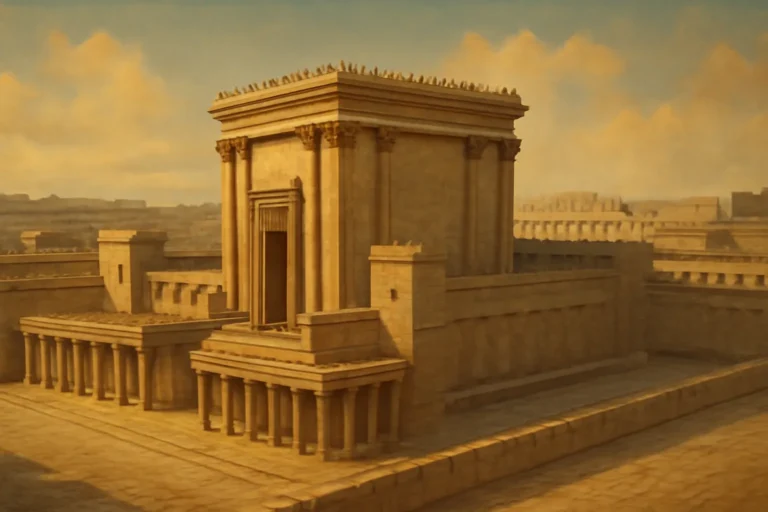
By the time of Herod the Great, the Jerusalem temple complex had been transformed into one of the most ambitious sacred sites in the ancient world. The Herodian expansion did not merely enlarge the sanctuary; it redefined the entire platform, creating a vast elevated precinct that could accommodate large crowds, pilgrims, and a complex program of offerings. This monumental project reflected the synagogues of a diaspora reality by enabling faithful participation and enhancing the visibility of the temple’s authority across the region.
The architectural narrative of the late Second Temple era centers on several defining features:
A massive platform—often described as a broad, elevated plaza—framing the precincts and providing space for ascent, processions, and gatherings.
Retaining stone walls built from enormous blocks, which still stand as remarkable testimonies to Roman-era engineering and the resources mobilized for religious expression.
A refined sanctuary within the overall complex, including ancillary courts and spaces that facilitated ritual offerings, teaching, and administrative life.
The renown of the Western Wall as a surviving element of the temple’s surrounding fortifications, which has persisted as a place of prayer and reflection for generations.
Herod’s program can be traced through a sequence of changes in layout and scale. The tallness of the retaining walls, the expansion of the platform, and the refinement of the sanctuary’s exterior and interior appearances all signaled a new era of public religiosity and civic identity. The project was a political as well as religious statement: it demonstrated the elite leadership’s commitment to sacred space, to Rome’s tolerance for local cultic life, and to the idea that worship could be publicly demonstrated on a grand scale while remaining rooted in biblical tradition.
Within the broader Temple Mount complex, several spatial zones defined access and ritual function. The outer courtyards welcomed visitors and displayed the grandeur of the sacred space, while inner gates led to progressively restricted precincts, culminating in the Holy of Holies—the most sacred interior room, which historically housed the divine presence as interpreted by ancient Israelite tradition. Although the physical contents of the Holy of Holies from the later period are not available for public study, the layout demands reverence and ritual precision, reflecting a hierarchy of spaces and roles within the priestly order.
Religious Life in the Second Temple Era: Practice, Leadership, and Calendar
The Second Temple era was not solely a matter of architecture and festivals; it was a living system of worship, law, and communal governance. The temple precincts functioned as a center for ritual life, education, and political identity, where the priestly class—led by the high priest and the priestly families—oversaw offerings, readings of the law, and instruction for the people. The religious calendar revolved around three annual pilgrimage festivals, intense seasonal rites, and ongoing sacrifices performed by an organized priesthood.
Key themes in temple-centered life include the following:
Priestly caste and succession: The high priest and his subordinates presided over sacrifices, divination, and the administration of temple goods. The priesthood was not only a religious office but also a social and economic actor within the broader community.
Sacrificial system: At the heart of worship stood offerings, from morning and evening sacrifices to special occasions tied to harvests and ceremonial cycles. The sacrifices were understood as a means of maintaining covenantal relationship with God and ensuring communal well-being.
Festivals and pilgrimages: The pilgrim tradition brought Jews from the diaspora to the sacred precincts during Passover, Shavuot, and Sukkot, turning the temple into a crucial hub of national and religious life.
Teaching and law: The temple precincts were also a place for the study and transmission of law, with rabbinic and priestly interpretations providing guidance for daily life and ritual purity.
During this era, the temple functioned as a living repository of memory. It drew upon scriptural narratives, legal traditions, and ritual practices that older generations had carried from the era of the First Temple. The continuity was not merely physical; it extended to liturgy, ritual cleanliness codes, and the observance of sacred times that bound distant communities to a common religious project. Variations and debates within the priestly circle, as well as pressures from the wider empire, contributed to a dynamic religious environment in which tradition persisted even as new ideas circulated.
The Holy Calendar and its rituals
The temple’s ritual life was deeply tied to a calendar that marked seasons of sacrifice and instruction. The annual timetable centered on major offerings, but it also integrated additional rituals in response to agricultural cycles and communal needs. For adherents, fidelity to the calendar expressed obedience to the covenant and upheld the sanctity of the community. Observers from the diaspora who journeyed to Jerusalem during the festivals reinforced the sense of a shared religious identity that transcended local origin.
The Destruction and Aftermath: End of an Era and Its Echoes
The fate of the Second Temple reached a decisive turning point with the Roman siege of Jerusalem and the destruction of the city in 70 CE. The temple complex, as a sacred center, suffered extensive devastation, and the inner sanctum associated with the Holy of Holies was rendered inaccessible to worshippers. The loss was felt deeply within the Jewish communities of the time and for centuries thereafter, shaping religious consciousness and the way the Temple is imagined in liturgy, poetry, and historical memory.
In the immediate aftermath, the priestly order no longer functioned in the same way, and a new reality emerged for how worship and identity were cultivated. The destruction did not erase the significance of the temple idea; rather, it redirected religious life toward the study of Torah, synagogue-centered practice, and hopes for an eventual restoration. The diaspora communities, in particular, retained a strong attachment to the temple’s memory as a symbol of covenantal fidelity and national continuity.
While the site of the main sanctuary lay in ruins, the physical space around it—especially the platform and its retaining walls—left a durable mark on the urban landscape of Jerusalem. The Western Wall, a remnant of the retaining structure that remains accessible today, became a focal point for prayer and reflection for many generations. The memory of the temple endured as a powerful symbol in Jewish liturgy and art, often invoked in prayers that express longing for restoration and divine presence.
Archaeological Insights into the Second Temple World
Direct archaeological evidence for the interior of the temple sanctuary itself is limited due to the sacred status of the Temple Mount and the later Islamic constructions that occupy the site. However, a broad range of material remains, architectural fragments, and excavated contexts on nearby sites provide a rich picture of what the Second Temple period looked like and how people lived around the sacred precincts. Archaeology has helped scholars refine questions about urban planning, daily life, and the dynamics of ritual space in late antiquity.
Important lines of evidence include the following:
Large and precisely cut stones in the Herodian walls, which reveal logistical prowess and the required manpower to mobilize such monumental projects.
The Temple Mount platform itself, as a highly engineered system of retaining walls and terraces that shaped the geography of Jerusalem for centuries.
Finds from adjacent neighborhoods, such as the City of David and other archaeological tells, offering glimpses into daily life, foodways, and trade networks that supported temple-centered life.
Inscriptions and artifacts from the broader region that illuminate religious practices, priestly obligations, and the social organization surrounding the temple cult.
Archaeology has also highlighted the limits of our knowledge. The Temple Mount remains a sensitive political and religious site, which restricts extensive excavations within the core precincts. Consequently, much of what is known about the temple complex depends on a combination of historical texts, architectural analysis, and comparative studies with other contemporary sanctuaries. Despite these limitations, scholars have been able to reconstruct a vivid sense of how the Second Temple-era city functioned: a densely inhabited urban center with ceremonial spaces, markets, administrative offices, and a road network that facilitated religious processions and civic life.
Selected discoveries and their implications
The following themes have emerged from archaeological work conducted around Jerusalem and its environs:
Scale and engineering: The sheer size of the platform and the mass of stones indicate a high level of state organization and resources mobilized for sacred purposes.
Ritual accessibility: The layout of gates, courtyards, and stairways reveals pathways by which crowds could approach the sanctuary during festivals, with a clear hierarchy of access and participation.
Urban life around the temple: Residences, shops, and domestic artifacts found in nearby areas illustrate the daily rhythms that supported a temple-centered economy and social life.
Historical sources in dialogue with material culture: The material remains complement textual descriptions, enabling a multi-faceted view of how the temple functioned within the broader political and religious world of antiquity.
Legacy and Modern Significance: How the Second Temple Shapes Memory and Practice
The impact of the Second Temple on later Jewish thought, as well as on Christian and later Islamic traditions, is profound. The memory of the temple experience continued to shape liturgy, theology, and identity long after its physical destruction. In Jewish life, the term Second Temple period evokes an era of religious creativity and institutional development under challenging political conditions, while the temple itself remains a powerful metaphor for divine presence, covenantal fidelity, and the longing for restoration.
Different strands of tradition approached the temple legacy in distinct ways. For some communities, the temple ritual was a historical anchor for the law and prophetic hopes. For others, the memory of sacred space informed moral and ethical reflections on community life, ritual purity, and social responsibility. The temple story also entered Christian interpretive frameworks, where Jesus’ ministry and Passion narratives are read against the backdrop of first-century temple life and its controversies, highlighting tensions between temple authority, purity codes, and new modes of spiritual interpretation. In Islamic tradition, the Temple Mount is recognized as a site with deep religious resonance, further illustrating how sacred geography can be shared, contested, and recontextualized across civilizations.
Today, scholars continue to explore the Second Temple through interdisciplinary approaches that combine archaeology, epigraphy, biblical studies, and historical geography. The aim is not only to reconstruct a physical past but also to understand how a standing sanctuary influenced governance, law, and communal living for generations. The temple’s enduring legacy rests on the idea that sacred space can unify diverse communities around shared memory while allowing for transforming interpretations as new ideas and challenges arise.
Why the second temple era matters for contemporary readers
For modern readers, the legacy of the Second Temple offers several important lessons. First, it demonstrates how religious institutions can function as engines of social cohesion, especially in times of external pressure or diaspora. Second, it shows how architecture and urban design can embody theological priorities, turning space into a living pedagogy about covenant, justice, and communal responsibility. Third, it reminds us that sacred memory—whether expressed through ritual, liturgy, or architecture—can endure even when physical structures are altered or destroyed. The Second Temple period thus serves as a case study in resilience, adaptation, and the enduring human impulse to create spiritual centers that anchor collective life.
To capture the arc of the Second Temple narrative, consider this concise timeline that threads together major milestones, while keeping in mind that the historical record blends biblical texts, history, and archaeology:
Late 7th–6th centuries BCE: Destruction of the First Temple and exile; the end of an era and the opening of a new period in Jerusalem’s religious life.
c. 539–516 BCE: Persian authorization for return; leadership by Zerubbabel and Yehoshua; initiation of the restoration of the sanctuary.
516 BCE: Completion of the initial Second Temple sanctuary; restoration of sacrificial services and covenantal worship.
4th–2nd centuries BCE: Hellenistic influences and political shifts; continuing priestly leadership and adaptation of practices to changing circumstances.
37–4 BCE: Herodian expansion and monumental redevelopment of the temple complex; platform construction, architectural expansion, and enhanced public visibility.
70 CE: Destruction of Jerusalem’s temple by the Romans; end of the classical temple-centered era; shift toward diaspora-centered religious life and textual study.
To aid readers exploring this topic, here is a compact glossary of central terms associated with the Second Temple period and its broader religious landscape:
Temple Mount: The elevated sacred precinct in Jerusalem that hosted the Second Temple and remains a focal point of religious significance and controversy in multiple faith traditions.
Holy of Holies: The most sacred inner chamber within the sanctuary where the divine presence was believed to reside, restricted to high priestly access on specific occasions.
Western Wall: The surviving segment of the temple’s outer retaining wall, which has become a principal site for prayer and remembrance.
Second Temple period: The broader historical era spanning roughly 516 BCE to 70 CE, characterized by temple-centered worship, priestly leadership, and a rich exchange of cultural and religious ideas.
Herod’s expansion: The late-1st century BCE project that dramatically enlarged and enhanced the temple precincts, reshaping Jerusalem’s sacred geography.
Sanhedrin: The ancient Jewish council or supreme religious court that played a central role in legal and communal decision-making during the temple era and beyond.
Archaeological Methods and Interpretive Approaches
Scholars studying the Second Temple era rely on a blend of methods to piece together the history of the sanctuary and its surrounding life. Archaeology, epigraphy, textual analysis, and geographic reconstruction each contribute unique insights. The constraints of excavating in and around the Temple Mount are well known, and researchers frequently rely on near-site investigations, controlled digs in adjacent neighborhoods, and comparative studies with other ancient sanctuaries to fill gaps in the record.
Important methodological considerations include:
Interpreting architectural remains within the context of ancient construction techniques and urban planning.
Reconciling biblical accounts with material evidence and contemporary historical sources such as the writings of contemporary historians.
Accounting for political sensitivities while designing and communicating research about sacred spaces that continue to matter to living communities.
Using stratigraphy, typology, and artifact analysis to build a coherent picture of daily life, ritual practice, and economic networks around the temple complex.
In sum, archaeology does not offer a single snapshot of a temple building but rather a mosaic of evidence about the world in which the sanctuary existed. The conclusions drawn from this mosaic illuminate not only the physical structure of the temple itself but also the social, economic, and theological ecosystems that sustained it.
In Conclusion: The Second Temple as a Lived Past
While this article does not rely on a formal closing paragraph, it is worth reiterating that the Second Temple represents more than a chronology of buildings. It is a living narrative about how a community sustained faith, law, and identity in the face of exile, conquest, and diaspora. The temple served as a unifying symbol for diverse communities and a catalyst for religious innovation, education, and governance. Its memory continues to shape contemporary religious thought and cultural memory in ways that extend beyond the borders of any single tradition. The study of this era remains a dynamic field, inviting ongoing dialogue among historians, archaeologists, theologians, and communities that honor this historical temple’s legacy.