Genesis 1 Overview: Framing Creation as Order from Chaos
Genesis 1 offers a clear, organized, and theologically loaded account of how the world comes into being. This chapter sets the stage for the entire biblical storyline by presenting a Creator who speaks, organizes, and blesses. The purpose of this overview is to explore the structure, the flow of the creation week, and the theological themes embedded in the text. By looking at the sequence, the language, and the motifs, readers gain a map for understanding how the Genesis 1 narrative functions within both ancient near eastern literature and later Judeo-Christian reflection.
Literary Form and Language in Genesis 1
The opening chapter of Genesis relies on a formulaic style that repeatedly uses a simple verb phrase—“God said”—followed by a command and then a result. This pattern creates a sense of order and agency that is central to the narrative. The repetitive cadence—“And there was evening and there was morning, the first day” through “the sixth day”—serves both as a literary device and a theological assertion: the world is not a random accident, but a cosmos that unfolds by deliberate decree.
In this text, the divine name is significant. The chapter consistently uses Elohim, the generic term for God, rather than the personal name YHWH that appears later in the Bible. This choice emphasizes God’s sovereignty and the creational power of the divine speech. The refrain-like formulae—“And God said… It was so”—underscore the link between speech and existence.
The Structure of the Creation Week: Forming and Filling
A crucial way to understand Genesis 1 is to categorize the six days into two complementary rhythms: days of forming (days 1–3) and days of filling (days 4–6), culminating in a day of rest. This “form-and-fill” arrangement reveals a deliberate architecture—the universe is laid out by God, then populated according to a divinely designed order.
Days 1–3: Forming the Spaces
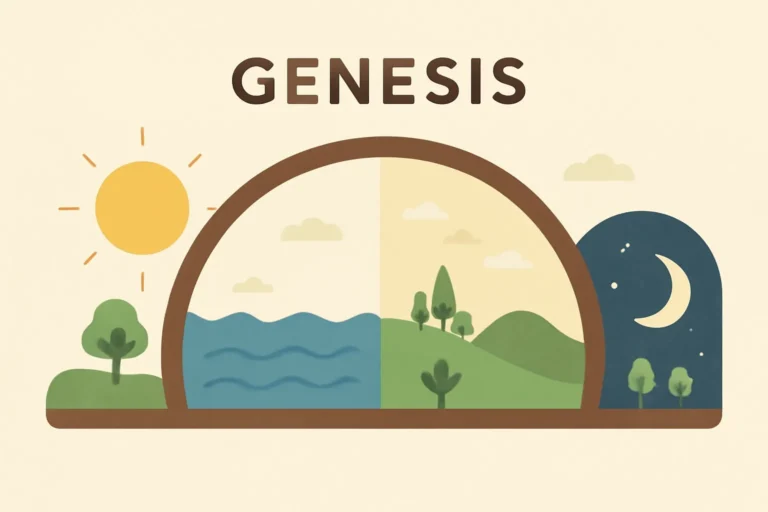
Day 1 — Light is separated from darkness, creating the basic dichotomy of day and night.
Day 2 — The sky is formed to separate the waters above from the waters below, establishing the realm of the atmosphere.
Day 3 — Dry land appears as waters gather; vegetation and plant life emerge on the land.
Each of these days focuses on domain formation: light/dark, sky/sea, land/sea, with light-bearing bodies not yet introduced until Day 4. This sequencing signals a careful plan: order precedes function, and the creation of spaces makes possible the later inhabitants.
Days 4–6: Filling the Spaces with Life
Day 4 — The celestial bodies (sun, moon, and stars) are created to govern day and night and to mark seasons, days, and years.
Day 5 — Creatures of the sea and sky are formed and assigned their respective habitats.
Day 6 — Land animals appear, and humanity is created in the image of God (Genesis 1:26–27), with a blessing and a commission to steward the earth.
In these days, the created order becomes populated, moving from inanimate domains to living beings who inhabit those domains. The pairing of forming and filling yields a cosmos that is not merely a backdrop for life but a coherent system in which each part has a role and is ordered in relationship to the others.
The Primordial Light and the Pivotal Role of Speech
Genesis 1 begins with a remarkable emphasis on light as a primary good, even before the sun, moon, and stars are created. Some scholars see this as a deliberate literary signal: light is the first created element that discloses order and enables activity. The ongoing use of divine speech to bring about reality—“Let there be”—is not a mere stylistic choice; it is the theological claim that God’s word has creative authority.
Word and deed are inseparable in the Genesis 1 narrative.
The speech-act creates existence; the result is immediately declared good.
The cadences of speaking, seeing, and naming reflect a world that is intelligible to human beings because it is created by a rational, intentional God.
Theological Themes in Genesis 1
Several core themes emerge from a careful reading of Genesis 1. These themes function as a theological lens through which readers interpret the narrative and its implications for the rest of Scripture.
The Sovereignty and Creative Power of God
The repeated formulaic pattern—“And God said” followed by “and it was so”—highlights God’s sovereignty and creative power. There is no debate about whether creation occurs; God’s command is sufficient to bring the cosmos into existence. This pattern inaugurates a worldview in which God is the ultimate source of reality, lawgiver, and governor of order.
Order, Goodness, and the Order of Creation
Throughout Genesis 1, God’s work is declared good at each stage. The deliberately arranged structure—dividing light from darkness, waters from waters, and land from seas—demonstrates a shift from chaos to order. The repeated phrase “there was evening and there was morning” grounds the creation in a tangible, weekly rhythm that resonates with human experience of time.
Humans as Bearers of the Image of God
A central theological claim in Genesis 1 is that humans are made in the image of God. This status confers dignity, authority, and vocation. Humans are given a special role in the created order: to rule, steward, bless, and subdue the earth. The verse, often cited for its ethical and theological significance, reads as a clear statement about human vocation and identity.
Blessing, Naming, and Dominion
The text introduces the concept of blessing (God blesses living creatures) and the authority given to humanity to exercise dominion over the creation. These motifs emphasize that life is oriented toward flourishing within a divine order. The act of blessing is not merely an encouragement; it is a commissioning that carries practical implications for human conduct and responsibility.
Rest and the Sabbath Pattern
The seventh day, though briefly described, culminates in a divine rest that introduces the concept of a Sabbath rest as a pattern for human behavior. The cadence of six days of work followed by a day of rest shapes later Jewish and Christian patterns of worship, work, and sabbatical rhythms.
Cosmic Temple and Cosmology: Interpreting the Creation as a Sacred Space
Some scholars and interpreters read Genesis 1 as portraying the cosmos as a cosmic temple being built by God. In this view, the seven-day sequence mirrors the process of constructing and sanctifying a temple—the dwelling place of the divine presence. The order of creation, the separation of domains, and the blessing on humanity all function to set the stage for God’s presence with his people. This cosmological temple motif does not negate other readings, but it offers a powerful way to imagine the formation of the universe as a sacred space with a purpose beyond mere material existence.
Historical and Literary Context: Genesis 1 in the Ancient Near East
Understanding Genesis 1 also involves considering its ancient Near Eastern milieu. While Genesis 1 presents a distinctive monotheistic framework, it engages literary conventions of its time. The repetition, the seven-day structure, and the use of a structured sequence reflect a broader ancient interest in order, authority, and cosmic governance. Reading Genesis 1 alongside other ancient creation narratives helps readers notice both the contrasts (monotheism, ethical vocation, humanity’s dignity) and the common literary devices (hierarchies of power, divine word as a creative act).
Genesis 1 and Genesis 2: Complementary Readings
Many readers encounter a tension or juxtaposition between Genesis 1 and Genesis 2. While Genesis 1 emphasizes cosmic order and universal creation, Genesis 2 narrows focus to the Garden of Eden and the intimate relationship between God, humanity, and creation. Interpreters often affirm that these chapters are not contradictory but complementary: Genesis 1 presents a macrocosmic overview of creation, while Genesis 2 offers a microcosmic, anthropocentric account of human origins and vocation. This pairing invites readers to explore how a grand, universal framework supports a particular, intimate story about human purpose.
Interpretive Approaches and Debates
There are several well-established interpretive avenues for Genesis 1, each emphasizing different aspects of the text. What follows are common approaches rather than exhaustive doctrinal positions.
Literal/Young-Earth interpretations tend to read the days as 24-hour periods and advocate a relatively recent creation timeline.
Literary and canonical approaches stress the narrative voice, the patterned phrasing, and the book’s place within the broader Bible, often focusing on theology over chronology.
Priestly sources and authorship highlight the P tradition’s distinctive vocabulary (such as Elohim) and its emphasis on ritual, order, and cosmology.
Day-age and framework hypotheses reinterpret the “days” as longer periods or as literary frameworks that organize material without strictly sequential time-frames.
Cosmological and temple-theology readings understand the creation as the divine construction of a sanctuary from which God engages with the world and through which human worship is oriented.
Comparative texts studies connect Genesis 1 to other ancient literature, illuminating shared motifs, distinct assertions about God, and divergent ethical horizons.
Key Passages and Their Implications for Faith and Practice
The Genesis 1 account contains several pivotal verses that shape later biblical thought and practice. While many of these verses are widely known, their implications for theology, ethics, and worship deserve careful attention.
Genesis 1:1–2: The Beginning and the Primordial State
The opening lines establish two crucial ideas: creation by divine initiative and the initial condition of formlessness and void (often translated as tohu and bohu). This sets up a drama of divine transformation: from void to order, from chaos to cosmos, under God’s sovereign will.
Genesis 1:26–27: The Divine Image in Humanity
The declaration that humanity is made in the image of God carries a weighty ethical and relational charge. It grounds human dignity, defines personhood, and undergirds the ethical demand to treat others with respect. The plural language in the divine command—“Let us make man in our image”—also signals a beginning of a robust theological anthropology that invites ongoing exploration.
Genesis 1:28–31: Blessing, Command, and Provision for Life
God’s blessing and command to multiply, fill the earth, and exercise dominion introduces a rhythm of blessing driving human purpose. The completeness of God’s provision—plants and animals given for sustenance—underscores the goodness of the created order and the interconnectedness of all living things.
Genesis 1:31: “It Was Good” and the Goodness of Creation
The repeated verdict of good at each stage invites readers to reflect on the character of the Creator and the intrinsic value of the created order. This refrain resonates with ethical and liturgical implications: creation is not morally neutral; it bears witness to God’s goodness and invites responsible human stewardship.
Practical Takeaways for Students, Theologians, and Curious Readers
Reading Genesis 1 as an overview of creation yields several practical implications for study, faith communities, and personal reflection.
Study the structure of the creation week to appreciate the deliberate arrangement of forming and filling, and how that pattern shapes later biblical themes.
Recognize the role of divine speech as the primary instrument of creation, a reminder of the power and responsibility inherent in language.
Consider human vocation in light of being created in God’s image and given stewardship over creation.
Explore the Sabbath motif as a model for worship, rest, and communal life, not only for ancient readers but for contemporary practice as well.
Engage the ancient context while also reading Genesis 1 in light of its canonical place in Scripture, allowing it to inform faith, ethics, and worship across generations.
How to Read Genesis 1 in a Classroom or Small-Group Context
For educators and group leaders, Genesis 1 can be unpacked through a series of guided steps that highlight both content and context.
Begin with a map of the days to orient participants to the forming/filling pattern and the seven-day frame.
Track key terms (e.g., God, image, blessing, dominion, good) and explore their theological implications.
Contrast reading strategies by briefly presenting literal, literary, and canonical approaches, inviting discussion about why readers might favor one perspective over another.
Engage cross-textual connections with Genesis 2 and related biblical passages to illustrate how Genesis 1 sets up a broader biblical theology of creation, humanity, and worship.
Variations on the Theme: The Creation Narrative in a Broader Context
Readers often search for different angles or “overviews of Genesis 1” to suit diverse purposes. Here are several reframes that capture important semantic breadth while staying faithful to the text:
Overview of Genesis 1’s creation sequence as a framework for understanding the order and structure of the cosmos.
Genesis 1 and creation ethics in terms of responsibility and care for living beings and the environment.
Creation theology and liturgy focusing on how the formulaic pattern invites worship and trust in the divine plan.
Cosmology as sacred architecture viewing the cosmos as a designed sanctuary where God’s presence can be imagined as dwelling with creation.
Comparative literature approach analyzing similarities and differences with contemporaneous creation narratives to highlight distinctive biblical claims.
Frequently Encountered Questions about Genesis 1
In teaching and study, a few questions commonly arise about Genesis 1. Addressing them briefly can help readers form a well-rounded understanding.
Why does Genesis 1 not mention evolution or natural process? The text emphasizes God’s intentional and direct act of creation, presenting a sovereignty-centered worldview. This does not deny scientific inquiry but places creation within a theological frame.
What is the significance of the days of creation? The seven-day structure emphasizes completeness, regularity, and divine order. The pattern of days supports a rhythm of work and rest that has enduring religious and ethical resonance.
Are there contradictions with Genesis 2? Most scholars view Genesis 1 and 2 as complementary, offering two different lenses—cosmic-wide scope and intimate human-focused detail—rather than a purely chronological contradiction.
What does it mean to be created in the image of God? It signals dignity, rational agency, and a calling to relationship with God, others, and the created order, including stewardship and moral responsibility.
Conclusion: The Ongoing Relevance of Genesis 1
While this article has provided a thorough overview of Genesis 1, the text continues to invite readers to engage with its layers—literary, historical, theological, and practical. Readers encounter a foundational claim: the world is not a chaotic accident but a created order that bears the imprint of a governed and purposeful Creator. The six-day sequence and the seventh-day rest introduce a rhythm that has informed Jewish and Christian worship, ethics, and imagination for millennia. In studying the creation account, students discover a cohesive vision of reality where language, order, and vocation intersect in meaningful ways.