Christian theology is the disciplined study of the beliefs, practices, and meanings that arise from the Christian faith. It seeks to articulate what Christians confess about God, the world, humanity, and salvation, while engaging with history, philosophy, culture, and biblical texts. In this sense, theological study is not merely a system of ideas; it is ongoing reflection that shapes worship, ethics, mission, and everyday life. The field is diverse, spanning historical development, doctrinal formulation, biblical interpretation, and practical application. Students of theological studies often begin with questions about the nature of God, the person and work of Jesus Christ, the role of the Holy Spirit, and how Scripture forms authority for belief and practice. From there they explore how Christian doctrine has changed over time, how it relates to science and culture, and how it guides leadership, ministry, and service in local communities and around the world.
Historical arc of theological studies
The study of Christian doctrine has a long and dynamic history. Early church theologians wrestled with defining the mystery of the Trinity and the person of Christ while preserving the core proclamation of the gospel. The patristic period produced creeds, catechetical manuals, and philosophical defenses that connected faith and reason. In the medieval era, scholars like Augustine, Anselm, and Aquinas integrated Greek philosophy with biblical revelation, developing a robust account of grace, justification, and natural theology. The Reformation era reoriented theological inquiry toward Scripture as the ultimate authority and highlighted doctrines such as sola scriptura, sola fide, and grace alone. The post-Reformation and modern periods expanded the conversation to include scientific developments, historical-critical methods of Bible study, and new theological perspectives on religious pluralism, ethics, and social justice.
Today, theological studies take place in a global context. Researchers examine how Christian belief interacts with different cultures, languages, and social realities. They debate how ancient creeds relate to contemporary experiences of gender, race, poverty, and environmental stewardship. The arc of Christian theology remains dynamic: it reflects on tradition while remaining open to reform, critique, and renewal in light of ongoing biblical interpretation and pastoral practice.
Key doctrinal areas within Christian theology
A broad survey of Christian doctrine reveals several core domains where study often concentrates. Each area contains rich subtopics, historical developments, and divergent viewpoints that shape debates within and across denominations.
The nature of God and the doctrine of the Trinity
Most branches of historic Christianity begin with a robust affirmation of God as the one and only Creator, while also acknowledging the triune mystery: Father, Son, and Holy Spirit. The doctrine of the Trinity seeks to hold together the monotheistic core of Christianity with the relational, life-giving distinction of the three persons. The study of Trinity includes discussions about divine attributes, eternal generation, procession, and how God’s triune life relates to creation, salvation, and ecclesial life. Theologians weigh biblical testimony in passages such as Genesis, the Gospel of John, and Pauline letters while considering historical formulations like the Nicene Creed and the Athanasian Creed as confessional anchors.
Christology
The central figure in Christian faith is Jesus Christ, whose person and work are examined in terms of incarnation, sinless life, atonement, resurrection, and exaltation. Theological study asks how Jesus is truly God and truly human, how salvation is accomplished through his death and resurrection, and what his ongoing intercession means for believers. Different traditions emphasize various aspects of Christ’s work—substitutionary atonement, Christus victor, moral influence, or penal reformulation—while seeking to maintain a coherent account of salvation that resonates with Scripture and church experience.
Creation, Fall, and Providence
Doctrine of creation explores how God brings the universe into being, sustains it, and relates to it. The image of God in humanity, the fall, and the providence of God shape how theologians understand human nature, responsibility, and the meaning of history. The study extends to questions about evolution, the goodness of creation, suffering, and how God can sovereignly govern the world while allowing human freedom. The relation between grace and nature, creation care, and eschatological hope are common themes in this area.
Salvation, atonement, and justification
Central to Christian theology is the question of how humans are reconciled to God. The atonement narrative includes themes of forgiveness, grace, faith, repentance, and transformation. Debates commonly focus on how salvation is received (faith, grace, works), the scope of atonement (exclusive, universal, or limited), and the relation of God’s justice to mercy. The doctrine of justification—how one is declared righteous before God—has been a critical point of discussion across traditions, influencing pastoral practice, soteriology, and ecclesial life.
Anglophone and many Euro-American traditions balance Sola Scriptura with tradition and the role of the church in interpreting Scripture. The study concerns how biblical texts are read, how they are interpreted across historical periods, and how authority is exercised in communities of faith. Questions include the nature of biblical inspiration, the canons of Scripture, hermeneutical methods, and the place of creedal affirmations and confessions as interpretive guides without replacing Scripture as the normative standard.
Church, sacraments, and ecclesiology
The nature and purpose of the church, its structures, leadership, and mission are central to ecclesiology. The study addresses sacred rites such as baptism and the Lord’s Supper (Eucharist), church governance, sacramental theology, and how local congregations connect with the universal church. Theological inquiry includes how worship shapes belief, how sacraments mediate grace, and how the church participates in God’s mission in the world.
Methodologies in theological inquiry
The study of doctrine uses a range of methodologies that interact with biblical studies, philosophy, history, and pastoral contexts. A competent theological curriculum invites students to practice these methods with intellectual humility, critical rigor, and spiritual seriousness.
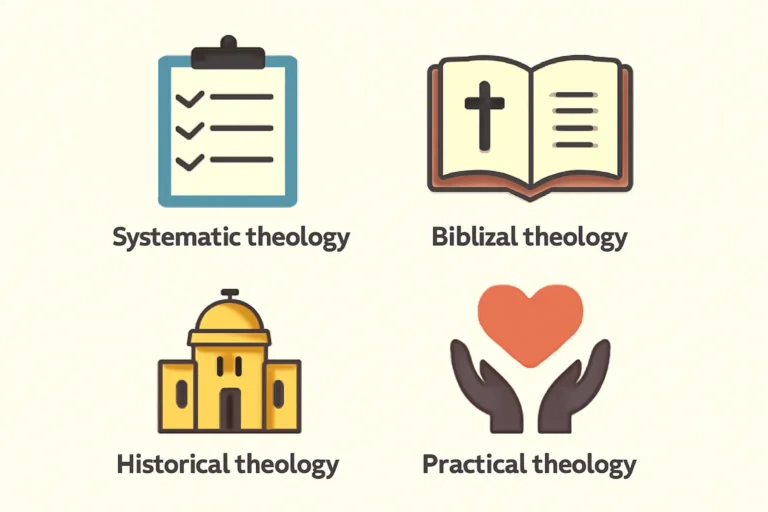
Systematic theology
Systematic theology seeks to arrange doctrinal truths into coherent systems. It addresses questions such as: What does the entire Bible teach about God, creation, sin, redemption, and eschatology? How do these truths relate to one another? Systematic theologians build comprehensive frameworks that can be applied to preaching, teaching, and public discourse. They pay attention to doctrinal coherence, historical context, and pastoral applicability.
Biblical theology
Biblical theology traces the unfolding message of God across the biblical canon. It focuses on the storyline of Scripture, genres, and the development of themes such as covenant, kingship, exile, and kingdom. The aim is to let Scripture’s own timeline guide interpretation, while recognizing how later doctrinal formulations relate to earlier texts. Biblical theology often serves as a bridge between exegesis (textual study) and systematic synthesis.
Historical theology
Historical theology studies the church’s beliefs as they emerged through time, including debates, councils, reformations, and common life in different eras. It helps theologians understand how contexts—political, cultural, philosophical, and empirical—shaped doctrinal developments. This approach highlights continuity and change, showing how past decisions influence present convictions and how past mistakes inform present cautions.
Philosophical theology
Philosophical theology engages with metaphysical questions, epistemology, ethics, and the philosophy of language to scrutinize theological claims. It asks how we can meaningfully speak about God, how religious language relates to reality, and what kinds of arguments can reasonably support belief. This field is particularly important when addressing skeptical audiences or when debates about divine attributes become abstract and demanding.
Practical or pastoral theology
Practical theology translates abstract doctrinal insights into everyday ministry and spiritual formation. It considers how preaching, catechesis, spiritual disciplines, mission strategy, and social outreach reflect and embody theological convictions. This approach keeps doctrine from becoming merely theoretical by connecting belief to care for individuals, families, and communities.
Primary sources and traditions in theological study
Christian theological study draws on a rich array of sources. Familiarity with these texts, genres, and traditions helps students trace the development of doctrine and assess how it bears on contemporary life.
Scripture and its various literary genres (narrative, poetry, prophecy, wisdom literature, letters).
Patristic writings from early church teachers such as Augustine, Origen, Athanasius, Cyril, and John Chrysostom.
Medieval articulations in the works of Anselm, Thomas Aquinas, Bonaventure, and Duns Scotus, among others.
Creeds and confessions like the Apostles’ Creed, Nicene Creed, Athanasian Creed, and later reformational confessions (e.g., Heidelberg Catechism, Westminster Confession).
Reformers’ writings (Luther, Calvin, Zwingli) and post-Reformation theologians who contributed to spiritual renewal, social thought, and biblical interpretation.
Contemporary voices across global contexts that address issues such as justice, ecology, gender, race, and technology.
Those pursuing Christian theology studies usually follow a progression of study that matches their vocational aims, from lay education to professional ministry to scholarly research. The field welcomes both formal programs and self-directed learning, though structured study provides a framework for rigorous inquiry and credible credentialing.
Undergraduate foundations typically include introductory courses in biblical studies, church history, systematic theology, ethics, and logic. A bachelor’s degree may be titled Theology, Biblical Studies, or Religious Studies, often with the option to concentrate in a particular area.
Graduate theological education commonly offers pathways such as:
Master of Divinity (M.Div.) for planned pastoral leadership and ministry preparation.
Master of Arts in Theology (M.A. in Theology) or Biblical Studies for broader scholarly training.
Master of Sacred Theology (S.T.M.)/Master of Theology (Th.M.) for advanced research and doctoral preparation.
Doctoral programs (Ph.D. or D.Theol.) for biblical, historical, or philosophical theology with a strong emphasis on original research.
Course design and study techniques emphasize exegesis (critical reading of texts), historical-contextual analysis, linguistic study (where relevant, such as Greek, Hebrew, Latin), and engagement with secondary literature. Students learn to formulate research questions, develop a literature review, and present a coherent argument.
Practical steps include joining academic seminars, participating in theological reading groups, publishing articles in student journals, completing field education in churches or missions, and building networks with mentors and peers.
Christian theology is not only an intellectual exercise; it also shapes ethical deliberation and spiritual formation. The study of doctrine informs how believers understand moral obligation, justice, dignity, and human flourishing in contemporary societies. Theological reflection engages questions such as:
How should Christians respond to poverty and economic inequality in their communities?
What responsibilities arise from the belief in creation care and environmental stewardship?
How does a doctrine of imago Dei affect views of race, gender, and human rights?
In what ways should the church practice mercy, charity, and social action without compromising doctrinal integrity?
Disciplines like pastoral theology, spiritual formation, and ethics help move theory into practice. The most effective theologians engage both the mind and the heart, cultivating intellectual integrity while listening to the lived experiences of diverse communities. This holistic approach encourages pastors, scholars, and laypeople to embody their beliefs through acts of worship, teaching, and service.
Contemporary debates and global perspectives
Christian theology today is practiced in a pluralistic and interconnected world. Debates often surface around the following topics, which reflect both continuity with tradition and the need for contextual adaptation:
Open theism, classical theism, and divine providence
Significant discussions concern how God relates to time, knowledge, and human freedom. Some theologians advocate open theism, which emphasizes God’s responsive knowledge within the dynamic reality of creation, while others uphold classical theism, which emphasizes God’s exhaustive foreknowledge and sovereignty. The challenge is to articulate a coherent account of grace, prayer, and human responsibility that remains faithful to Scripture and meaningful for believers today.
Global theologies and contextual readings
Across regions, theologians interpret the faith through local languages, histories, and social realities. Postcolonial theology, womanist and feminist theology, liberation theology, and indigenous theologies enrich the conversation by highlighting experiences of marginalization and resilience. Global dialogues encourage scholars to listen carefully, critique unexamined assumptions, and develop doctrines that are credible in diverse cultural milieus.
Ethics, justice, and public life
In the public square, Christian theologians engage with issues such as economic justice, racial reconciliation, bioethics, and environmental ethics. The discipline asks how faith commitments can translate into public policy, community practice, and personal conduct without compromising theological integrity or human flourishing.
Ecumenism and pluralism
The modern church increasingly participates in ecumenical dialogue and interfaith engagement. Theological studies explore how to remain faithful to one’s own confession while respecting others’ convictions, how to cooperate on shared ethical goals, and how to maintain unity in essential matters while honoring diversity in non-essentials. The result is a more robust practice of Christian unity that respects doctrinal differences while pursuing common goods in society.
Technology, digital humanities, and the study of theology
Digital tools have opened new avenues for theological research and pedagogy. Online libraries and databases, textual analysis software, and digital hermeneutics enable scholars to examine large corpora of texts, trace conceptual shifts across centuries, and model how doctrines emerge in particular historical contexts. Some notable trends include:
Digitization of patristic and medieval manuscripts for broader access and study.
Digital textual criticism and online concordances that aid exegesis.
Video lectures, online seminars, and virtual conferences that foster international collaboration.
Data-driven humanities methods used to map the diffusion of creeds, confessions, and doctrinal influences across time and geography.
While technology offers powerful tools, it also invites careful methodology. Theological scholars emphasize that rigor, interpretive humility, and pastoral sensibility remain essential, even as digital methods broaden reach and accessibility.
Resources, texts, and study practices for theological learners
Whether studying within a university seminary or pursuing self-guided education, certain resources help deepen understanding and sharpen critical thinking. The following are commonly used in theological study:
Scripture studies (lectionaries, study bibles, interlinear texts, lexicons).
Commentaries organized by canonical books, doctrinal themes, or historical periods.
Historical writings from the church’s traditions, including primary sources and modern analyses.
Systematic theory and philosophical theology texts that explore metaphysical foundations and logical frameworks.
Journals and monographs addressing current debates in doctrine, ethics, and church life.
Pastoral resources for preaching, catechesis, and spiritual formation that translate theory into practice.
To engage thoroughly with Christian theology, learners can adopt structured plans that combine reading, reflection, and community dialogue. Here are some suggested approaches:
Begin with a broad survey of core doctrines to establish a mental map of the field. Use a systematic survey approach to get the lay of the land before diving into specialized topics.
Adopt a three-track study plan: biblical studies, historical perspectives, and contemporary applications. This helps balance exegesis, context, and everyday relevance.
Practice exegesis and hermeneutics with selected passages. Learn to identify genres, literary devices, and theological motifs within their historical settings.
Join or form discussion groups, seminars, or study circles to critique arguments, defend positions, and learn from peers with diverse backgrounds.
Engage in writing projects such as literature reviews, research papers, and reflective essays to articulate understanding and develop a personal voice in the field.
Participate in local church life or mission opportunities to connect theological reflection with practical service and witness.
Glossary of key terms
Below are essential terms frequently used in Christian theology studies. Brief definitions accompany each entry to help learners build precise usage and avoid common misreadings.
Atonement: the means by which humanity is reconciled to God, often understood through substitution, victory over sin, or moral influence theories.
Canon: the official collection of books recognized as Scripture; authoritative for faith and practice.
Creed: a formal statement of faith used as a doctrinal summary and confessional standard.
Exegesis: critical interpretation of a text, especially biblical texts, to discover the intended meaning.
Exaltation: the belief that Christ ascended to divine glory and reigns as Lord.
Grace: undeserved divine assistance toward salvation and transformation.
Hermeneutics: the theory and methodology of interpretation, particularly of texts and traditions.
Incarnation: the doctrine that the eternal Son became human in Jesus Christ.
Imago Dei: the belief that humans are created in the image of God, bearing inherent dignity.
Orthodoxy: right belief; conformity to accepted doctrine within a tradition.
Providence: God’s ongoing care and governance of creation, including human affairs.
Salvation: the deliverance of humanity from sin and its consequences, yielding new life in Christ.
Sola Scriptura: a motto of the Reformation asserting Scripture as the primary authority for faith and practice.
Theology: the disciplined study of God and the divine purposes in creation and redemption.
Trinity: the Christian doctrine that one God exists in three persons: Father, Son, and Holy Spirit.
Career paths and practical outcomes of theological studies
Christian theology studies can lead to a variety of vocational and academic outcomes. Many graduates pursue forms of ministry, including church planting, catechesis, discipleship programs, campus ministry, or organizational leadership in religious nonprofits. Others enter academia, teaching or researching in colleges, seminaries, or think tanks. Still others apply their training in fields such as journalism, publishing, public policy, or social services where a robust ethical framework and the ability to analyze complex texts are valuable. Across all these paths, the ability to read critically, argue with charity, and listen well to different perspectives remains one of the most important outcomes of serious theological training.
Critical considerations for prospective students and readers
As you engage with Christian theology studies, here are some practical considerations that can contribute to a healthy, productive, and ethically aware learning experience:
Kneeling before the texts means acknowledging the sacredness of Scripture and tradition while maintaining critical inquiry.
Engage with dissent respectfully. Theological debates often reveal the depth of convictions on both sides, and listening to opposing views can sharpen understanding.
Balance fidelity and relevance. Hold fast to core confessions while addressing contemporary questions without compromising doctrinal integrity.
Develop a pastoral sensibility, especially if your aim is ministry or church leadership. Theory gains traction when it informs mercy, care, and community life.
Practice discernment in sources. Distinguish primary sources from modern interpretations that carry biases, while appreciating fruitful insights from scholarly and lay readers alike.
Keeping the flame of inquiry alive
The field of Christian theology studies invites lifelong learning. The questions never exhaust themselves—how God is, how God acts in the world, and how believers ought to respond in faithfulness. By combining rigorous study with humility, empathy, and prayerful reflection, learners can develop a coherent, credible, and compassionate understanding of Christian doctrine. The aim is not merely to accumulate knowledge but to form wisdom that shapes worship, ethical living, and hopeful mission in a diverse world.